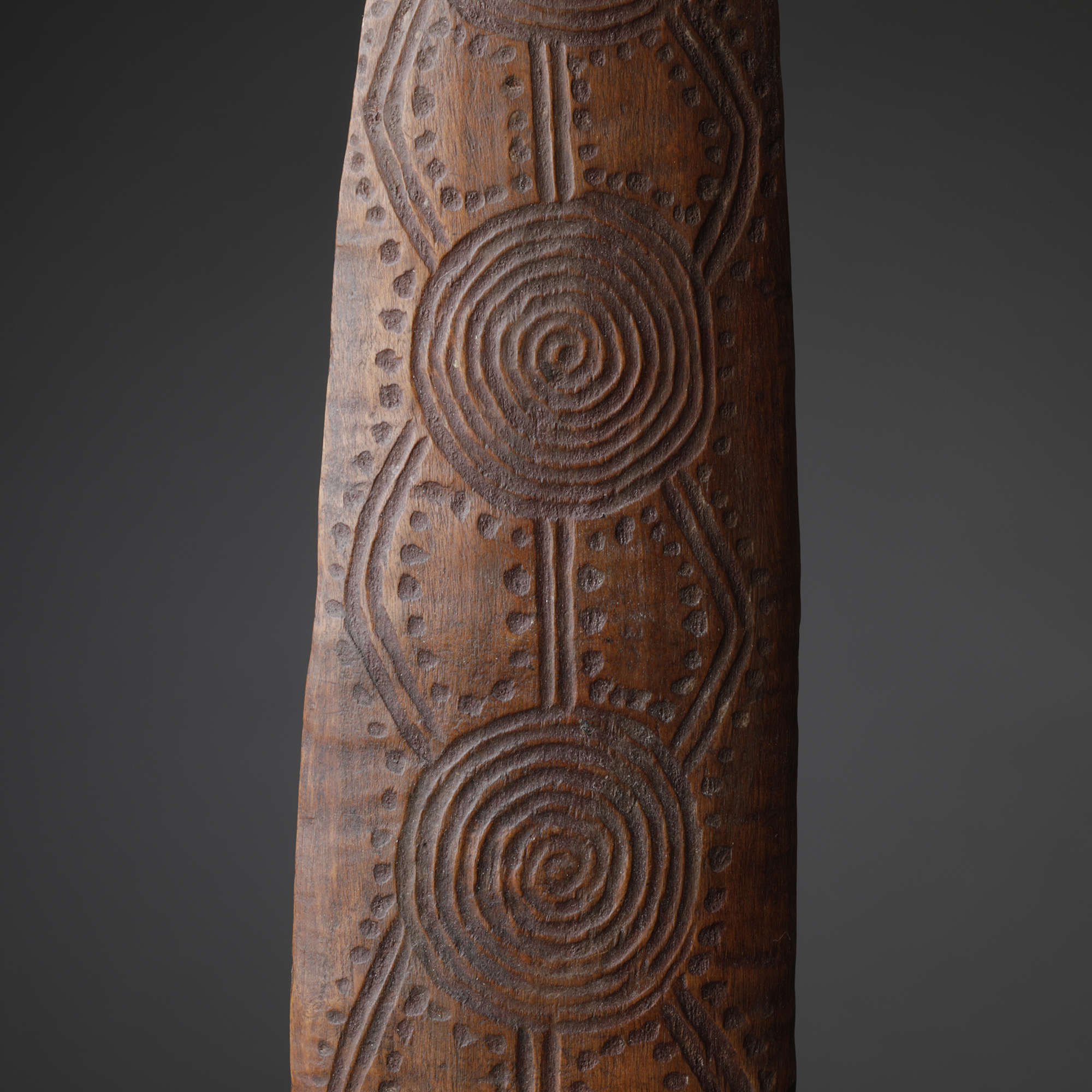
THREE ENGRAVED RITUAL OBJECTS CHURINGA
ABORIGINAL PEOPLES, CENTRAL AUSTRALIA
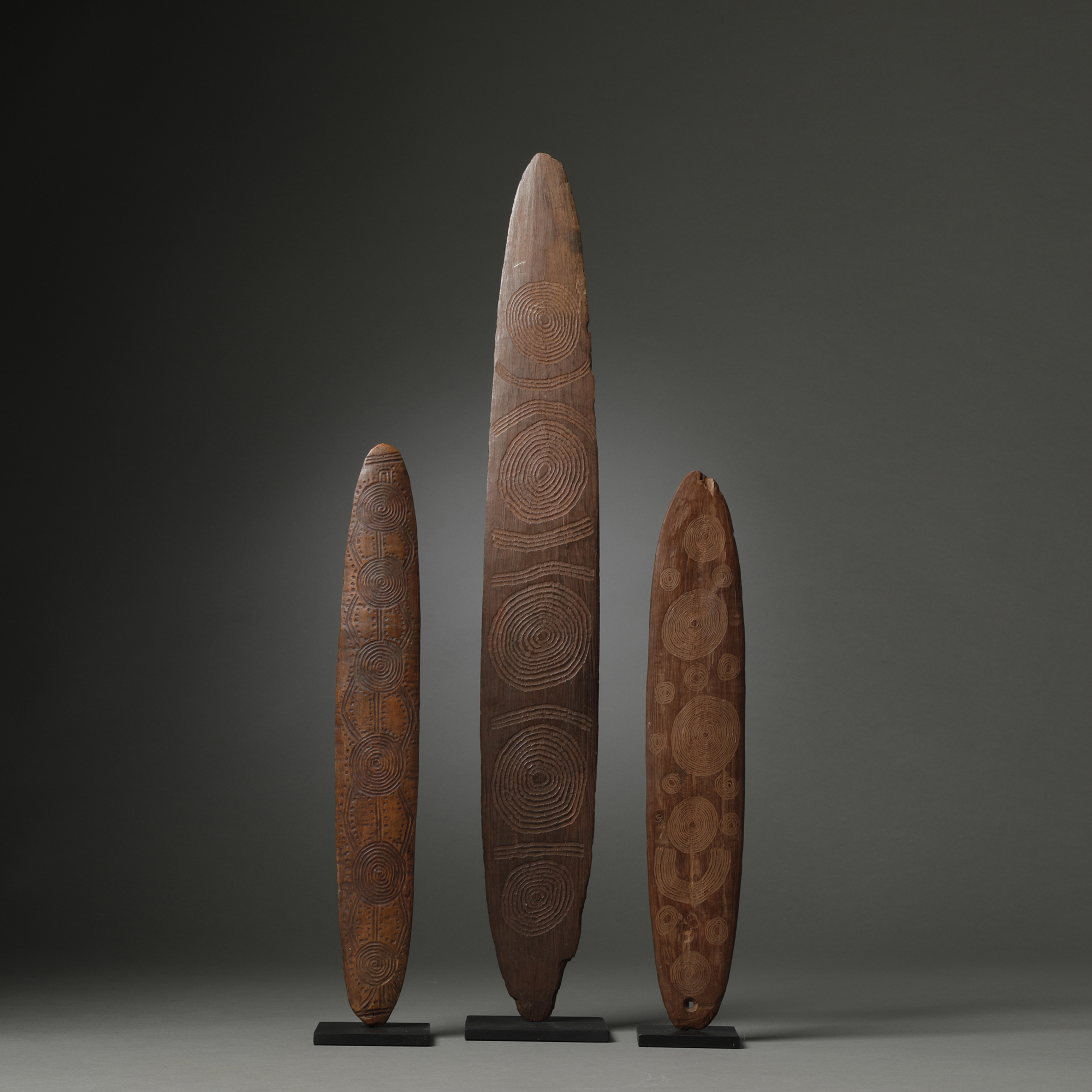
An exceptional group of three finely engraved wooden churinga, distinguished by their elongated, elegantly tapering forms and intricate arrangements of concentric circles, sinuous lines, and geometric motifs. Associated with the ceremonial traditions of Aboriginal peoples of Central Australia, churinga are sacred objects closely connected to ancestral beings, particular places, and the transmission of spiritual knowledge across generations.
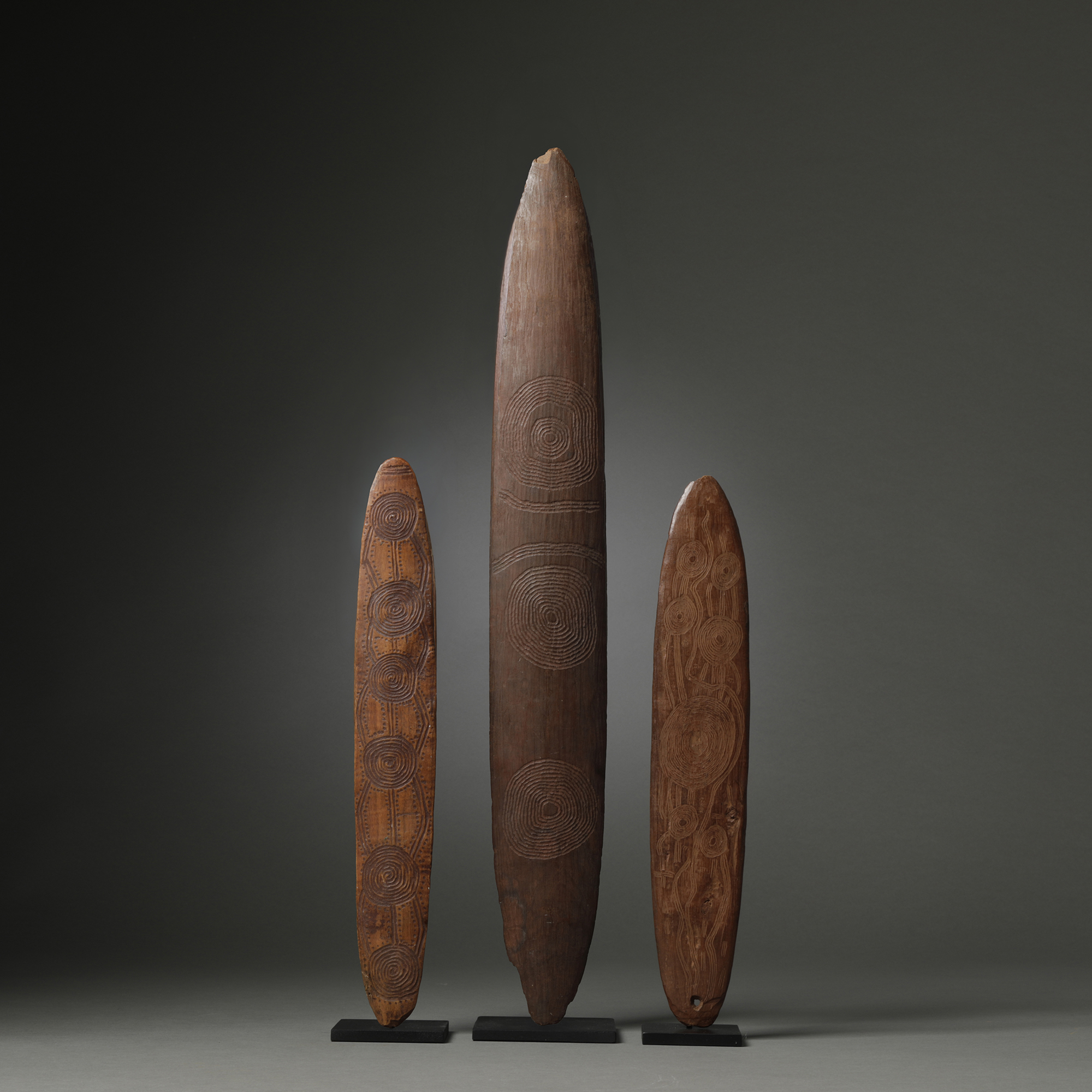
The churinga on the left, the narrowest of the three, displays an elaborate and densely organized composition. A succession of deeply engraved concentric circles extends along its central axis, interconnected by fine parallel lines and enclosed within a complex network of curving, dotted, and arched motifs. The reverse continues this rhythmic arrangement of circular forms, although with a somewhat more restrained treatment of the surrounding ornament. The precision and density of the engraving, combined with the object's slender proportions and warm reddish patina, give it an almost jewel-like delicacy.
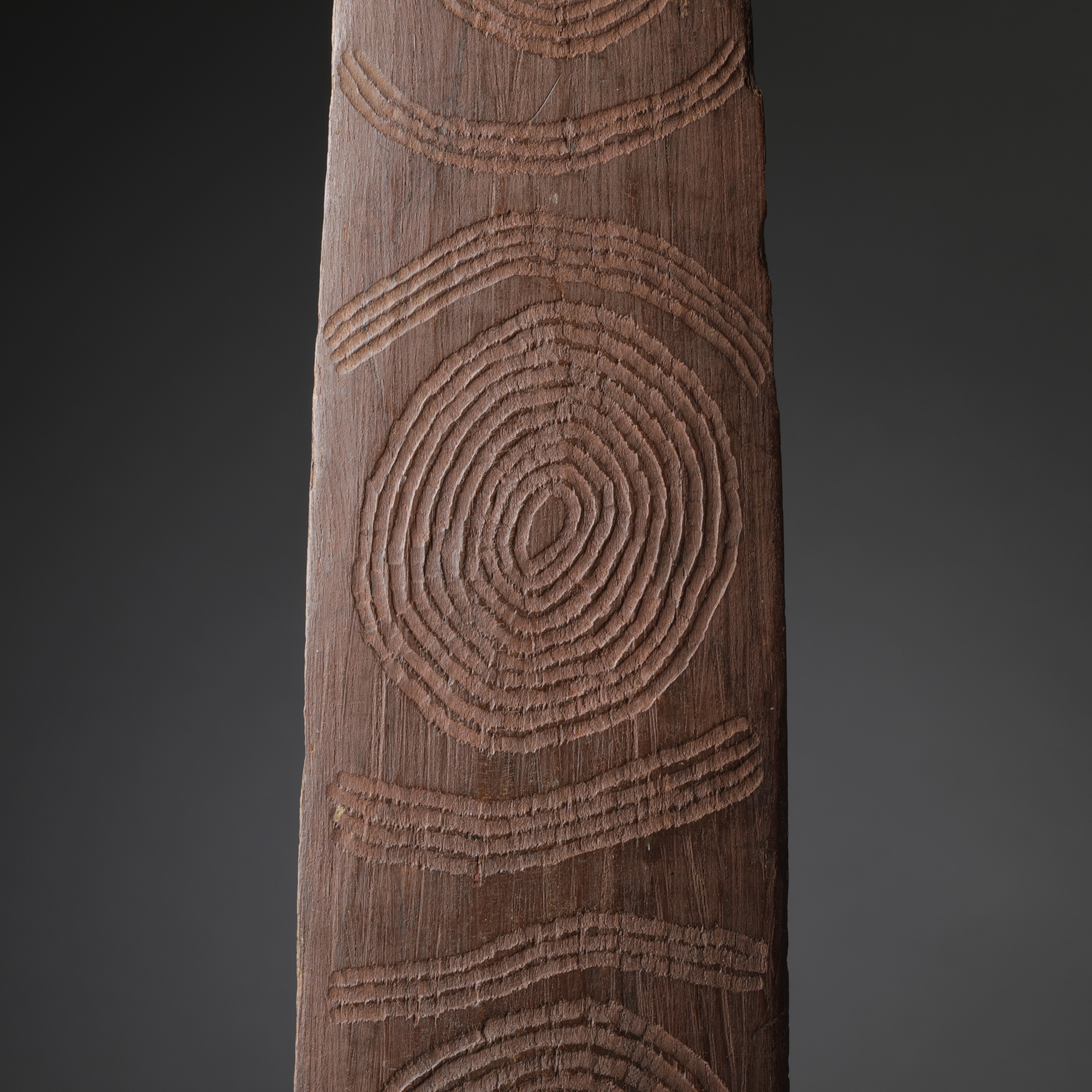
The central churinga, considerably larger and more imposing, presents a strikingly monumental arrangement of concentric circles. On one face, five principal circular motifs are distributed vertically along its elongated surface, separated by groups of gently curving parallel lines. The reverse features three more widely spaced concentric circles, creating a powerful contrast between the elaborate composition of the front and the austere geometry of the back. The unusually generous spacing of the engraved elements emphasizes the broad, uninterrupted surface of the wood, lending the object a remarkable sense of stillness and sculptural authority. Its dark, richly worn patina further enhances its imposing presence.
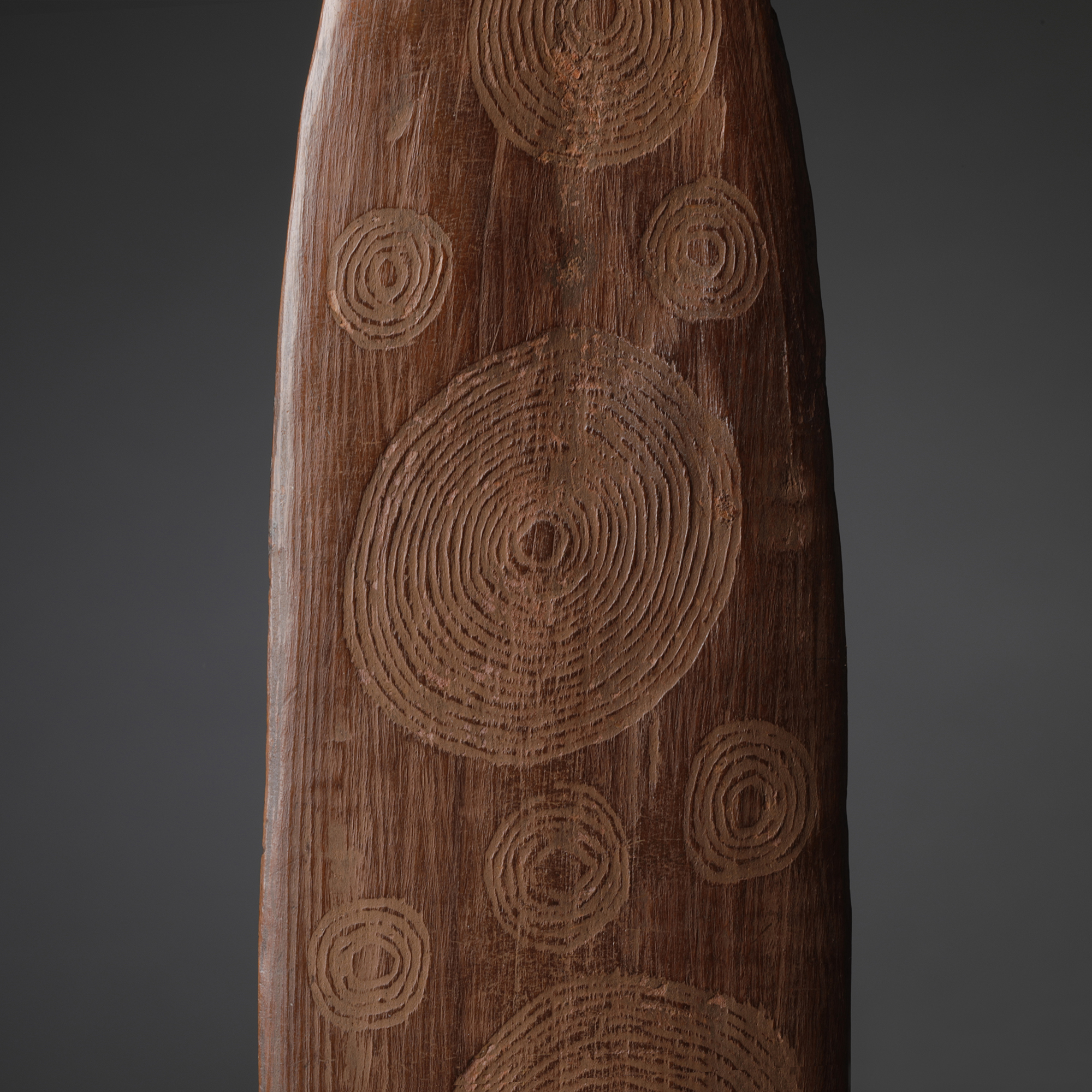
The churinga on the right is distinguished by a more freely arranged and asymmetrical composition. Concentric circles of varying sizes are distributed across its surface, with larger circular motifs surrounded by smaller satellite forms, interconnected by delicate engraved lines. Unlike the strictly axial compositions of the other two examples, its ornament creates a lively, almost celestial constellation of interconnected forms. The reverse presents a similarly intricate vocabulary of circles and connecting lines, but with a looser, more open arrangement. A small perforation near one end may have served for suspension or attachment.
Although the engraved motifs of churinga frequently relate to ancestral journeys, sacred sites, and the topographical features of particular territories, their precise meanings are traditionally restricted to initiated custodians and cannot reliably be interpreted from visual examination alone. The concentric circles and connecting lines that characterize these three objects form part of a broader Central Australian visual language in which apparently abstract geometric designs can encode complex relationships between people, country, and ancestral history.
Considered together, the three churinga offer a compelling study in the extraordinary diversity of expression achieved within a shared artistic tradition. From the densely worked intricacy of the first example to the monumental restraint of the second and the animated, constellation-like decoration of the third, each demonstrates a distinctive approach to rhythm, balance, and the organization of sacred imagery.
Their sculptural elegance and remarkable graphic sophistication reveal an artistic tradition in which the simplest elements—circles, lines, and dots—are transformed into compositions of exceptional visual power.
A & B - private collections, United Kingdom
C - Roy and Sophie Seiber Collection