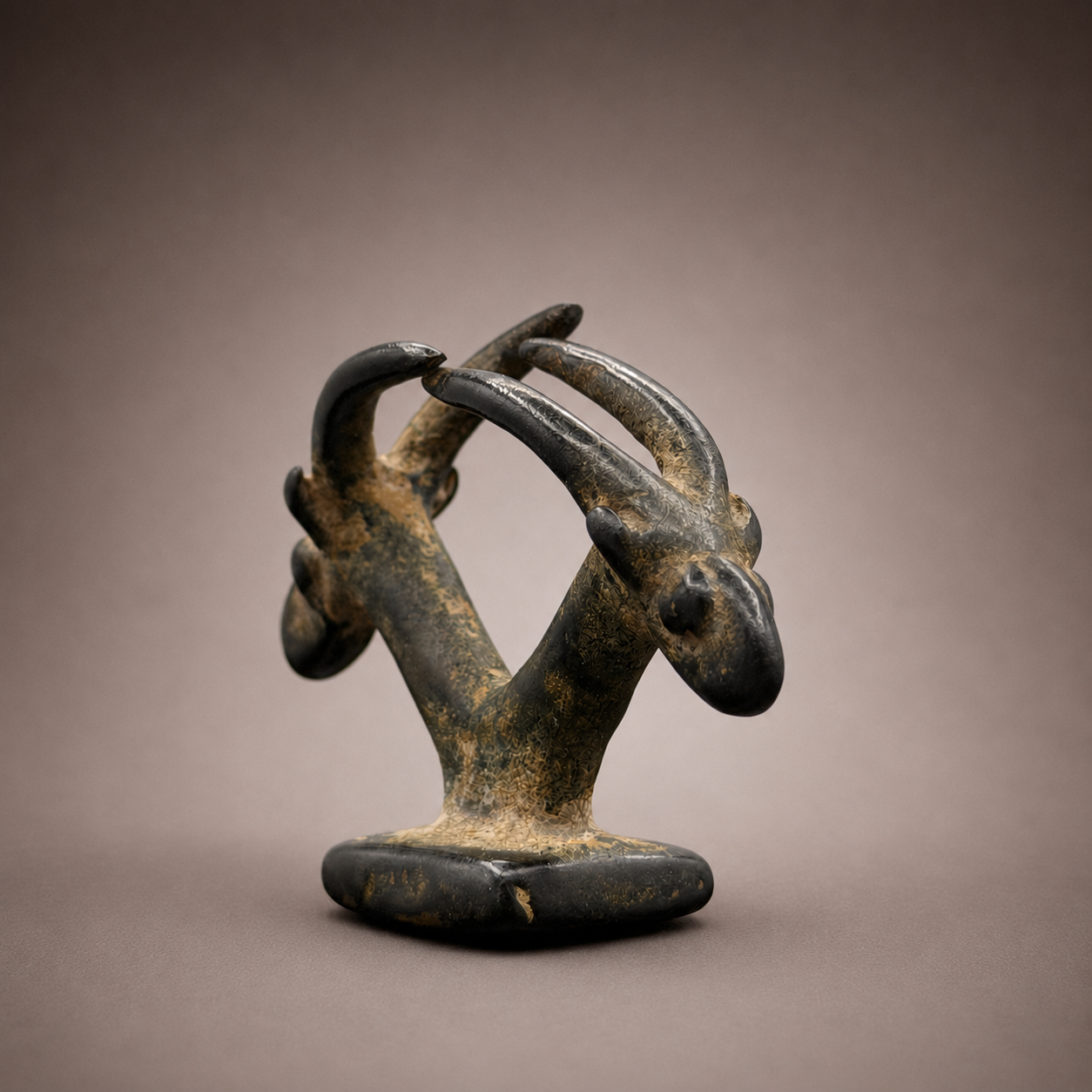
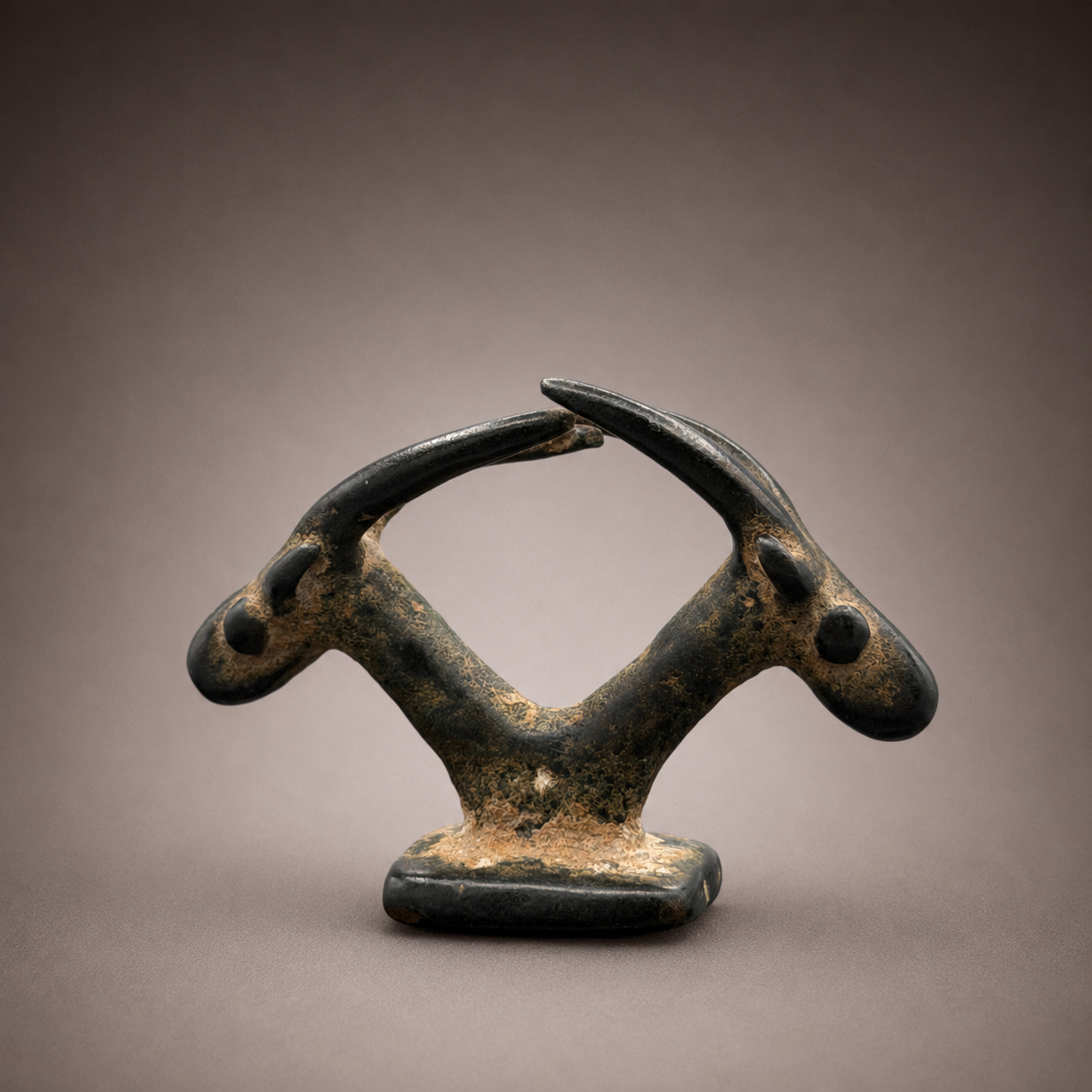
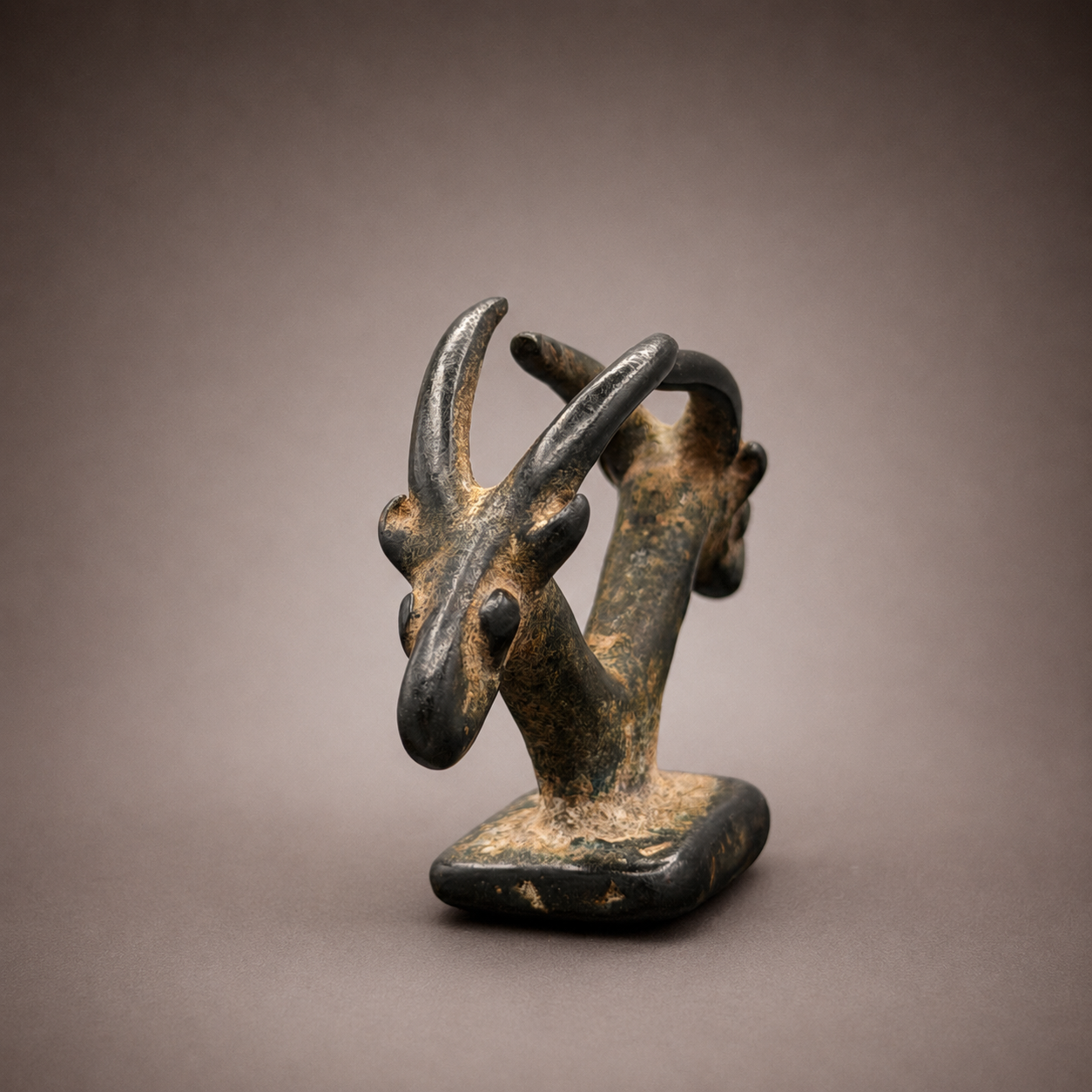
A finely cast Luristan bronze object in the form of two ibex heads facing outward in opposite directions, their sweeping horns arching upward and inward to nearly meet at the apex, forming the characteristic open-work silhouette that defines this celebrated class of ancient Iranian metalwork. The piece most plausibly functioned as the decorative head of a dress pin — a well-attested Luristan form in which an elaborately sculpted bronze terminal was mounted atop a long pin shaft used to fasten a cloak or garment at the shoulder — or alternatively as a pendant amulet worn on the body. Either use would have placed this object in close, visible relationship with its owner, serving simultaneously as personal adornment and apotropaic protection.
The two heads — each rendered with the schematic naturalism typical of Luristan animal bronzework — share a single neck post rising from a flattened, rounded base designed for attachment to a shaft or suspension cord. Circular eyes are rendered as deep drilled depressions, and the elongated muzzles taper with confident economy. The long curving horns are of the capra aegagrus type, consistent with the bezoar ibex native to the Zagros highlands — the emblematic animal of ancient Iran, holding a symbolic status analogous to the lion in Assyria, the dragon in Babylon, and the bull in Sumer.
The back-to-back double-headed composition — two animals sharing a single base, their gazes directed outward in opposite directions — carries an inherently apotropaic quality, the all-seeing vigilance of the paired ibex guarding its wearer from every approach. Small paired-animal compositions are considered among the most distinctive of all cast bronze works reported from Luristan, and at this intimate scale the piece would have been an object of daily personal significance rather than public ceremony. The surface carries a rich dark patina — deep charcoal and gunmetal with silver highlights on the high-relief surfaces — consistent with age and likely burial or votive deposition at the end of its working life. Most Luristan bronzes have been recovered from funerary contexts, suggesting that objects of this kind, however personal in daily use, ultimately served a ceremonial function in death as well.
Estate of Karl Stirner. Karl Stirner (1923 – 2016) was a German-born American sculptor known internationally for his metalwork.