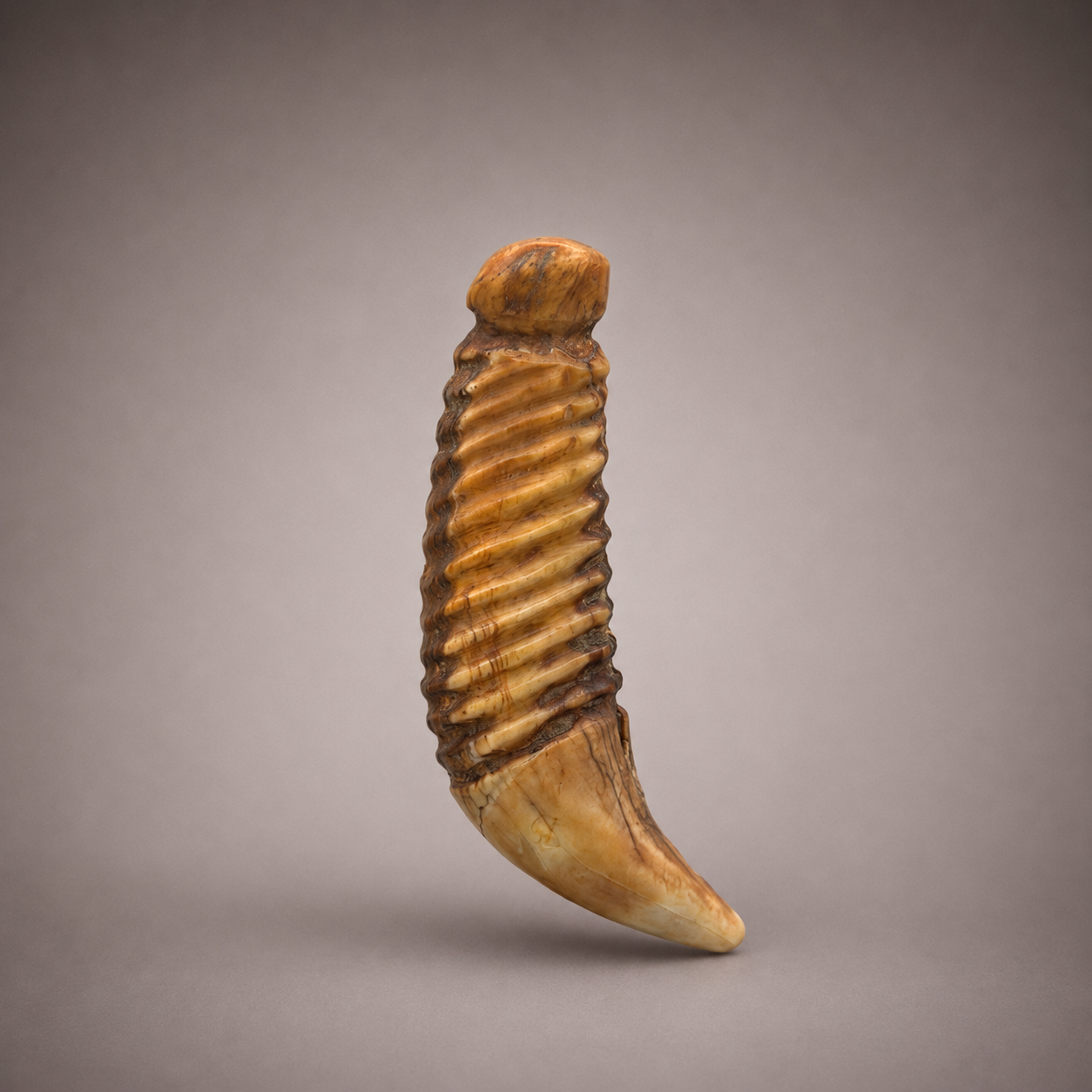
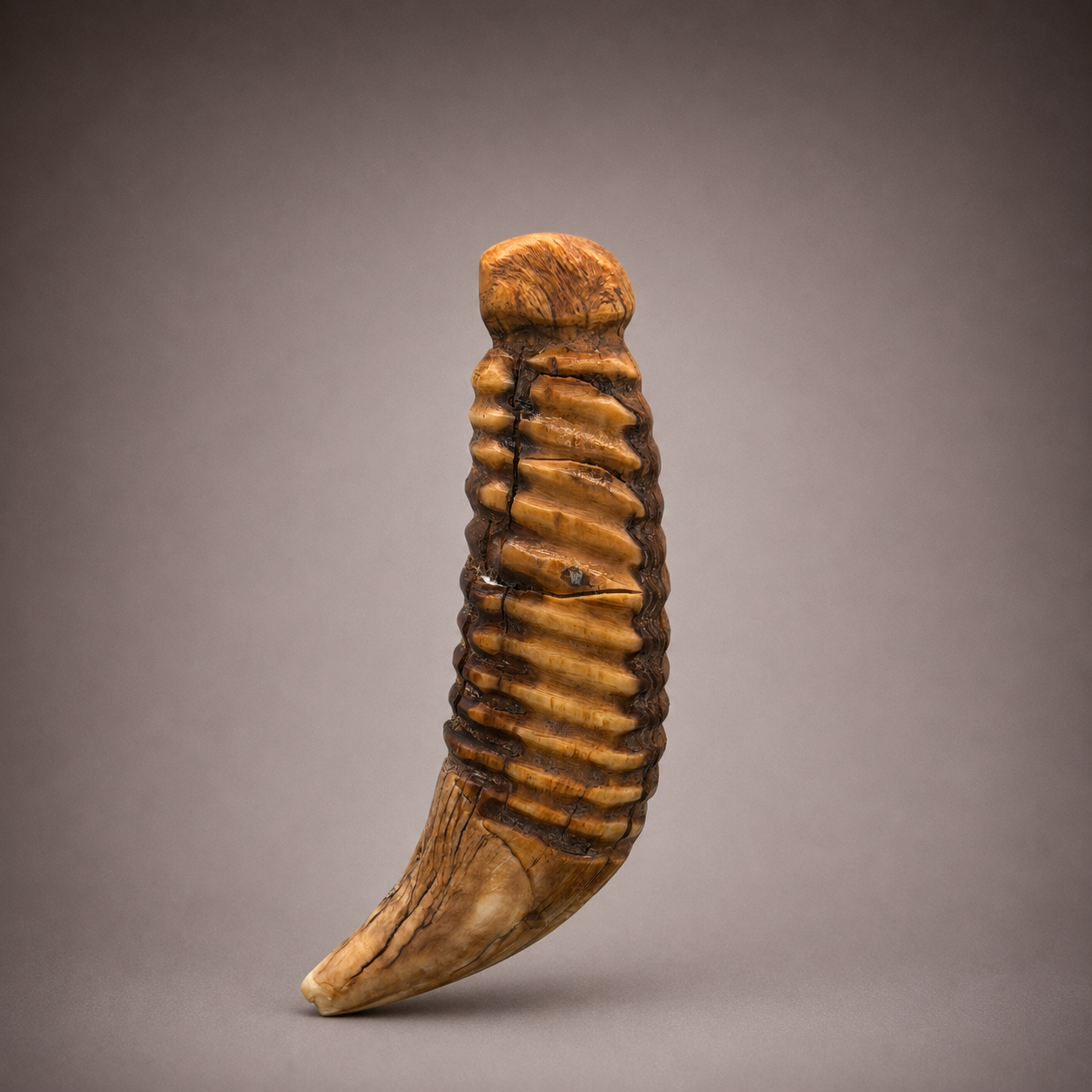
The bear — in virtually every culture that shared its range across the northern hemisphere — occupied a singular position in the spiritual imagination. Larger than any other land predator in its environment, capable of standing and walking upright, of using its forepaws with something approaching manual dexterity, of appearing to die each winter and return to life each spring: the bear was the animal that most closely mirrored human nature while exceeding human power. To possess a part of the bear — to carry its tooth — was to carry the bear itself, its strength, its endurance, its capacity for periodic death and renewal compressed into a single object that could be held in a closed fist.
This carved bear canine is a piece of considerable physical authority. The tooth itself is large — a fully developed canine from an adult bear of substantial size — its naturally curved form tapering from a broad, rounded crown to a long, sweeping point. The dentine has aged to a deep amber-gold, the surface cracked along its length in the longitudinal lines that develop in tooth material over many generations, the cracks now filled with the dark staining of time and contact. This is old material — the tooth itself, before any carving was applied to it, was already an object of age and power. Across the body of the tooth, a series of diagonal spiral grooves has been incised — possibly serving as a tally of kills, though their precise meaning is uncertain.
At the crown, the natural root of the tooth is retained — broader, darker, more porous — as the terminal element of the composition. A small metal fitting at this juncture provided either a suspension point for wearing the amulet on a cord against the body, or a repair that kept the tooth in use after age or ceremony had stressed it. Either way, the fitting speaks to an object too valued to retire.
The unworked tip is left entirely in its natural state — the long curving point of the original canine, its surface cracked with age, its color a lighter cream where the outer dentine has worn or split away to reveal the paler interior. This decision — to leave the natural tip untouched while carving the body above — is the same formal intelligence seen in the companion piece, and it speaks to a shared understanding: the tooth's own form is already eloquent, and the carver's task is to extend that eloquence, not to override it.
Seward Kennedy, London and New York