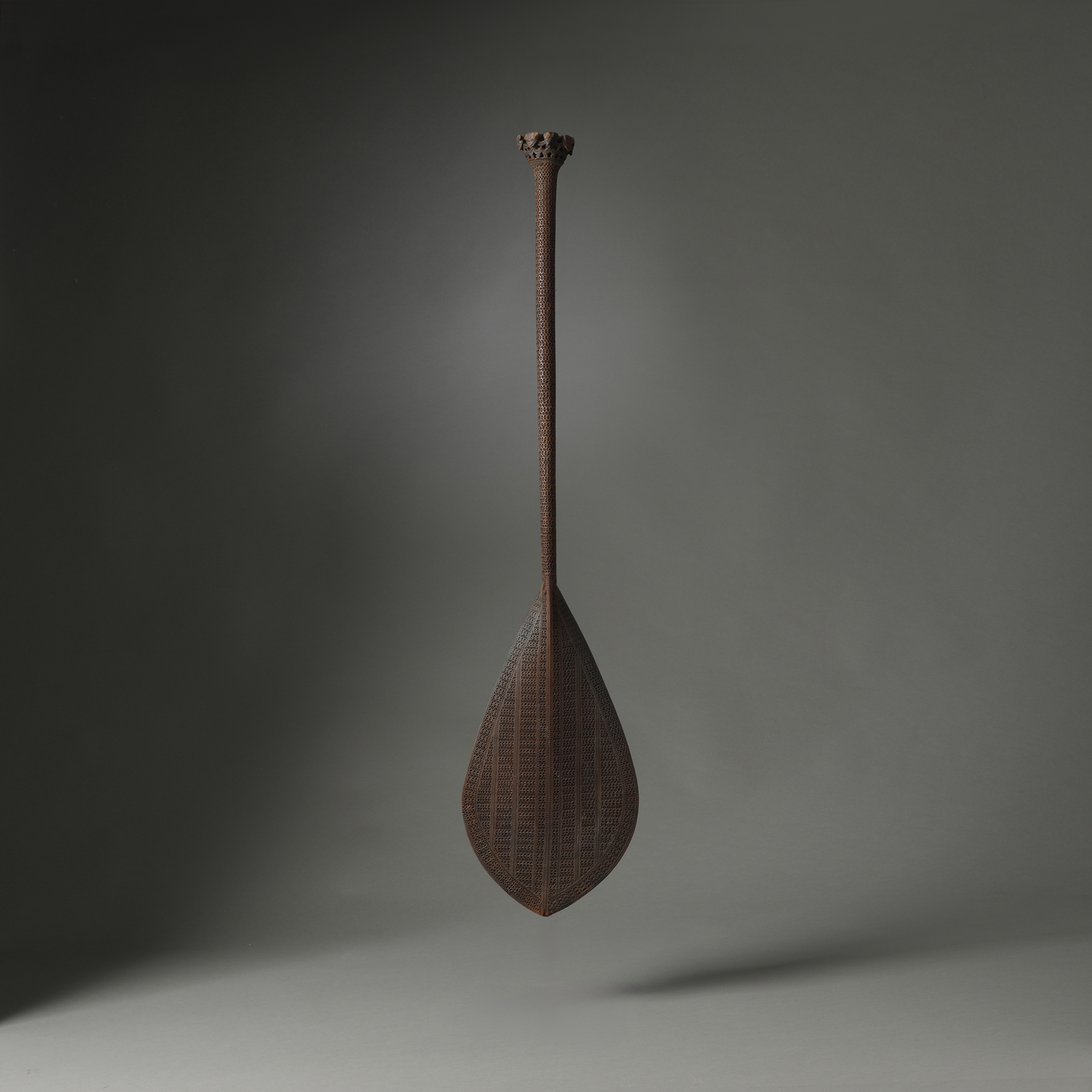
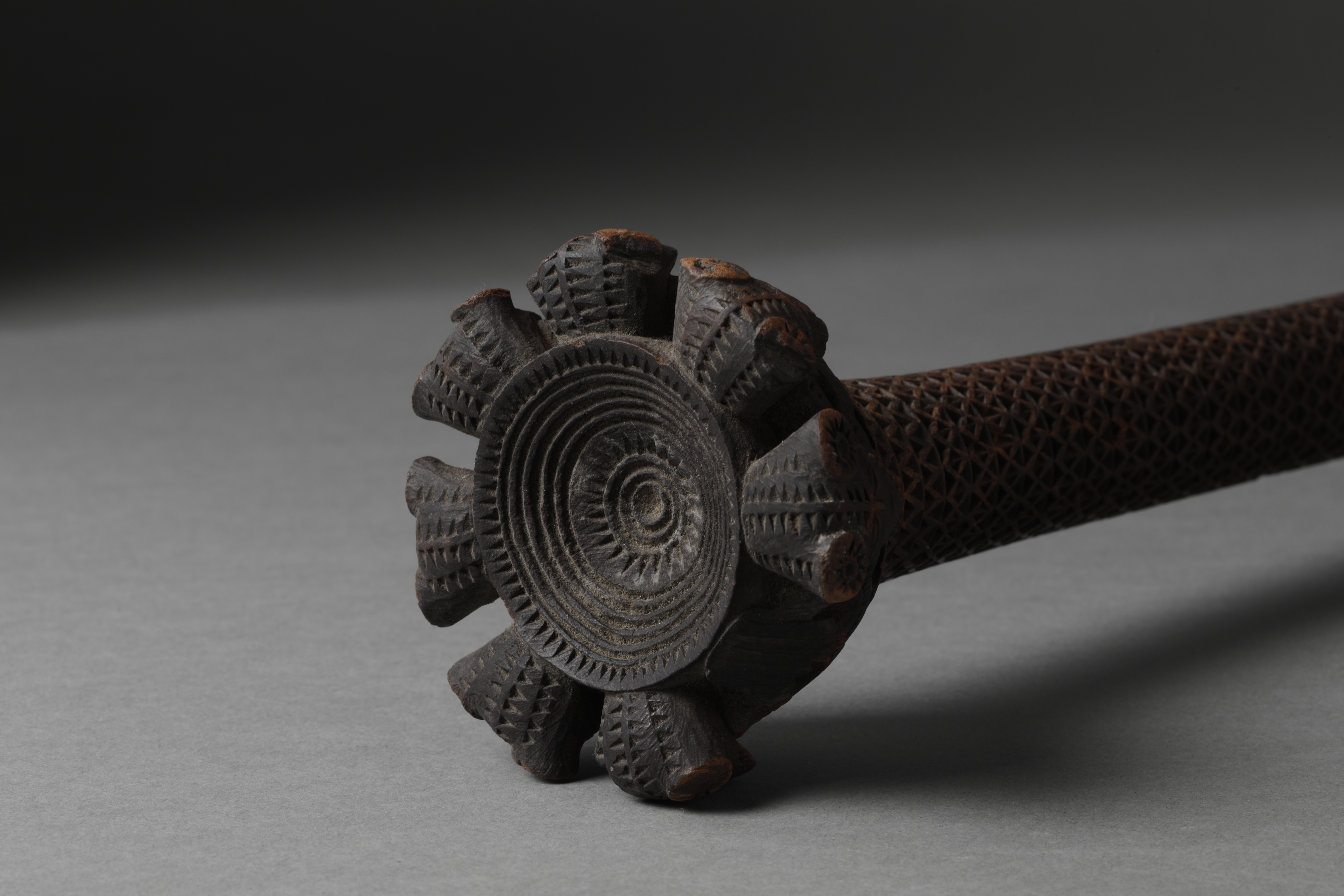
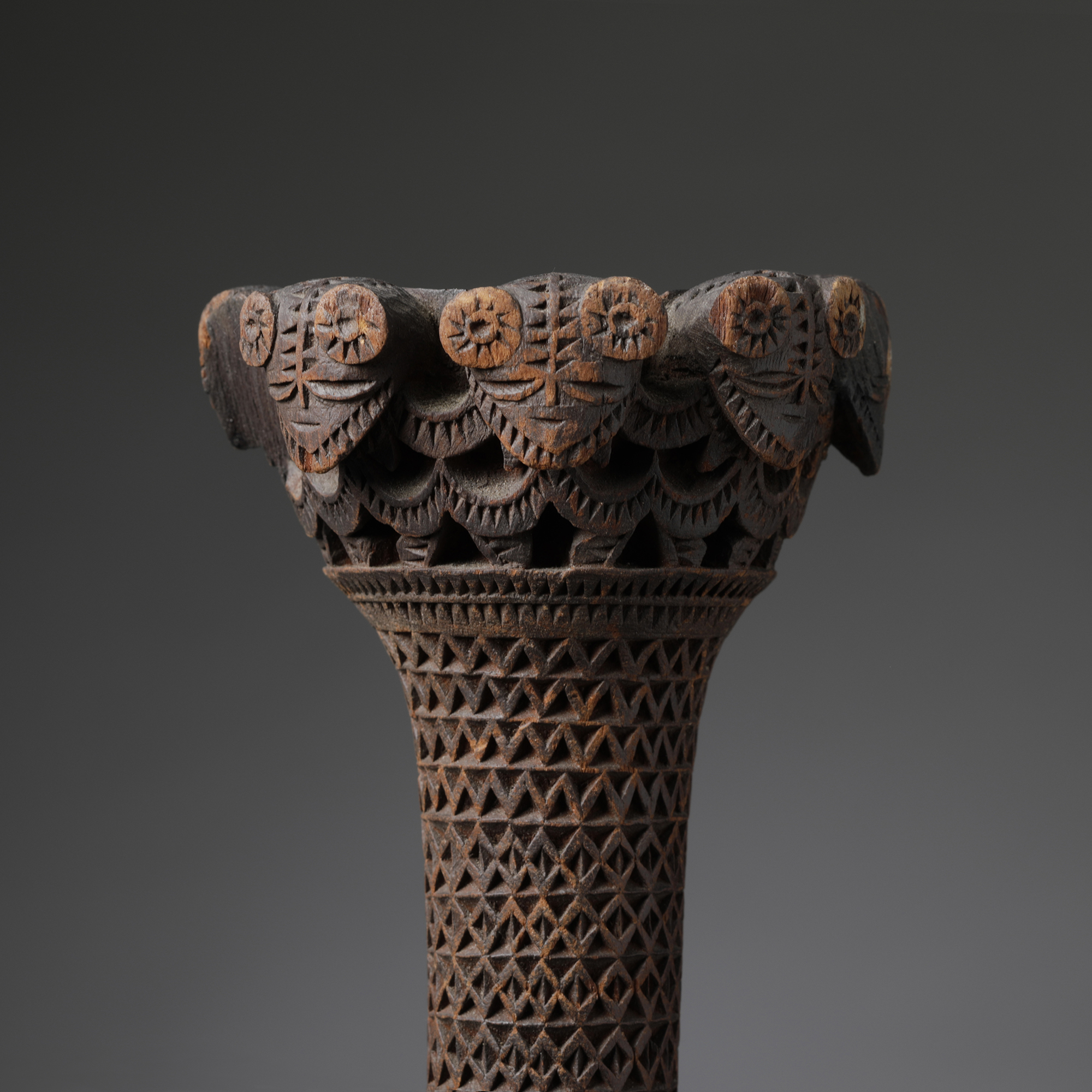
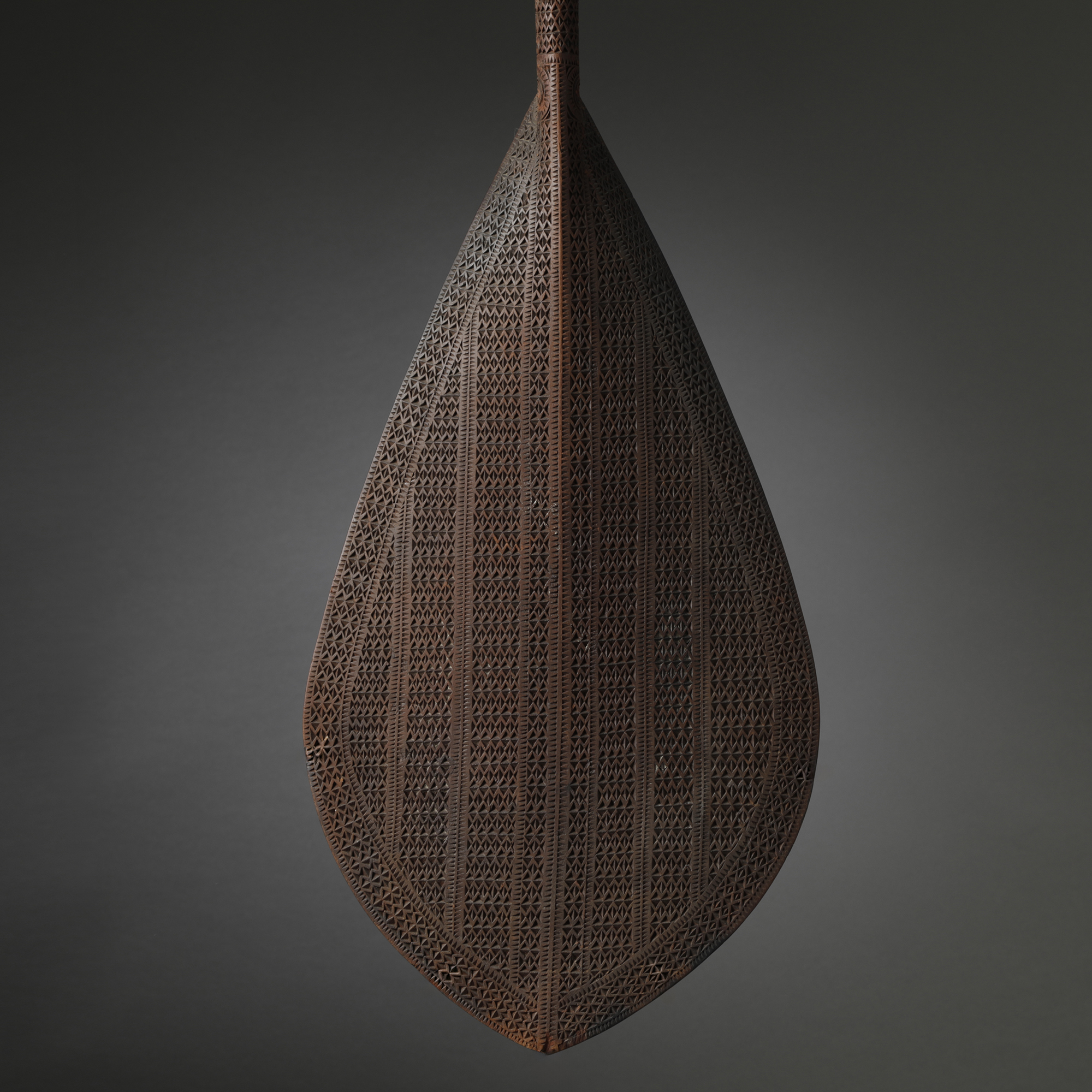
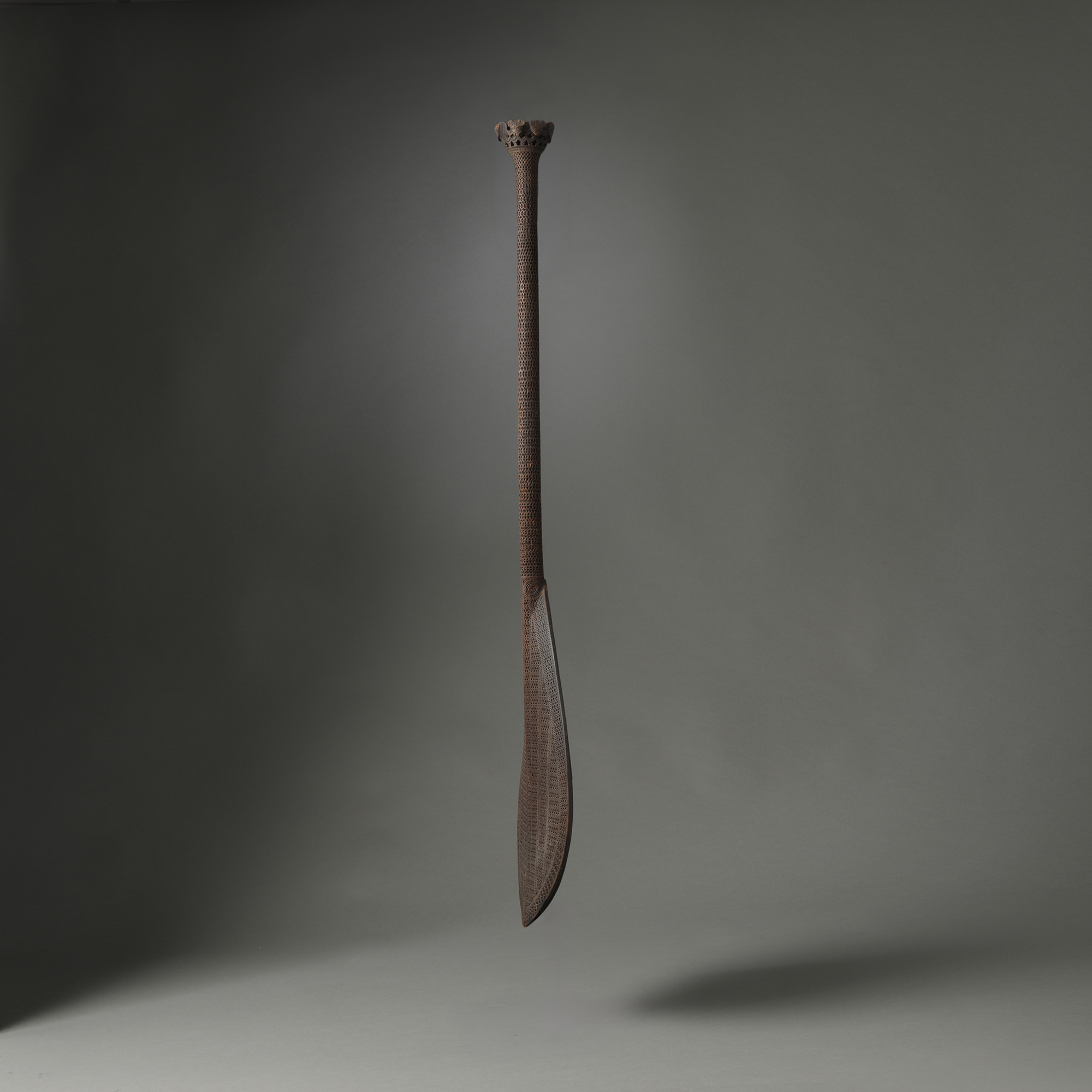
Ceremonial paddles from the Austral Islands are revered for their sharply delineated motifs and symmetrical forms, representing some of the finest Oceanic artistry. Comparable examples can be found in the British Museum and prominent private collections, marking them as prized artefacts among collectors of tribal and ethnographic works. The elaborate geometric carving is a hallmark of Austral craftsmanship, distinguishing these paddles as significant both aesthetically and culturally within Oceanic art history.
Though widely called ‘paddles,’ these objects are not functional paddles. They are ‘paddle shaped,’ but their sizes are too extreme; their shafts are too weak, and they are thoroughly unsuitable for use as paddles. Consequently, it has been assumed that they were emblems of rank or status, for ceremonial rather than functional use. But an exhaustive survey of the historical sources has confirmed that there are no known eyewitness accounts of their use or function. No local name is recorded for them, anywhere, before 1890, though they are sometimes called ‘hoe‘ after the Tahitian word for a paddle.
Most Austral Island paddles are dated roughly between 1820 – 1840, probably made on the Island of Raivavae, and are generally described as made for trade items, with their original use being treated as something of a mystery. There are good grounds for asserting however that few if any ‘paddles’ were made and exported after 1842. Firstly, the population decline was extreme, particularly among the adults. By 1840 the total population on Tabuai had fallen to 250 and on Raivave to 360. Actual carvers would have been even fewer. Moreover, after the French took over Tahiti in 1842, trade visits to the Austral Islands declined.
Julius Carlebach, 1940’s. Carlebach was a prominent New York art and antiques dealer whose gallery played an important role in the development of the American market for traditional African, Oceanic, and Indigenous North American art during the mid-twentieth century. Having emigrated from Germany to the United States in 1937, he established his gallery in New York in 1939, subsequently moving to Madison Avenue in 1958. Carlebach occupied an important position in the cultural milieu of postwar New York, serving a discerning clientele of collectors, artists, and intellectuals. His associations included the Surrealist artist Max Ernst and other figures drawn to the artistic and cultural significance of non-Western objects.
Private New York collection