The Bassa of coastal and interior Liberia have long maintained the Gela masquerade as one of their central institutions of social regulation and spiritual authority. The Gela mask embodies a female spirit of beauty, composure, and moral order — appearing at initiations, funerals, and community celebrations to affirm the values that bind Bassa society together. When the Gela dances, accompanied by singers and musicians, its presence is understood as the spirit made visible: a distillation of feminine grace and ancestral power that elevates the occasion beyond the ordinary.
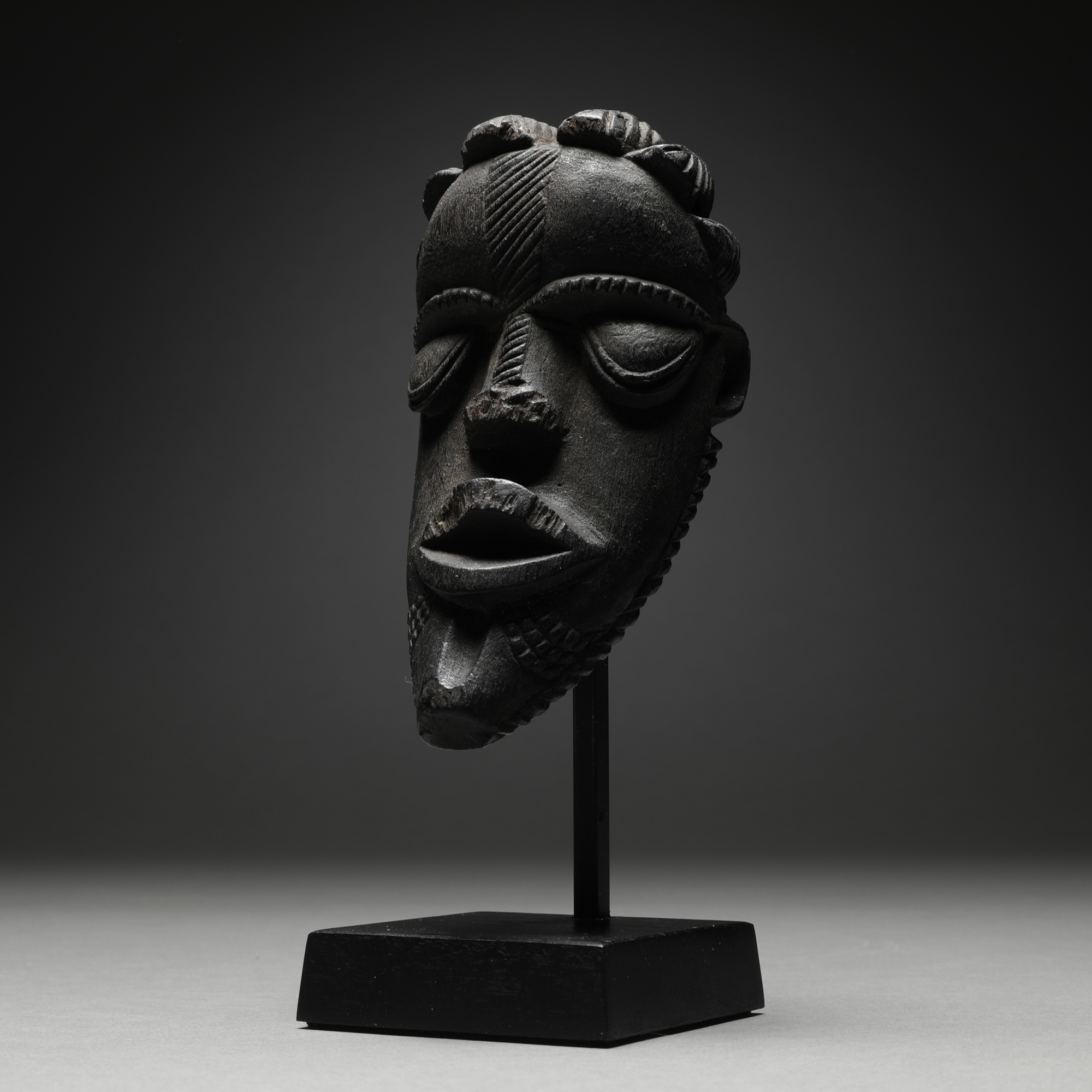
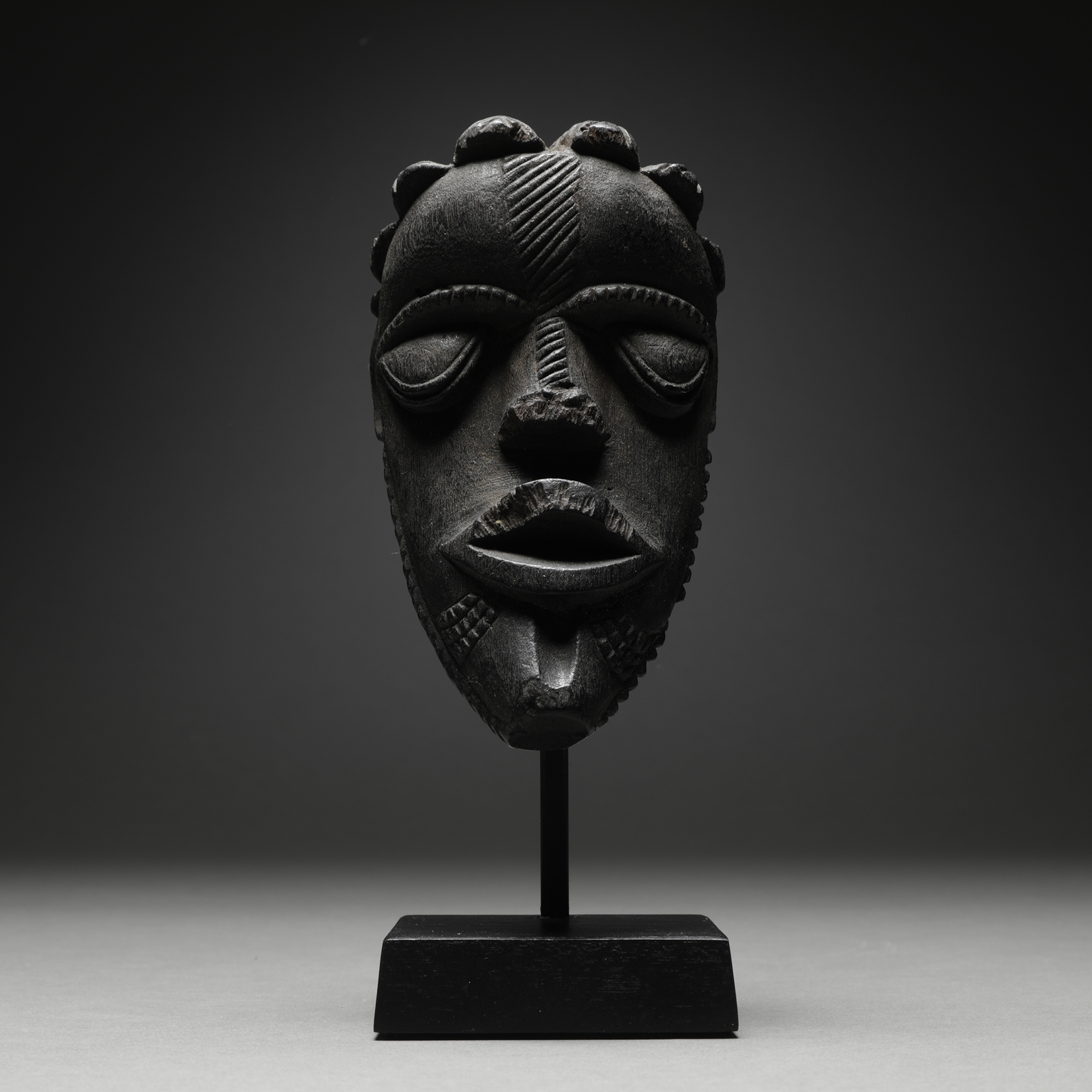
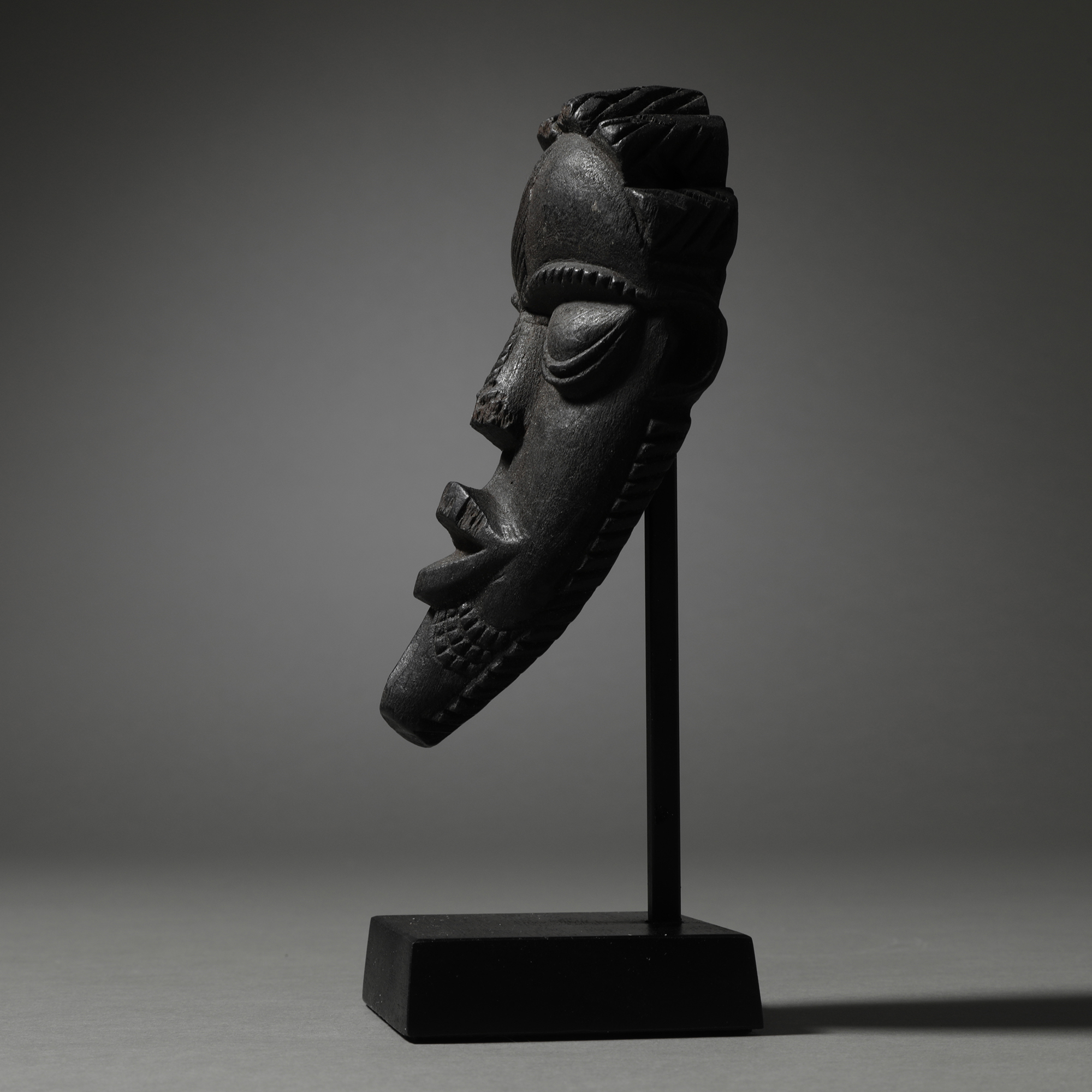
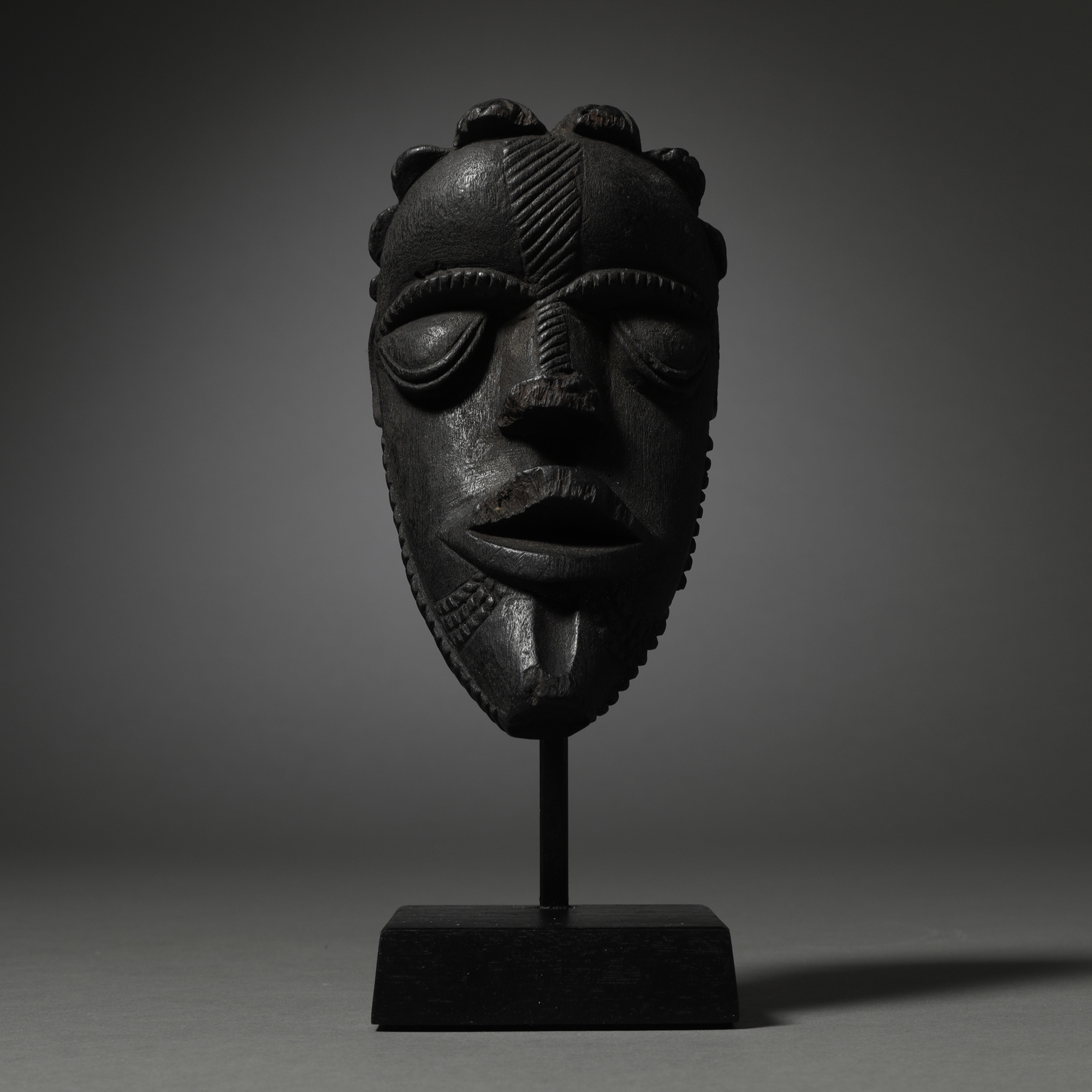
This Gela mask presents the type in its most refined and concentrated form. The face is an elongated oval that narrows to a composed pointed chin — a silhouette that conveys both dignity and delicacy — its surface treated with an even, deep black pigmentation that absorbs light and gives the mask an interior quality, as though illuminated from within rather than reflecting from without. The pigment, renewed before each performance, has been fully absorbed into the wood over many years, its surface worn to a subtle sheen at the brow, eyelids, and lips.
The coiffure is the mask's crowning statement. A horizontal band of finely notched rope-twist carving circles the brow — a diadem of carved fiber or plaited hair rendered with precision — above which a diagonal lattice panel suggests a carefully dressed and arranged coiffure, flanked by small raised knob ornaments at the crown. Hair arrangement among the Bassa, as across much of West Africa, was a primary expression of social identity and aesthetic refinement; its careful rendering here signals that the spirit embodied by this mask is one of cultivated, deliberate beauty.
The eyes are the face's commanding element. Heavily lidded, with dramatically swollen upper lids that hang low over the lower — nearly closing the eye — they convey a gaze that is simultaneously composed and penetrating, turned inward toward the spirit world rather than outward toward the crowd. In Bassa aesthetic thought, beauty of this kind is not passive; it is powerful. The Gela spirit sees what ordinary eyes cannot, and its nearly closed eyes signal the depth of that perception. There are no apertures in the eye — the dancer sees through the mask's open mouth or a small hole below, leaving the spirit face complete and uncompromised.
The lateral edges of the face — from brow to chin — are framed by a continuous border of fine notched or rope-twist carving that echoes the brow band and creates a contained, architectural silhouette when the mask is viewed in profile. Below the full, slightly parted lips, a small chin element decorated in crosshatch incision marks a beard or a tattoo — a masculine inflection on what is otherwise a feminized spirit form, the kind of deliberate ambiguity that gives the finest Bassa masks their psychological complexity.
An example by the same hand is in the Tervuren Museum collection.
Private Collection
Paolo Akam