The smallest objects in the Arctic artistic tradition are often the most charged. In a world where every possession had to justify its weight and every material had to be worked by hand in conditions of extreme cold, a carving of one inch in walrus ivory — perfect in form, complete in detail, resolved in expression — represents an investment of time, skill, and attention that speaks directly to the object's importance. This was not made casually.
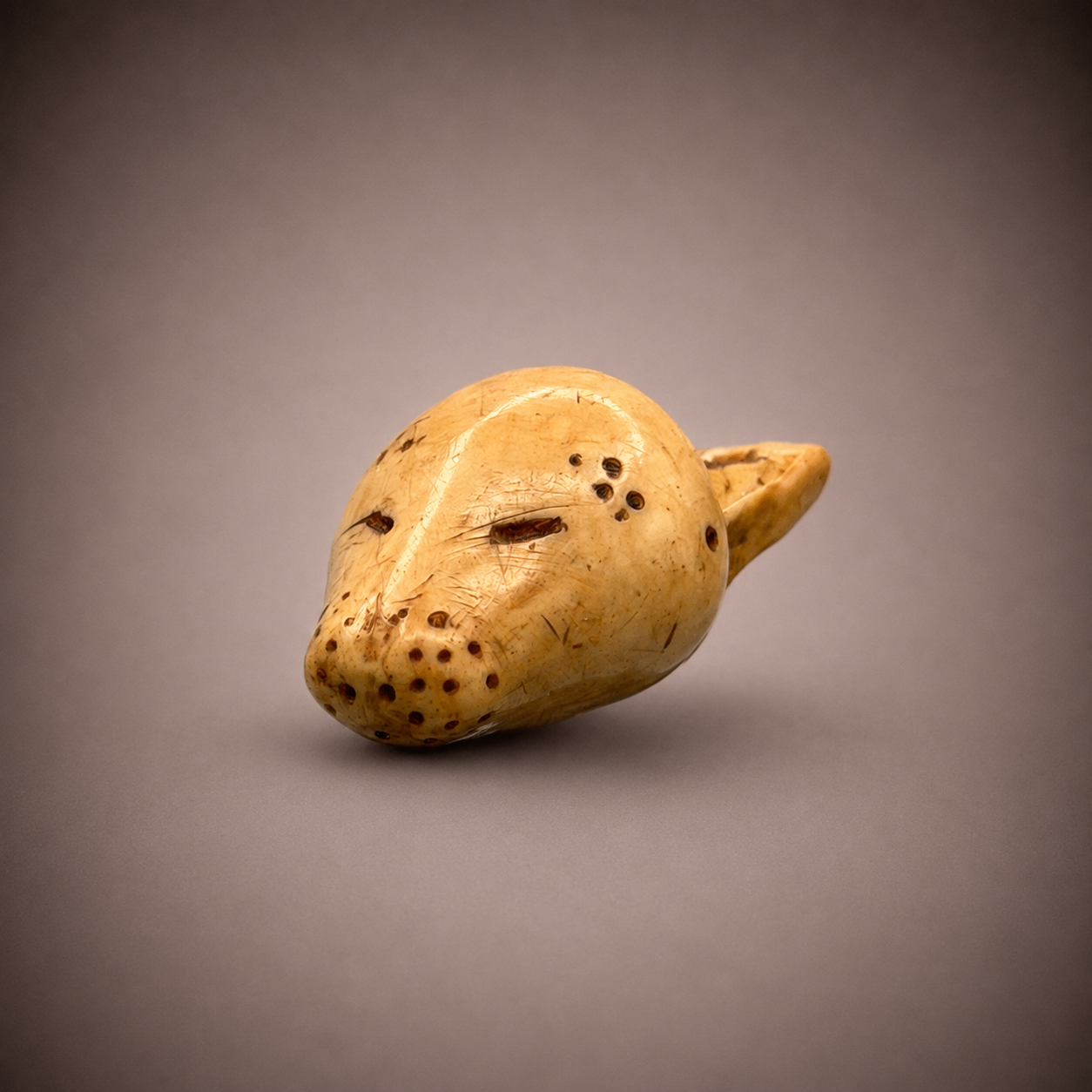
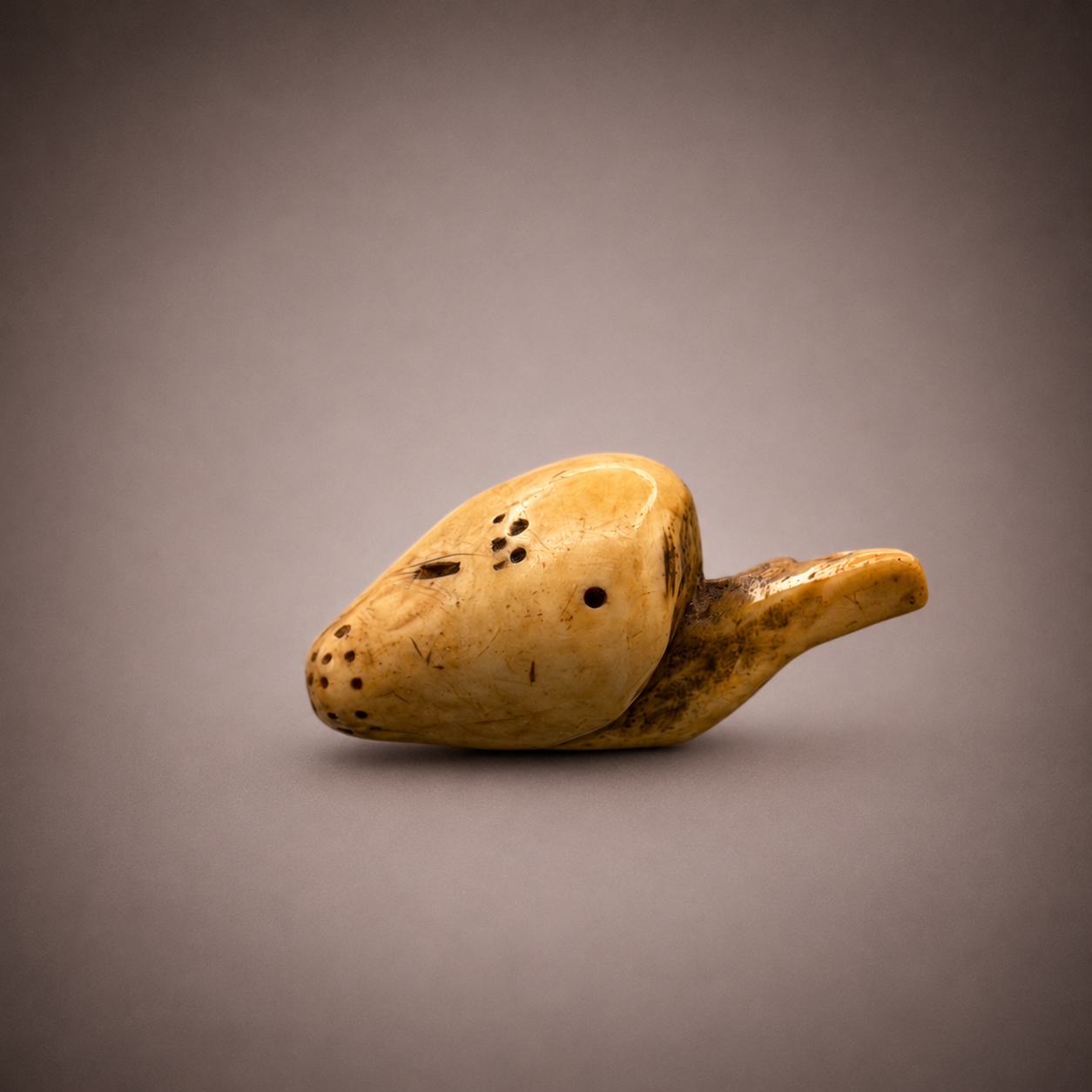
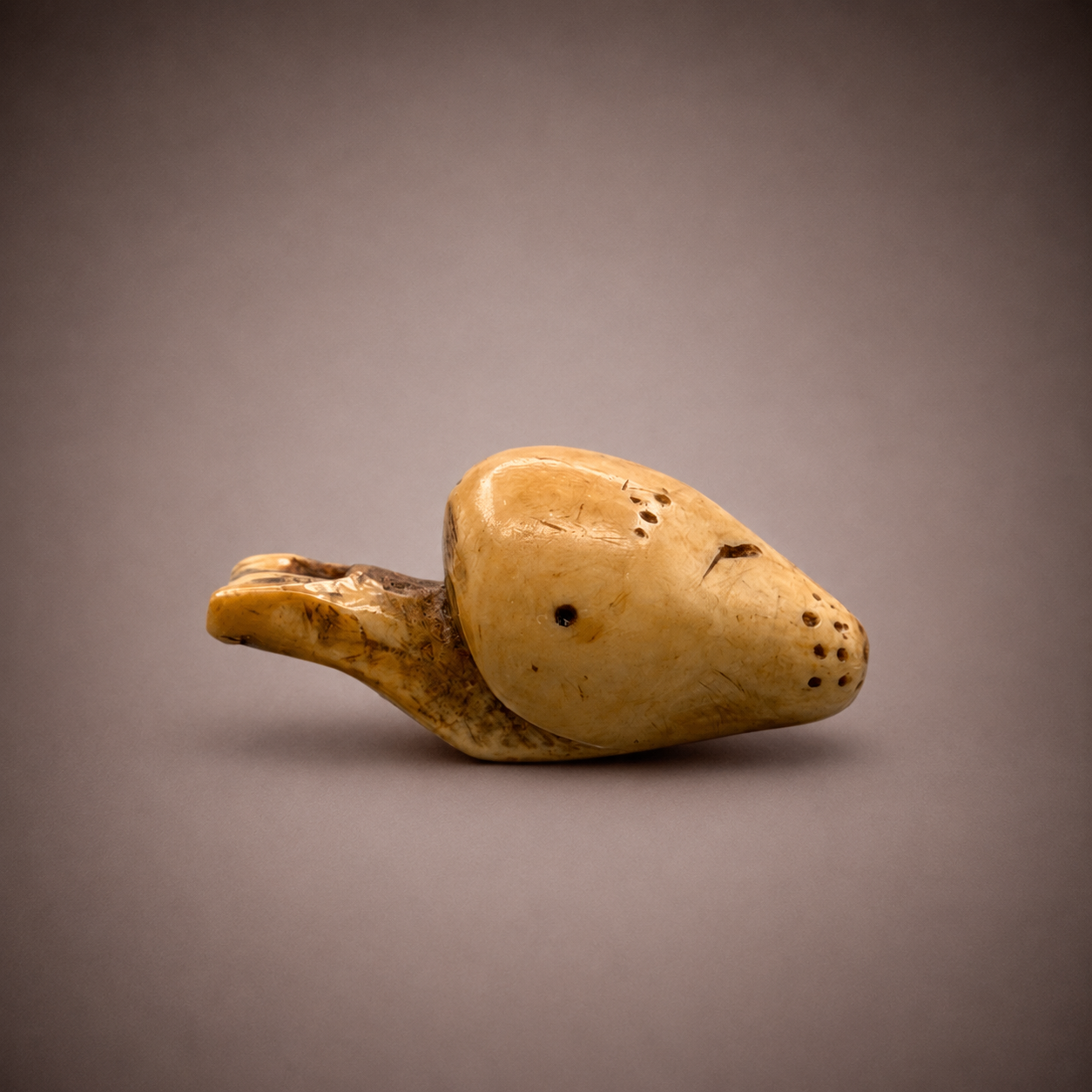
This miniature seal is carved from a single piece of old walrus ivory that has aged to a deep, warm amber — the color of ivory that has spent long years in close contact with human skin, carried in a pocket or pouch or worn against the body on a thong. The surface is polished to a high sheen by handling rather than tool, the natural flecking and spotting of the ivory matrix visible across the rounded body like the dappled markings of a ringed seal's pelt. The carver has rendered the animal with complete anatomical fidelity and absolute economy: the full, rounded body, the raised and slightly turned head, the projecting fore-flipper — everything necessary, nothing extraneous.
The function is revealed on the dorsal surface: a carved rectangular bridge rises from the seal's back, its transverse slot cut cleanly through to accept a thong or lashing. This is a toggle — a fastener and amulet simultaneously, the two functions inseparable in the Inuit and Yup'ik understanding of useful objects. Toggles of this kind secured the closures of hunting bags, clothing, and equipment; they were also among the most personal of amulets, the animal carved onto or into the toggle lending its yua — its inner spirit — to the person who carried it. A seal toggle on a hunter's bag was not decorative. It was an invitation to the seal spirit, a gesture of respect and connection that acknowledged the animal's willingness to be taken and asked for its continued cooperation.
The seal — puiji in Inuktitut — was the foundation of Arctic survival: food, fuel, clothing, and line all came from its body. To carry a seal in miniature was to carry the relationship itself, compressed into ivory and worn close.
Dug by Jason Iya on the Punuk Islands