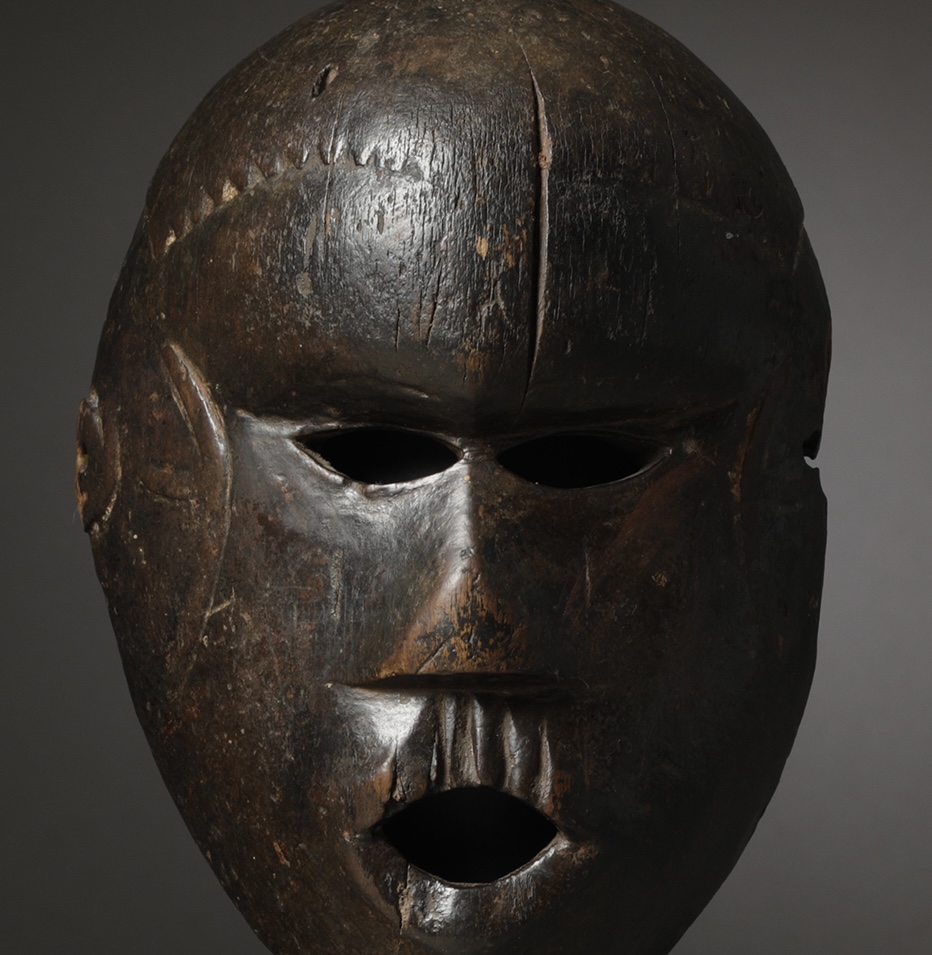
The Idoma of the Benue River valley in central Nigeria are renowned for their powerful masquerade traditions, in which masks serve as conduits between the living and the ancestral realm. This face mask displays the hallmarks of the Idoma aesthetic: a smooth, domed forehead, dramatically slit almond-shaped eyes, a prominent and boldly modeled nose, and an open, slightly parted mouth that conveys both authority and animation. The overall form is strongly ovoid, with a refined economy of surface that draws the eye inward, commanding attention without ornament.
The dark, lustrous patina — deep brown verging on black — speaks to sustained ritual use and repeated application of libations or oils over many years. Wear and abrasions along the high points of the forehead and cheekbones further confirm a life in active ceremony rather than storage. Small lateral projections at the temples are characteristic of certain Idoma mask types and would have served as attachment points for fiber, raffia, or other organic costume elements that completed the masquerade ensemble.
Idoma masks of this type were performed within the oglinye and anjenu masquerade associations, appearing at funerals, initiations, and community judicial proceedings. The masks embody ancestral spirits (alekwu) whose presence enforced social order and mediated between worlds. The open mouth suggests the mask was intended to speak — to give voice to the ancestors in the public arena of ceremony.
Merton D. Simpson (1928-2013), New York City, New York, USA
Robert & Patricia Berg, San Diego, California, USA
Michael Oliver, New York, USA