The bullroarer is among the oldest and most widely distributed sacred objects in human culture, but nowhere has it been maintained with greater ceremonial intensity and philosophical depth than among the Aboriginal peoples of Australia. Known by many names across the continent's hundreds of distinct language groups, the bullroarer is at once a musical instrument, a ceremonial object, a repository of ancestral power, and a physical embodiment of the Dreaming itself.
When swung on a cord in a wide arc overhead, the bullroarer produces its characteristic sound — a deep, pulsing roar that rises and falls with the speed of rotation, carrying across remarkable distances through open country. This sound was understood as the voice of an ancestor, the breath of a Dreaming being, or the direct manifestation of a sacred presence. In many traditions the sound alone was sufficient to clear women and uninitiated men from ceremonial ground; in others, the bullroarer's voice announced the beginning of initiation, signaled the presence of the sacred, or called participants to ceremony from across the landscape.
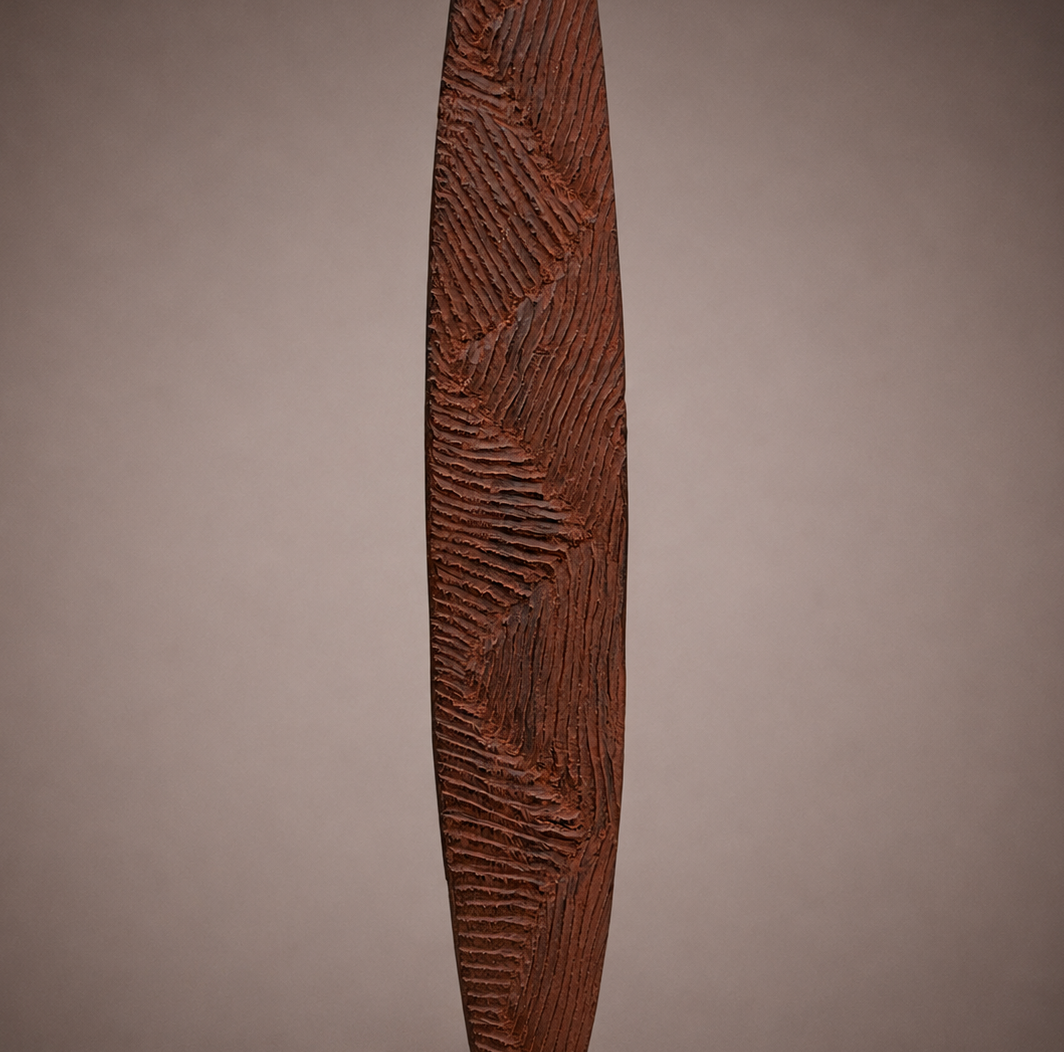
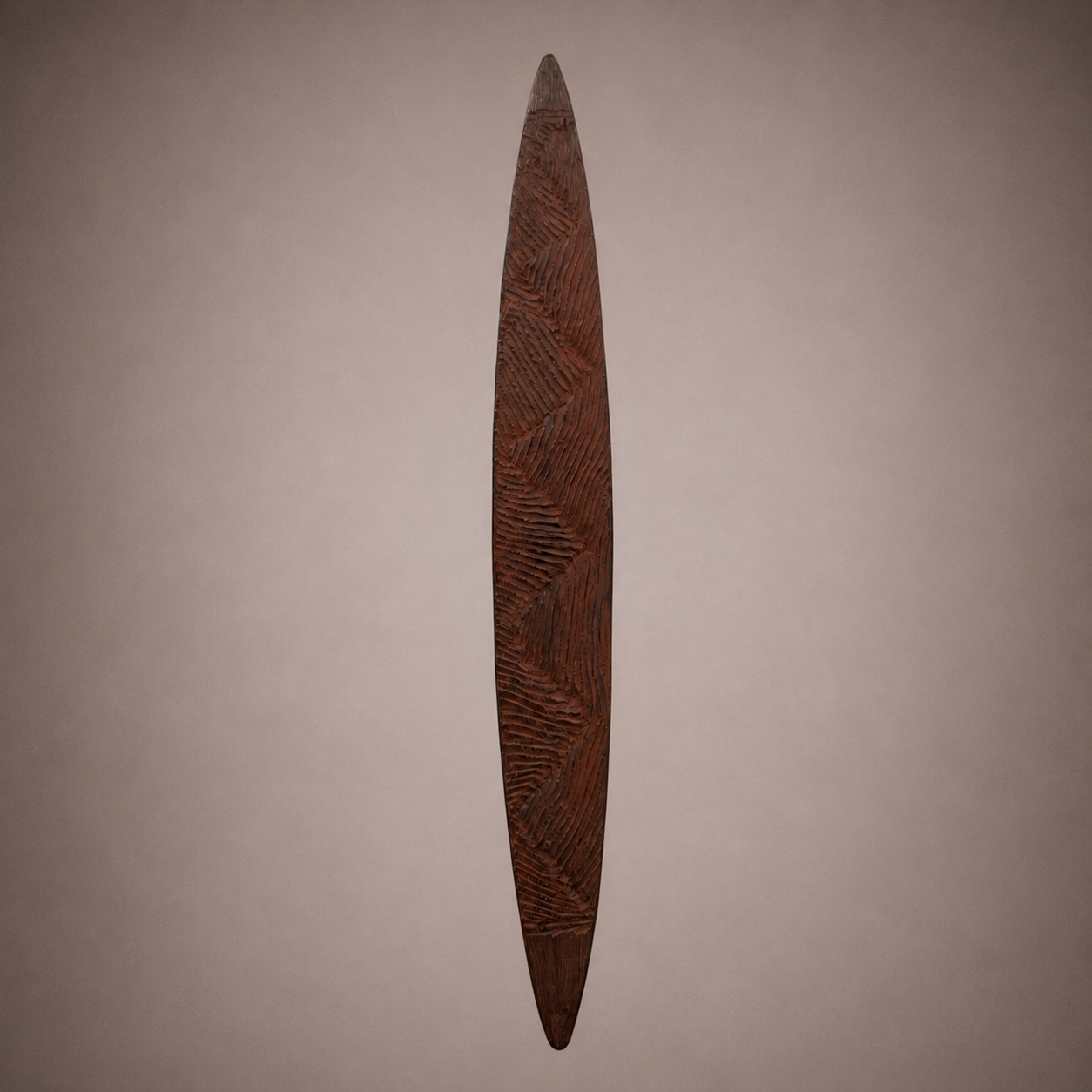
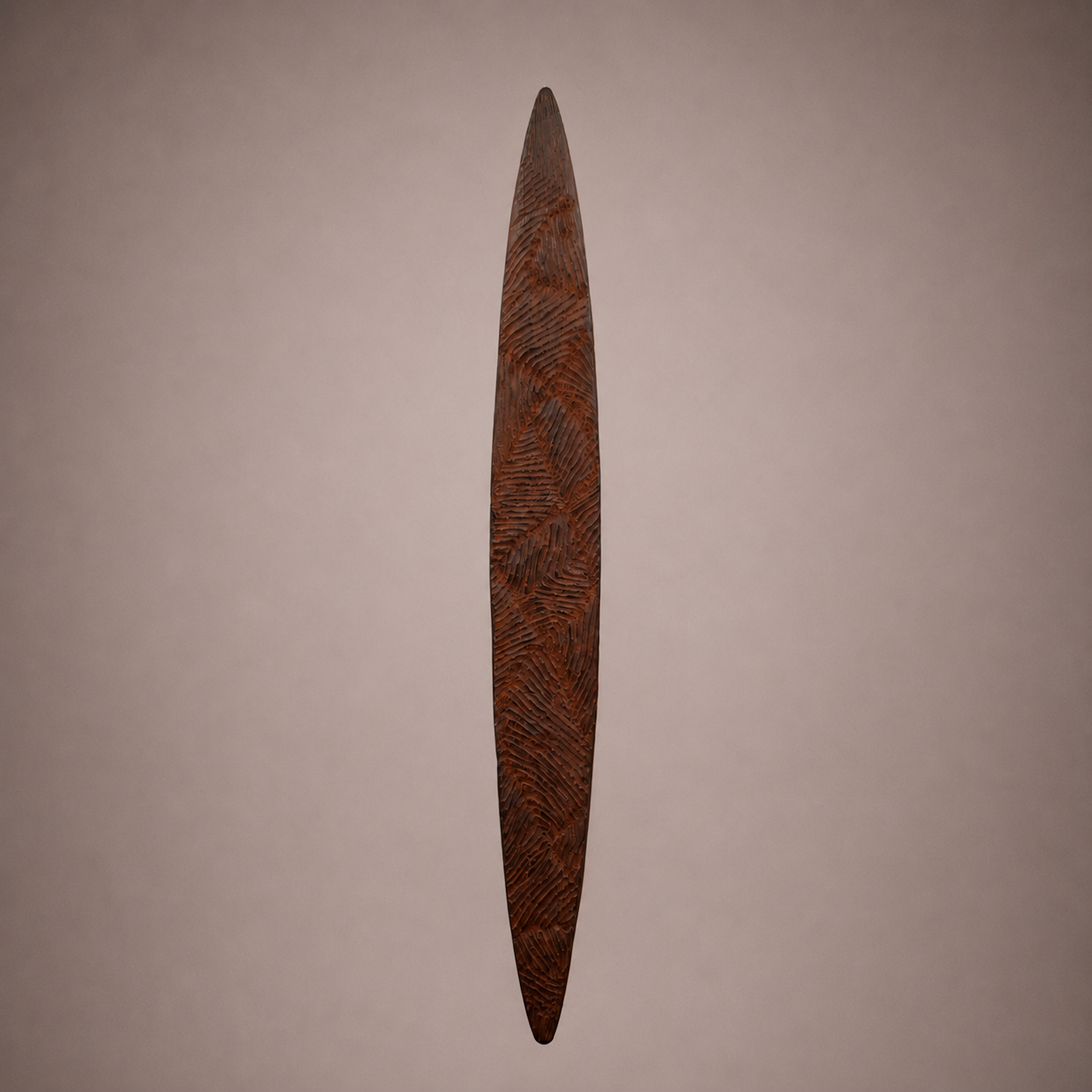
This example is a finely made object of evident age and use. The form is resolved with the aerodynamic precision that effective bullroarers require: a long, narrow lens tapering symmetrically to fine points at both ends, the widest point at the center providing the mass and surface area that generate sound when the board is spun. The wood is a dense Australian hardwood — reddish-brown, close-grained, light relative to its size — carved from a single piece and thinned to the exact profile that experience across generations had established as most effective.
The entire visible face is covered in deeply incised herringbone decoration organized around a strong central spine: from this axis, diagonal parallel lines radiate outward in alternating directions to either side, creating a bold zigzag or chevron field that runs uninterrupted from tip to tip. In Australian Aboriginal decorative tradition, herringbone and chevron patterns of this kind are among the oldest and most semantically charged visual vocabularies — appearing on objects, on bodies, and in sand drawings across the continent, their specific meaning varying by region and context but consistently associated with water, with movement, with the tracks of ancestral beings across the landscape, and with the structural grammar of the Dreaming. The confident, assured execution — deeply cut, evenly spaced, covering every available surface — suggests a maker working from internalized knowledge rather than copying: this pattern was not designed, it was known.
At the lower tip, a drilled hole provided the attachment point for the cord — the physical connection through which the performer's arm transmitted energy into the spinning board, setting the ancestor's voice in motion.
Private US collection