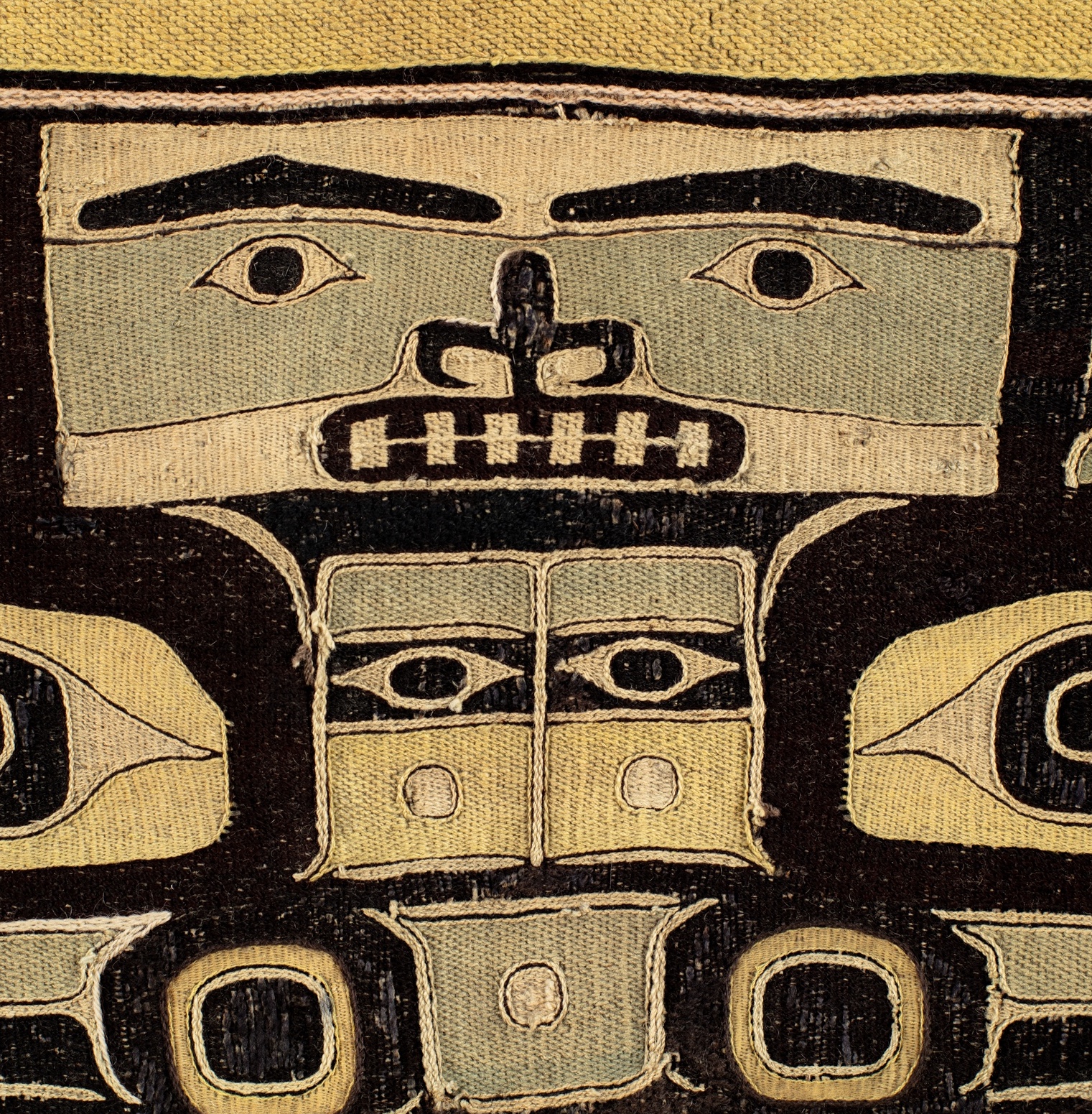
TLINGIT, NORTHWEST COAST
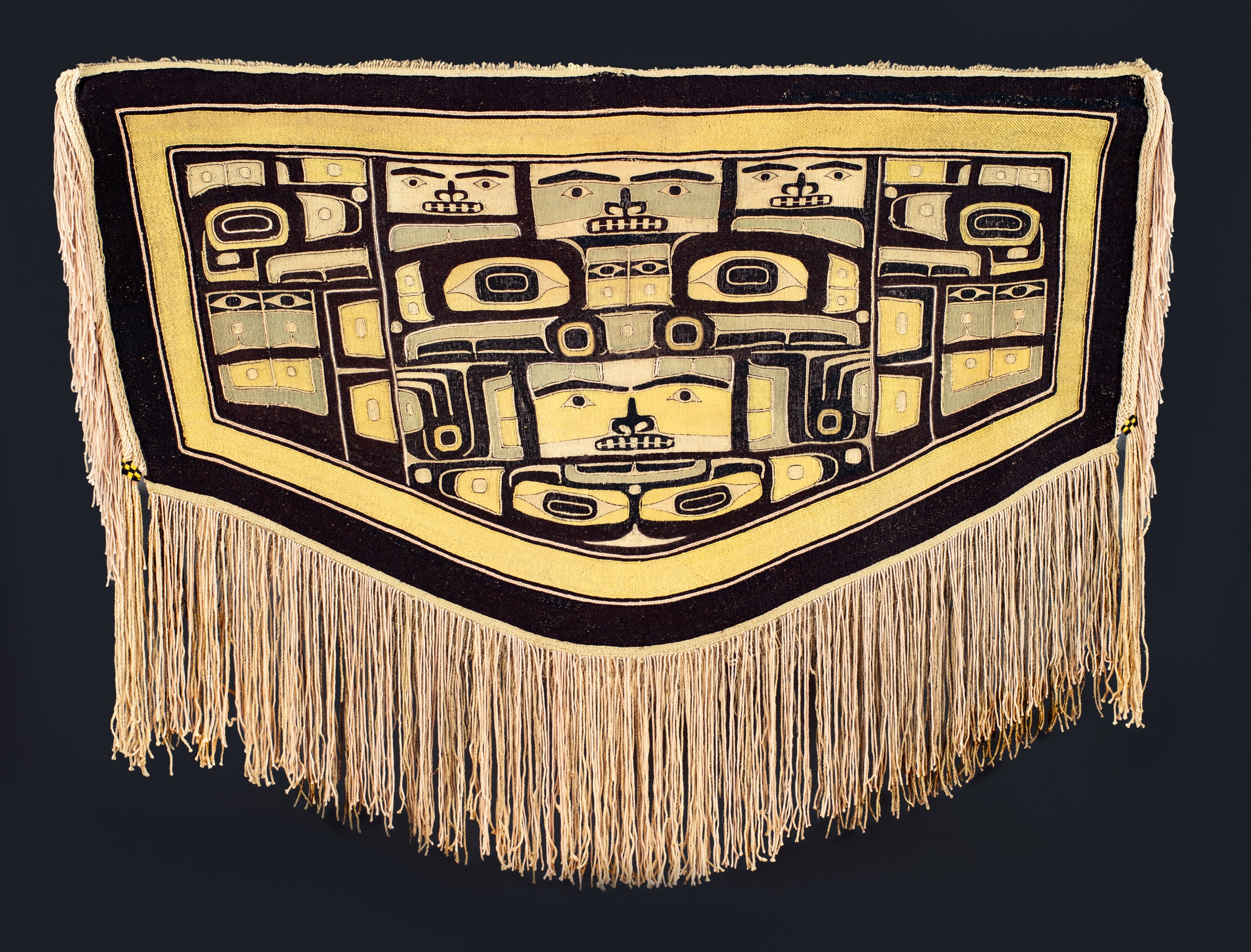
Woven from mountain goat wool and hand-processed cedar bark, this exceptional nineteenth-century Chilkat blanket represents one of the most sophisticated textile traditions of the Indigenous Americas. Chilkat blankets were woven exclusively by highly skilled women, whose knowledge was passed through generations and whose work carried great cultural prestige. The process was extraordinarily labor-intensive: raw mountain goat wool was collected, cleaned, spun, and combined with shredded cedar bark to create a strong, flexible yarn, then dyed with natural pigments. From preparation to completion, a single blanket could require many months—and often more than a year—of dedicated work. Such blankets were worn during potlatches, dances, and other ceremonial events, where their movement and symbolism reinforced the wearer’s rank and social identity.
The design is executed in the classic Chilkat weaving technique, allowing curvilinear formline imagery to be woven directly into the fabric rather than embroidered or painted afterward. The composition features powerful crest figures—abstracted animal and supernatural beings associated with clan identity, ancestry, and inherited rights. These designs were not simply decorative, but encoded social status, lineage, and ceremonial privilege.
Within this dense complex of interlocking and nested imagery are found depictions of ravens, eagles, bears, killer whales, and human-like spirit figures, all rendered through flowing lines and geometric shapes that communicate balance, transformation, and spiritual authority. The inclusion of three faces positioned in a row across the top center of the composition is unique in this class of weavings.
The blanket’s refined graphic clarity, spare but powerful color palette, and its long, rhythmic fringe panels present a showcase of early Chilkat weaving at its highest level.
Examples of this age and quality are increasingly rare, particularly those retaining strong structure and visual power. This blanket stands as a museum-quality work—an enduring testament to the mastery of Indigenous women weavers and a profound cultural document of the nineteenth-century Pacific Northwest.
PUBLICATION HISTORY
The Box of Daylight, a 1983 exhibition at the Seattle Art Museum, and published in the accompanying catalog. The catalog was written by Bill Holm. Holm (1925–2020) was a highly influential American art historian, artist, and scholar best known for his extensive work on Northwest Coast Native art, including formline design and material culture of Indigenous peoples such as the Tlingit, Haida, and Tsimshian. He served as Curator (later Curator Emeritus) of Northwest Coast Indian Art at the Burke Museum in Seattle and was a Professor of Art History and Anthropology at the University of Washington.
Philip S. Padelford (1912–2009). Padelford attended the University of Washington as an undergraduate and graduate student. He earned a doctorate in history from Yale in 1942, and served as an officer in the Navy in the Pacific during World War II. Padelford was vice president and director of Wakefield Seafoods, the major company in the Alaskan King crab industry.
.jpeg)