The ekpesi is among the most visually arresting headdress forms in the whole of West African masquerade tradition. Worn by the principal drummer during Afo masquerade performances, it transforms the musician into something more than accompanist — into a figure of focused spiritual power whose rhythm mediates between the visible community and the forces that govern it. The headdress is not merely worn; it amplifies.
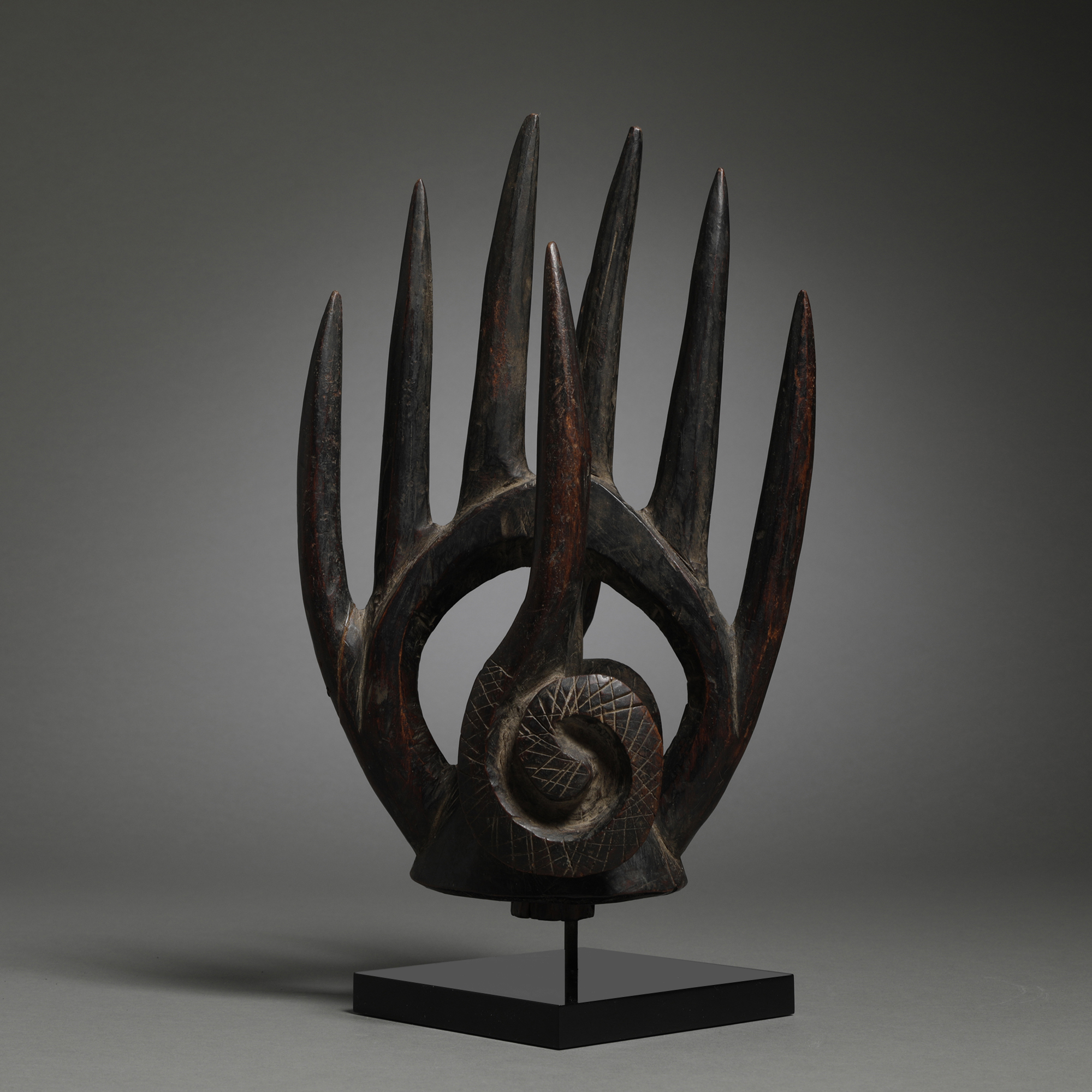
This example achieves its effect through a composition of almost ruthless formal intelligence. From a compact, helmet-like base rises a great circular ring — the axle of the entire composition — from which seven long, tapering spikes radiate outward and upward in a fan that simultaneously suggests a crown, a sunburst, and an open hand raised in command. The spikes are carved with remarkable sureness: each tapers to a needle point, the surfaces worn smooth and lustrous by age and handling, with warm red tones breaking through the deep black ground where the wood has been stressed or abraded.
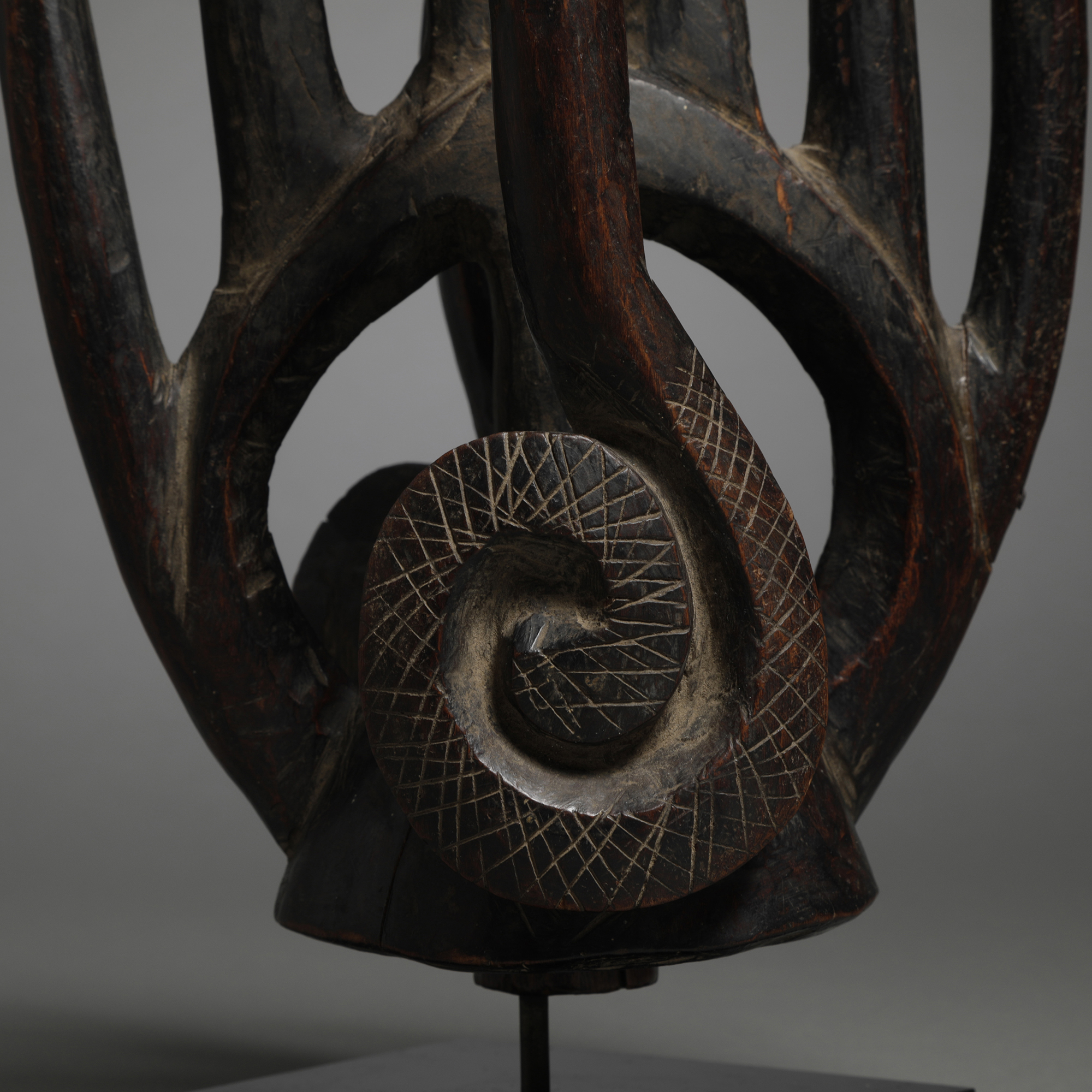
Nested within the ring, on both faces of the object, is a coiled serpent. The snake is the headdress's most charged element. Its body is rendered in dense, confident crosshatching — a pattern of incised lines laid at opposing angles across the coils — and it spirals inward from the ring's circumference to a raised head at the center. Among the Afo and related peoples of the Benue valley, the python carries connotations of the earth, of cyclical regeneration, and of powers that move beneath the surface of ordinary life. Here, encircled by spikes and held within a ring, the serpent is not threatening but contained — domesticated power, harnessed to the rhythm of the drum.
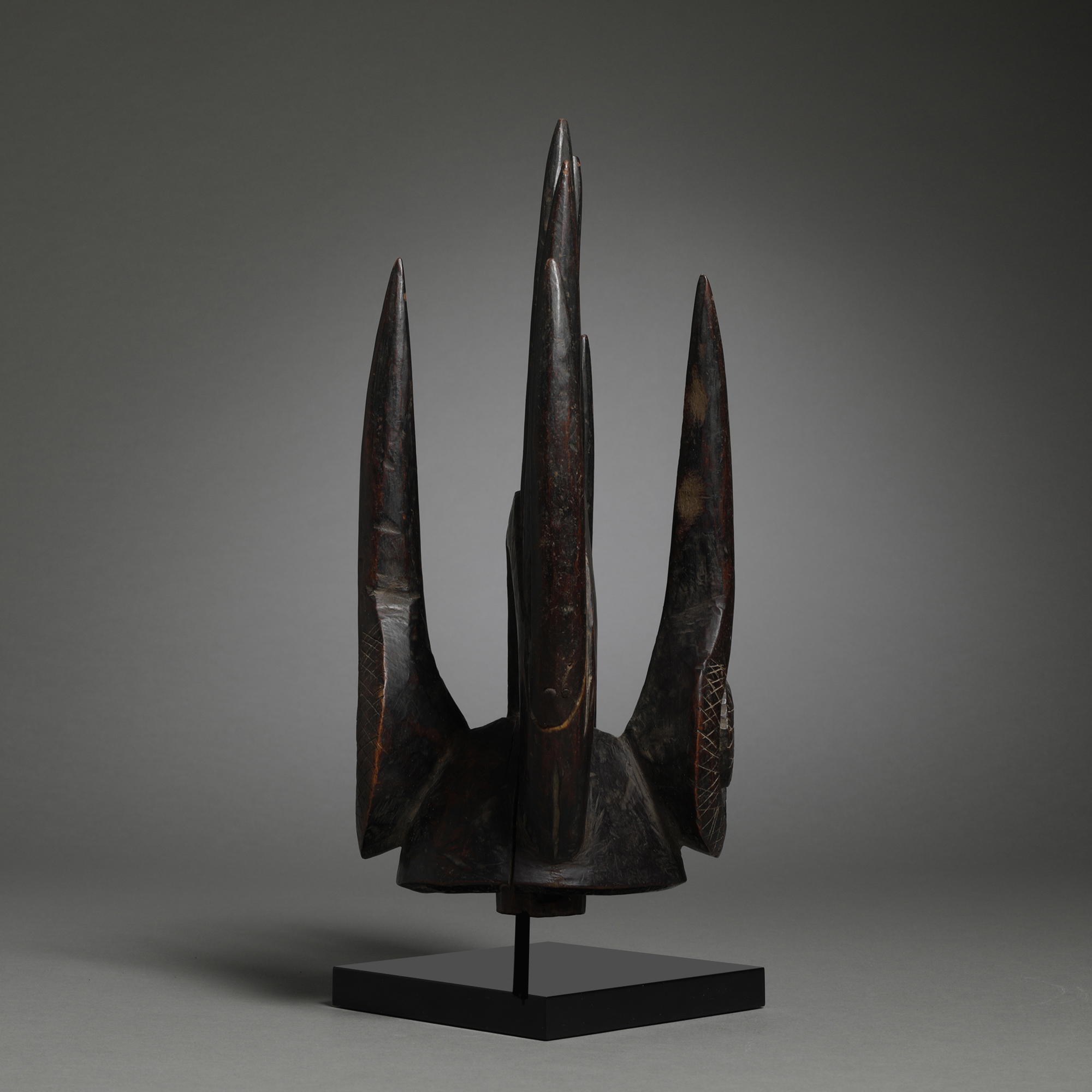
The rear of the headdress is equally resolved, with the central spike rising to its greatest height from between two flanking forms that carry the same hatched surface treatment as the serpent body, lending the back face a strict, heraldic quality. The patina throughout is deep and consistent — black with persistent reddish-brown undertones, built up from repeated applications of pigment and oil and worn to a subtle sheen at the spike tips and ring edge.
Few headdress types from Nigeria's Middle Belt command both the formal radicalism and the symbolic density of the ekpesi. This example, with its intact spikes, finely incised serpent, and excellent overall condition, represents the type at its most compelling.
This headdress comes from the collection of Stanley Marcus. Harold Stanley Marcus (1905 – 2002) was president and later chairman of the board of the luxury retailer Neiman Marcus in Dallas, Texas, which his father and aunt had founded in 1907.
PUBLICATION HISTORY
African Art in American Collections, 1989, Robbins & Nooter p. 282 illustration no. 734
Stanley Marcus, Dallas, Texas
Christie’s, New York, May 1995