Among the Zuni of the American Southwest, certain stones were understood to contain living spirits — not carved into being, but discovered, recognized, and then tended. A naturally occurring stone that suggested an animal form was itself already a fetish; the carver's task was simply to clarify what the stone already held. The bear, foremost among the six directional guardians of the Zuni world, was associated with the west, with healing, and with the most potent forms of protective medicine. A bear fetish was not an ornament; it was a presence, an ally, a living participant in the spiritual negotiations that sustained the individual and the community.
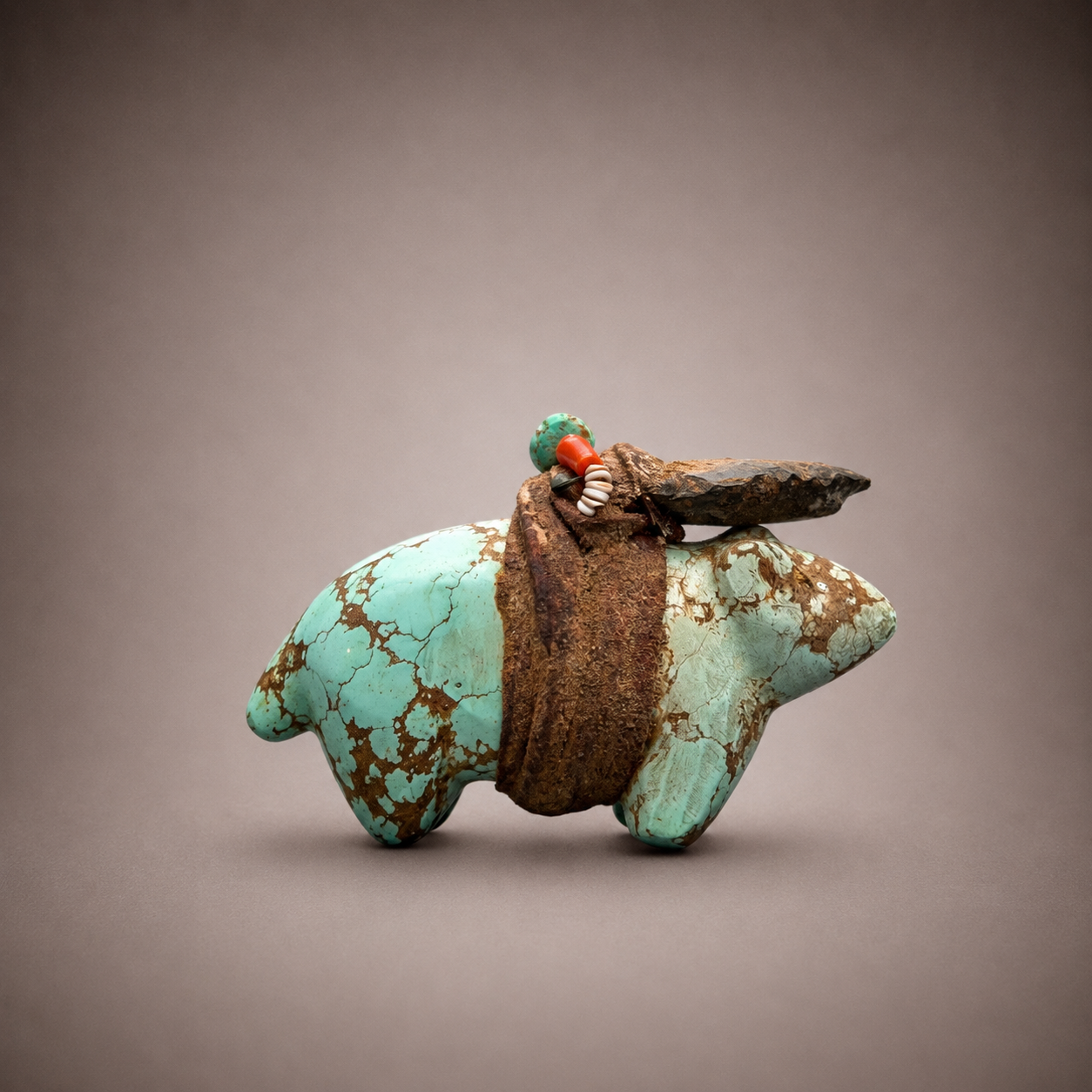
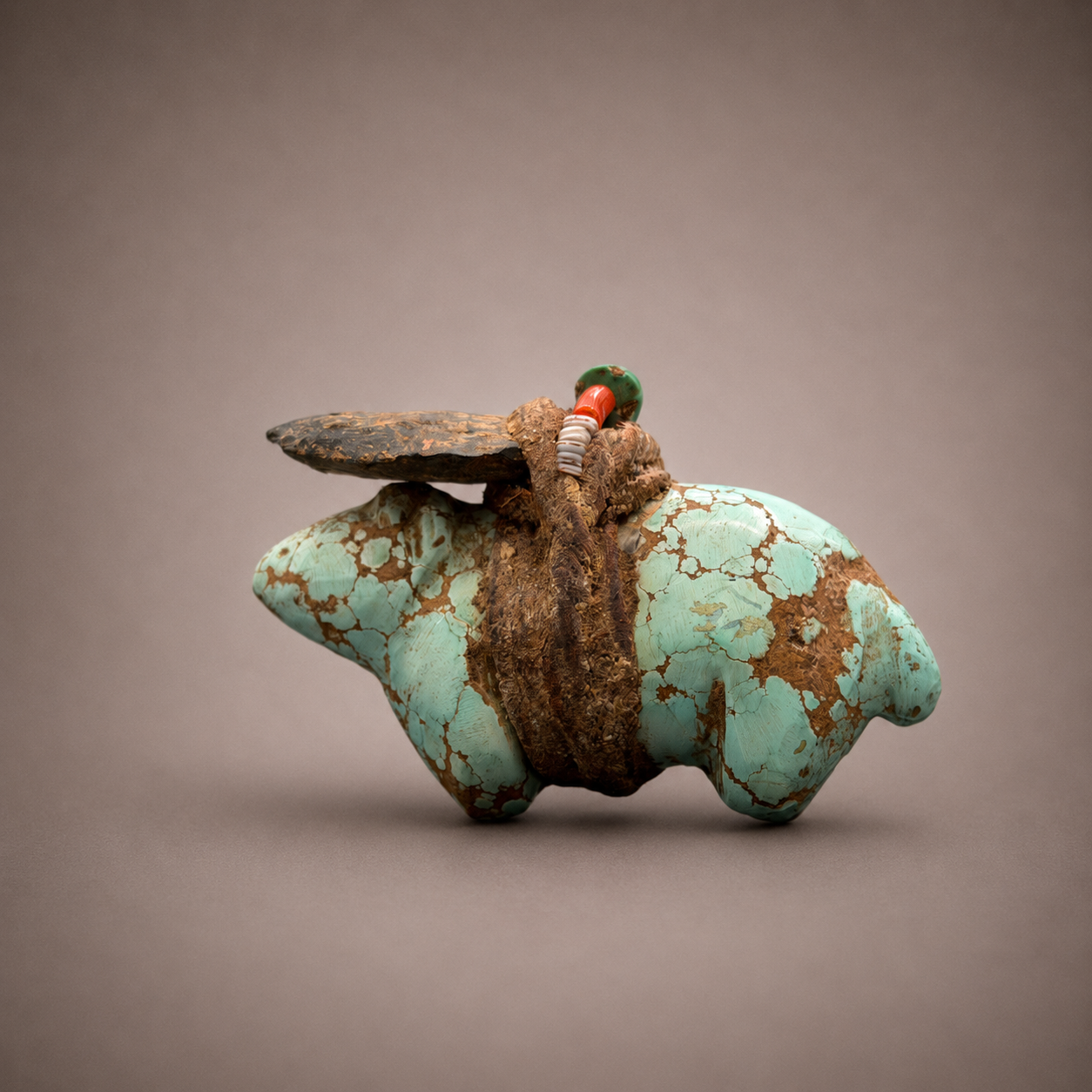
This bear fetish is carved from a piece of natural turquoise of exceptional character — a vivid sky-blue stone veined throughout with a dark brown matrix that the carver has incorporated rather than concealed, leaving the animal's dorsal surface in its raw, unworked state while smoothing and defining the body below. The effect is striking: the bear appears to emerge from the earth itself, its turquoise flesh rising from the matrix stone as though caught in the act of manifestation. The four legs are compact and grounded, the haunches low, the posture one of alert stillness. The head is minimal and essential — a presence rather than a portrait, as Zuni aesthetic sensibility demands.
Across the animal's back, lashed with fine sinew wrapping, lies a dark stone arrowhead — obsidian or chert, its surface oxidized and ancient — bound in the classic configuration of the empowered fetish. The arrowhead amplifies the bear's medicine, directing its protective force with the precision and intent of the hunter's aim. At the lashing point, a small medicine bundle has accumulated: a single orange coral or shell tube bead, a small turquoise or green glass bead, and fine white shell disc beads, all bound together with sinew — offerings made to the spirit within the stone, prayers compressed into material form. These bundles were built up over time, each addition representing an act of petition or gratitude, and their presence confirms that this fetish was actively used and tended across a significant period of its life.
Turquoise, coral, and shell — the three materials of this bundle — form the sacred color triad of Pueblo ceremonial life: blue-green for sky and water, red-orange for life and blood, white for breath and cloud. Their combination here is not accidental
John and Nancy Hyde Devoe, New York. Acquired circa 1960s-1970s