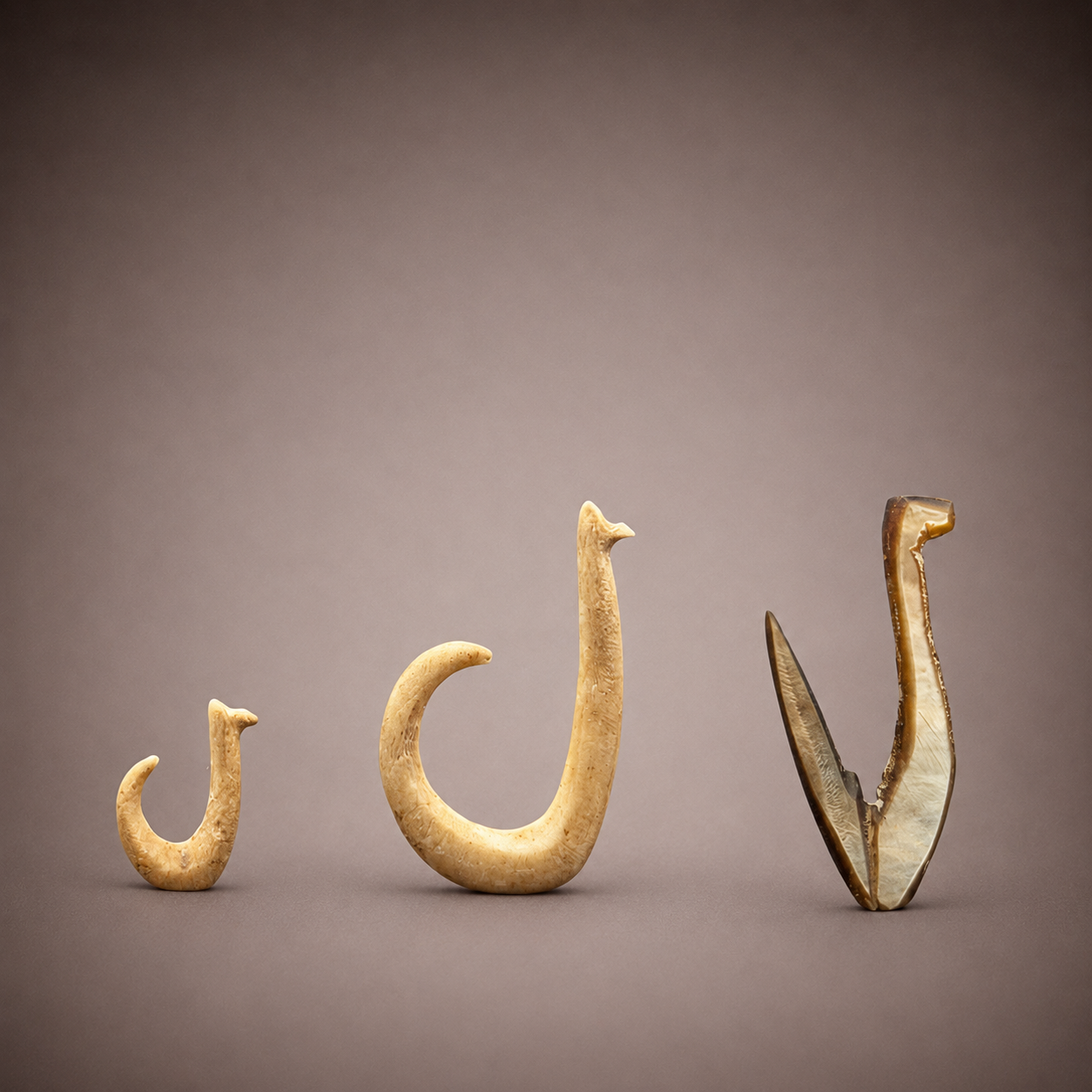
Three Fishhooks: Two Hawaiian (Makau) and One Solomon Islands Shell Hook
The fishhook is one of humanity's oldest and most universal tools — present in every culture that lived near water, adapted to every ocean's particular fish, current, and depth with the precision that survival demands. But in the Pacific, where the sea was not a boundary but a highway, the fishhook was also something more: a technology refined over millennia of open-ocean navigation, a form so successfully resolved that the finest examples achieve the visual authority of pure sculpture, and an object sufficiently valued that the best hooks were named, inherited, and offered to the gods before important fishing expeditions.
The Two Hawaiian Hooks (Makau)
The Hawaiian makau is among the most distinctive fishhook forms in the Pacific — its tall, nearly vertical shank, tight circular body curve, and precisely placed inward barb creating a silhouette that is instantly recognizable and formally unlike any other tradition's hooks. Both examples here follow this canonical form with fidelity: the long shank ascending to a small but sharply defined barb spur at the top, the body sweeping in a generous arc to a pointed tip that curves inward to close the gap. The larger of the two has a fuller, more open curve and a slightly more sinuous shank — the individuality of handwork within a shared form — while the smaller is tighter and more compressed, every element scaled down without loss of resolution.
Both are carved from bone — the material worked to a smooth, close surface that has aged to warm cream, the dense grain of the animal material providing its own subtle texture. At this scale — bait hooks, small enough to target the reef and nearshore fish that were taken in quantity for daily use and for the larger trolling rigs that pursued ahi and mahimahi in open water — the precision of the barb placement is remarkable: each spur exactly positioned to allow easy entry and prevent escape, the functional logic of the form thoroughly understood and faithfully executed.
In Hawaiian tradition the makau carried meaning beyond its practical function. Hook-shaped pendants in whale ivory and other precious materials were among the most significant personal ornaments in the chiefly repertoire; the hook form itself was associated with the demigod Māui, who fished up the Hawaiian islands from the ocean floor with a magical hook made from his grandmother's jawbone. To carry a hook, to make a hook, to fish with a hook well — all were acts that participated in a cosmological narrative older than memory.
The Solomon Islands Shell Hook
The third hook speaks an entirely different formal language. Cut from a single piece of Pacific shell — Trochus or large bivalve, its layered, iridescent interior surface visible along the inner faces — this is a V-form or rotating hook of the type characteristic of the Solomon Islands and wider Melanesian fishing tradition. Where the Hawaiian hooks are carved from bone in a single continuous curve, this hook is cut from flat shell plate into a two-armed form: a longer curved shank on the right terminating in an inward barb, and a shorter inner arm on the left creating the hook's functional gap. A small notch at the shank's upper tip accepted the fishing line.
The shell material was not merely practical — throughout the Solomon Islands and across Melanesia, shell was a substance of exchange value and social significance, used for currency, ornament, and prestige objects as well as for tools. A hook cut from Trochus or large oyster shell was an object in a web of meanings that extended well beyond the fishing grounds. The V-form's rotating action when a fish struck — the two arms pivoting against each other — was a functional refinement suited to the fast-striking pelagic fish of the Coral Sea.
Presented together, these three hooks compress an entire Pacific fishing world into a few inches of bone and shell: two traditions, two oceans, two formal solutions to the same ancient problem, each one perfect within its own logic.
Private UK collections