Among the Akan-speaking peoples of Ghana and Côte d'Ivoire, the system of brass goldweights — abrammuo — was one of the most sophisticated and culturally rich material systems ever devised for the measurement and exchange of gold dust. In use from at least the fourteenth century until the colonial disruption of the gold trade in the late nineteenth, these small cast-brass objects were the instruments of commerce and the repositories of proverbial wisdom simultaneously: every weight had a meaning, and many were made in the form of animals, objects, and human figures whose visual identity encoded a specific saying or moral precept that both parties to a transaction were expected to understand.
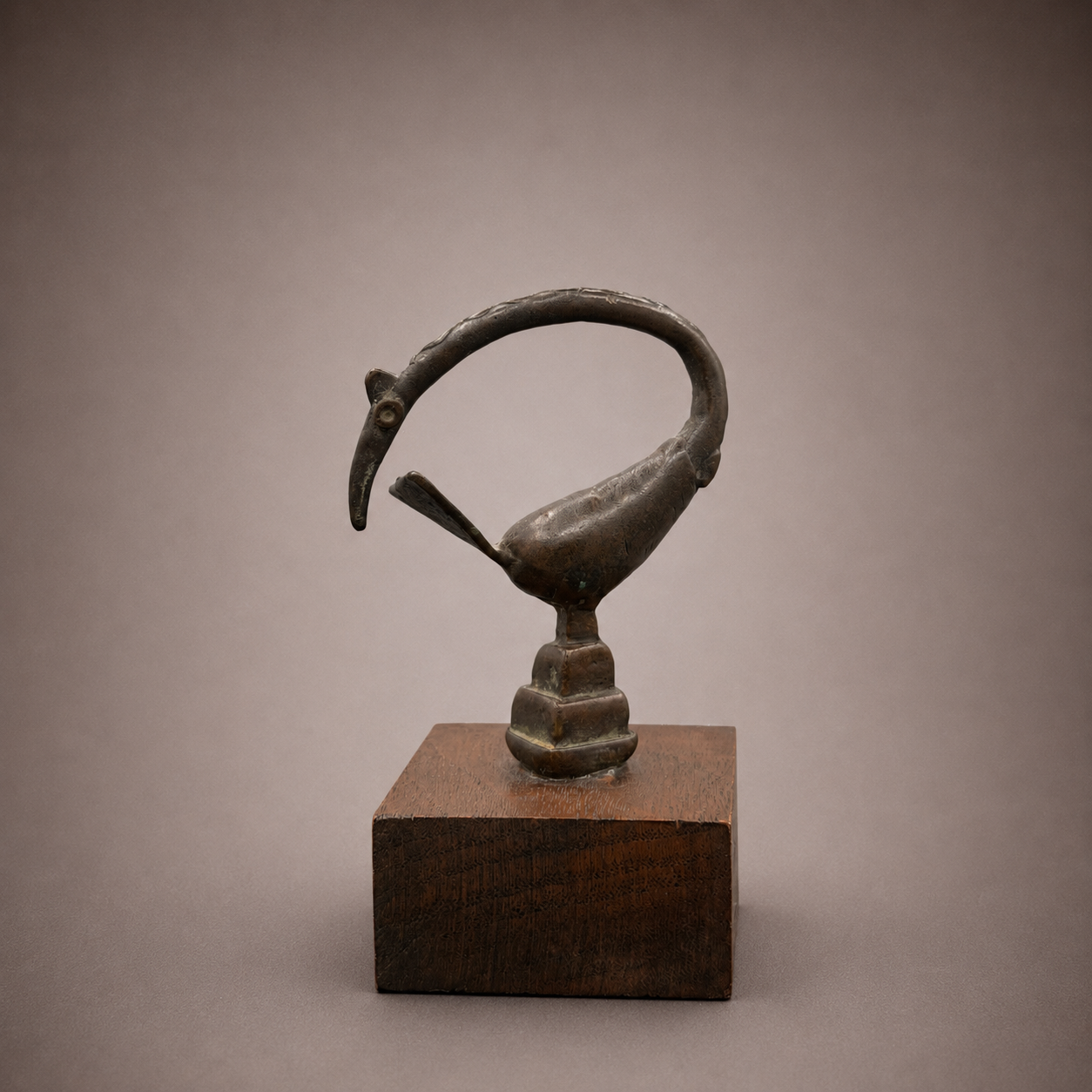
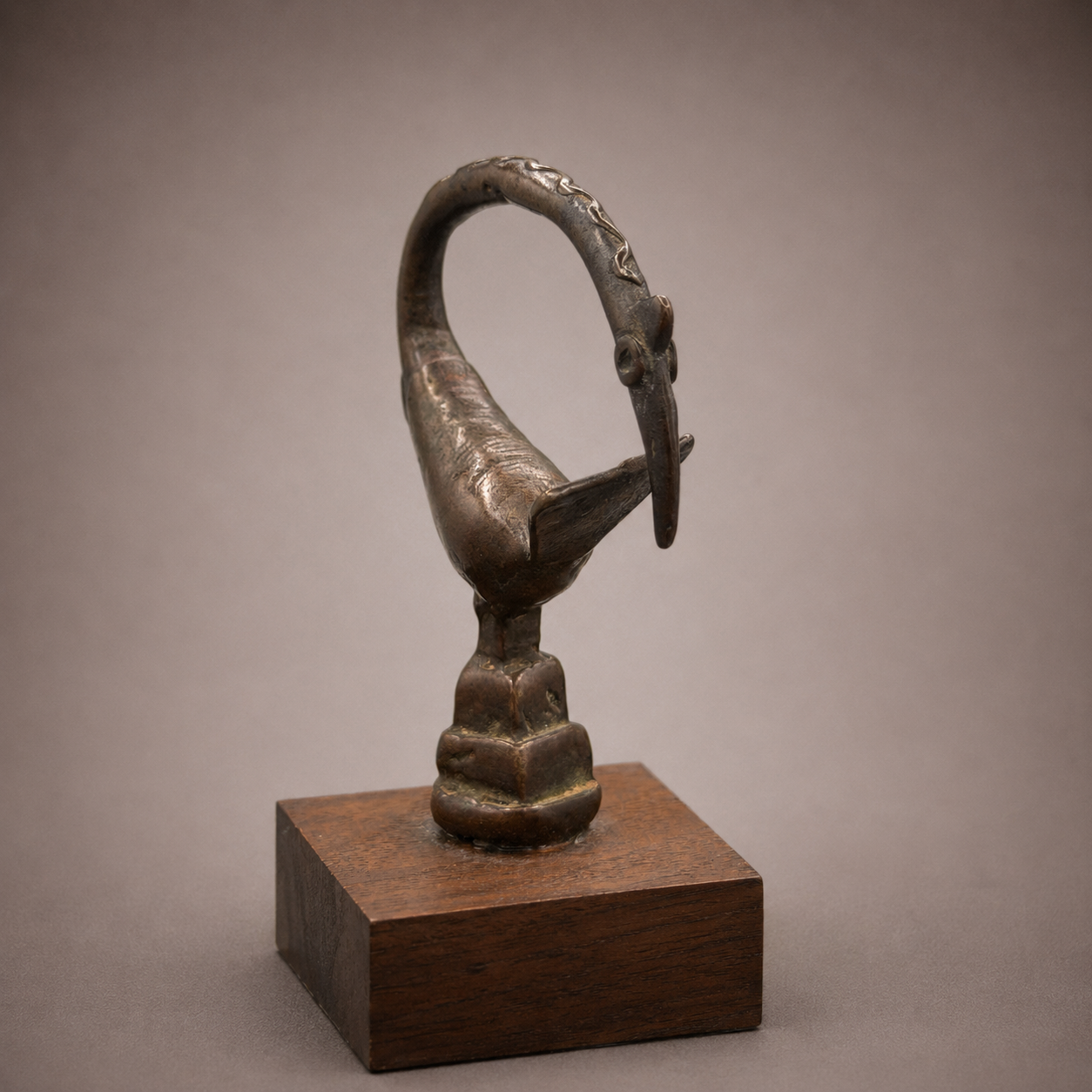
This hornbill weight is cast with the formal intelligence and sculptural confidence that distinguishes the finest Akan bronzes from the merely competent. The bird's long neck sweeps upward from the compact body in a full, graceful arc — curving back over itself so that head and beak face forward and down, the whole form contained within an ovoid silhouette that is satisfying from every angle. The long, downward-curving beak is the hornbill's defining feature and the source of its proverb: in Akan tradition, the hornbill was associated with patience, foresight, and the willingness to look downward — to attend carefully to what lies beneath the surface of things. A trader who used this weight signaled something about how he understood his own practice.
The neck and body carry fine incised or cast linear decoration rendering the feathering with naturalistic delicacy — a level of surface attention that goes well beyond functional necessity and speaks to a maker who took pleasure in the full resolution of form. A tiny raised boss with a drilled center serves as the eye — minimal, precise, and entirely alive. Below the body, a stepped three-tiered square plinth — cast as part of the single lost-wax pour — elevates the bird with the same architectural dignity given to prestige objects across the Akan world.
The patina is deep and even: a warm dark brown with traces of verdigris in the deepest recesses of the incised decoration, the surface of old brass that has spent long years in use and handling. The casting itself is crisp and clean — evidence of a skilled founder working within a tradition that had refined the lost-wax process to a high art across many generations.
Irena Corwin. Irena Corwin was a ballet dancer and actress who later became a jewelry designer in New York in the 1960s and 1970s. She went to Europe to acquire objects to incorporate into her jewelry.