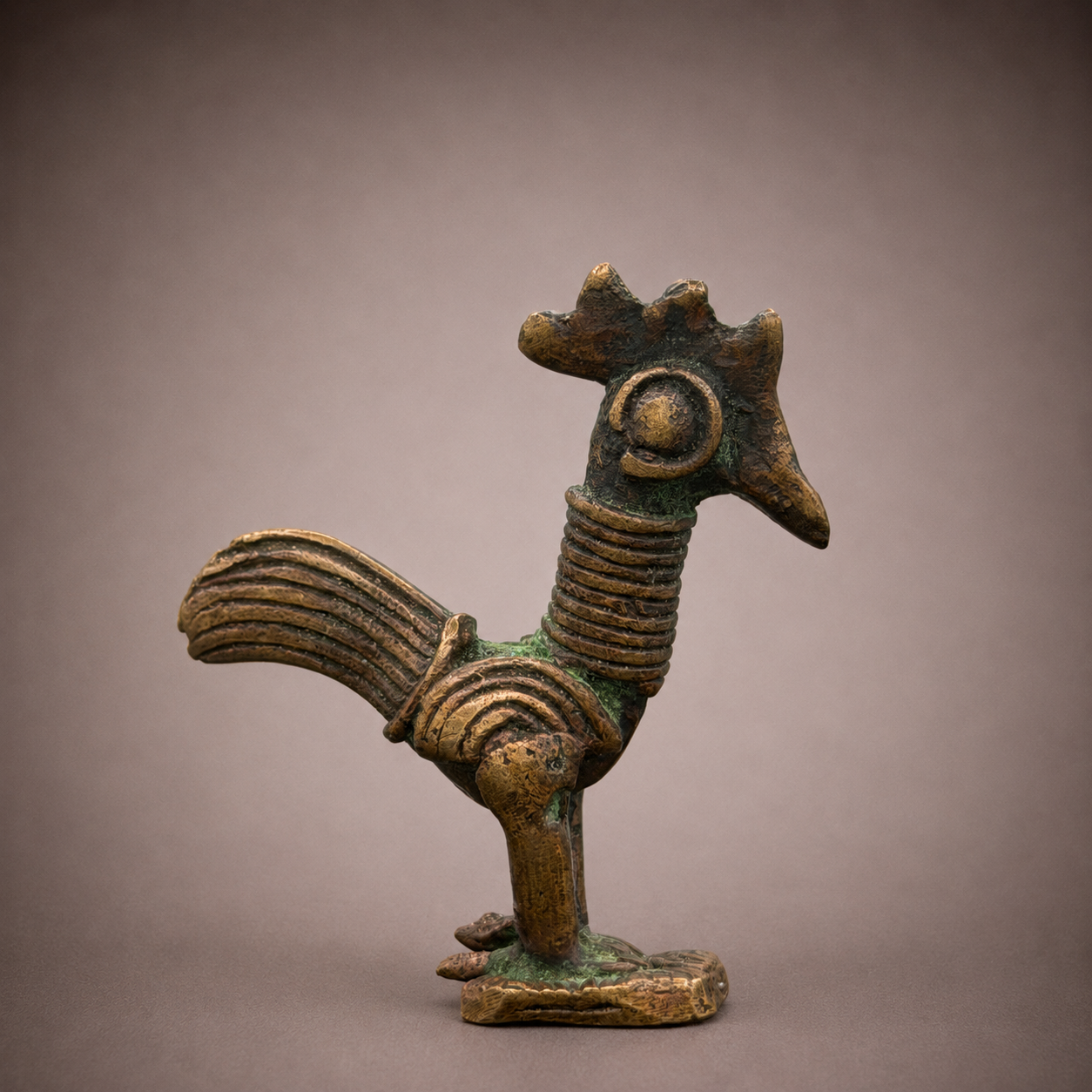
The rooster (kokoo) was one of the most symbolically loaded birds in the Akan proverbial universe, and among the most frequently rendered in brass. Its crow announces the dawn before the sun is visible — a proclamation of what is coming before it arrives. The Akan proverb most commonly associated with the rooster weight encodes this precisely: Kokoo — the rooster crows not because it has seen the sun, but because it knows the sun is coming. A trader who placed this weight on the scale communicated something about his own nature: that he acts on knowledge and foresight, not merely on what is already obvious to everyone.
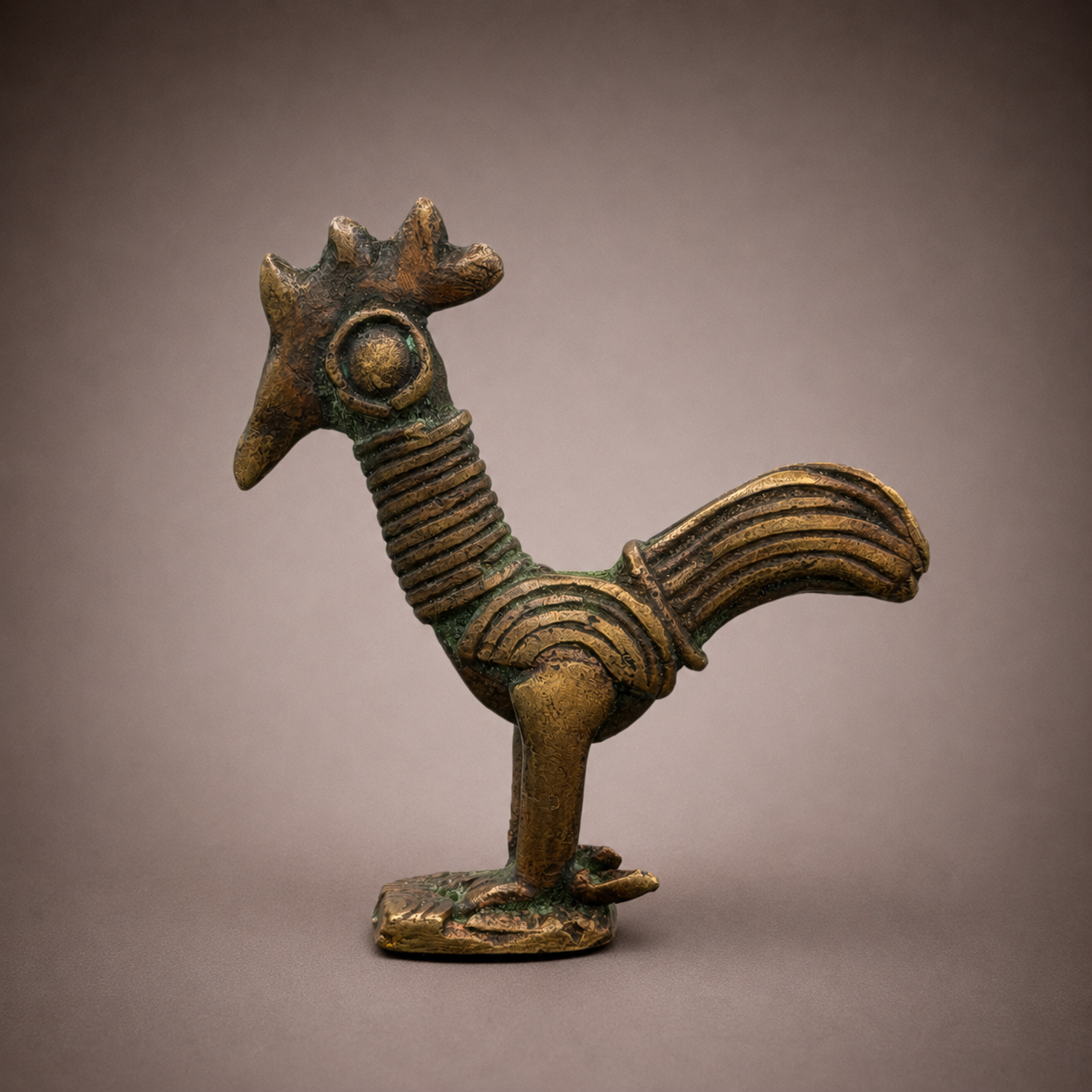
This rooster weight is among the most fully realized examples of the form. The bird stands in a posture of full alert display — chest forward, head raised, tail swept high — cast with a confident understanding of the animal's essential gesture that goes well beyond mere identification. The serrated comb erupts from the crown in a bold starburst of points; the beak projects forward at the precise angle of a bird in mid-crow; the fanned tail rises in a cascade of parallel ridges, each feather a bold raised rib that catches light along its full length.
The neck is the casting's most inventive element: encircled from base to head by a series of tightly spaced horizontal coils that give it the appearance of a spirally wound collar — a treatment that transforms the bird's anatomy into something simultaneously naturalistic and formally abstracted, suggesting both the physical neck and the idea of ornament, of prestige marking, of a bird that wears its status visibly. At the junction of neck and body, a bold scroll or volute anchors the composition at its center of gravity. The eye is a raised spherical boss set within a cast ring — a small but exact detail that gives the face its alert, watchful quality.
The base is an irregular oval plinth, textured to suggest ground, the feet clearly articulated with individual toes gripping the earth — the rooster not posed but planted, present, occupying its territory with the assurance of the proverb it embodies.
The patina is exceptional and has developed over a long period into a rich two-tone surface: warm golden brass glowing on every raised ridge, every coil, every feather tip and comb point — the metal burnished by handling to its original color — while deep verdigris green has settled into the recesses and body surfaces, the natural oxidation of old brass in a humid tropical environment. The contrast between gold and green gives the weight the visual complexity of a painting, the two tones working together to describe form and depth simultaneously.
Irena Corwin. Irena Corwin was a ballet dancer and actress who later became a jewelry designer in New York in the 1960s and 1970s. She went to Europe to acquire objects to incorporate into her jewelry.