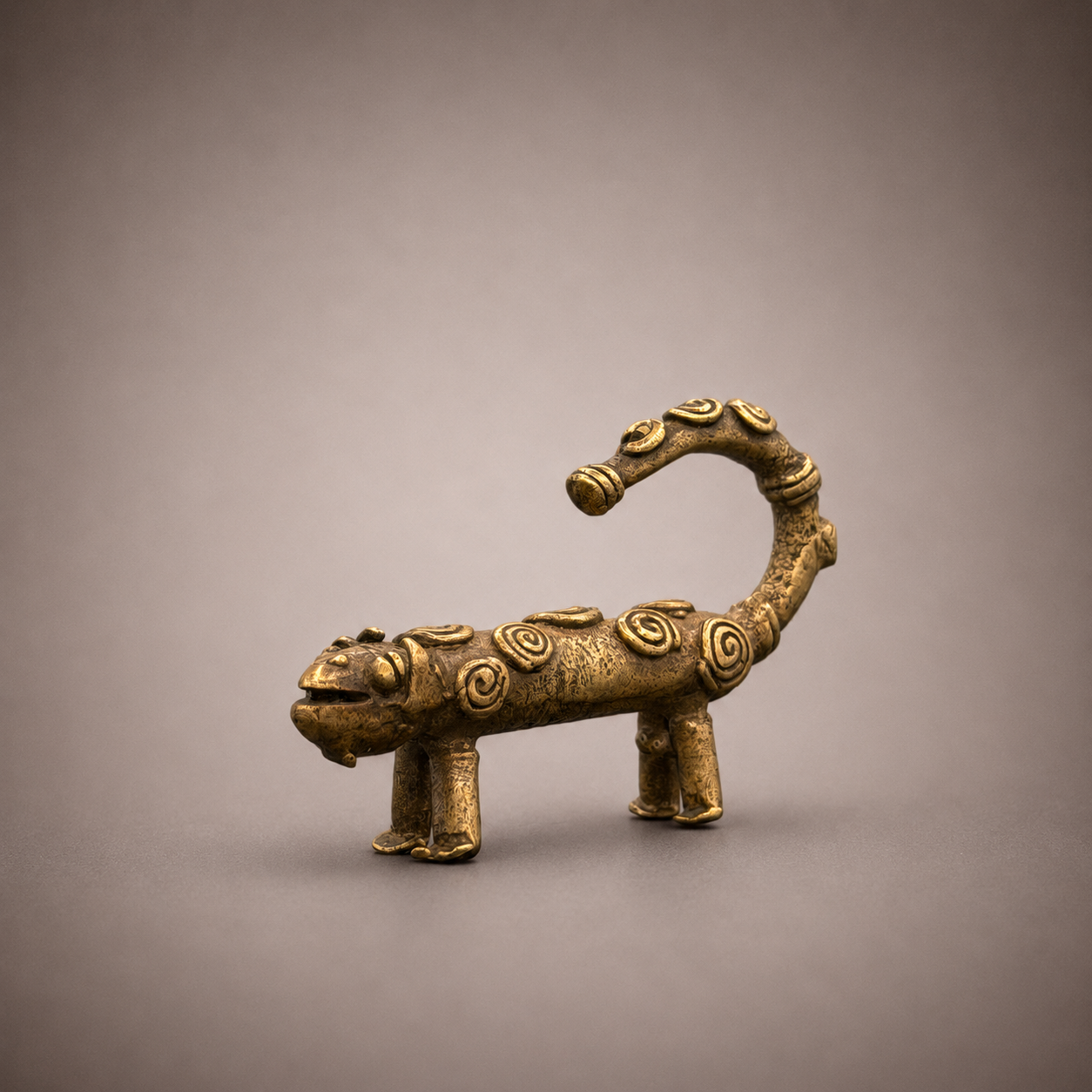
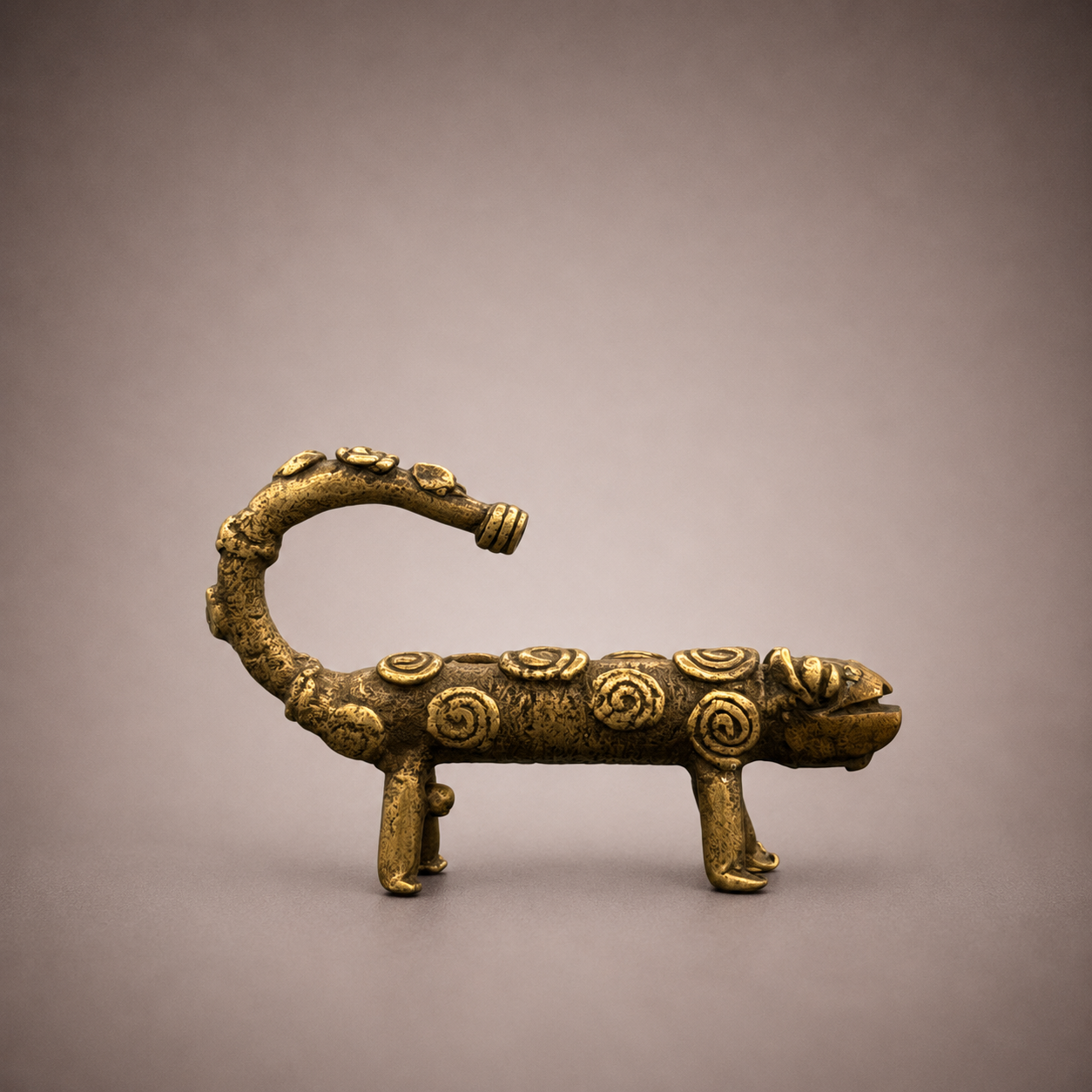
The monitor lizard — the great Varanus niloticus of the West and Central African riverbanks and forest margins — was a creature that occupied an uneasy place in the Akan imagination. Large, deliberate, armored, and ancient-seeming, the monitor moved between water and land with the unhurried assurance of an animal that has no natural predators of consequence. It was associated in Akan proverbial thought with patience, with the careful survey of terrain before action, and — through its name's phonetic proximity to owuo, death — with the crossing of thresholds that cannot be uncrossed. A weight in this form carried weight in more than the literal sense.
This monitor lizard is cast with a keen observational fidelity to the animal's essential character. The body is compact and powerfully cylindrical, raised on four substantial columnar legs that give the creature a convincingly terrestrial, ground-owning posture — the monitor's characteristic deliberate stride, each foot placed with intention. The wide, flat head is turned forward with the animal's characteristic blunt-nosed calm, two large hemispherical eyes set laterally on the skull exactly as anatomy demands, flanking a closed, composed mouth. This is not a threatening animal but a watching one — present, patient, taking the full measure of its surroundings before committing to any movement.
Across the body and continuing up the length of the sweeping tail, raised spiral bosses punctuate the surface at organic intervals — six or more on the body, three or four on the tail arc — each a tightly wound concentric coil that describes simultaneously the monitor's scaled, textured skin and the deeper Akan symbolic vocabulary of the spiral: cyclical time, the coiling python, the life force that returns to its own beginning. Between the bosses, the body surface is worked in a fine granular texture that provides a warm, matte ground against which the polished spirals read with crisp golden clarity.
The tail is this weight's most distinctive formal feature, differentiating it clearly from the crocodilian type. Where the crocodile's tail curls tightly back over its own body in a contained arc, this monitor's tail sweeps upward in a broader, more open curve — reaching for height rather than containment, the arc generous and self-assured. Additional spiral bosses punctuate the tail's length, and a rounded terminal knob closes the composition at the apex. The result is a silhouette that reads from across a room: horizontal body, vertical tail, the two axes in dynamic tension.
The patina is a warm, even golden brass — the metal enriched by years of handling to a tone that reads in certain lights as almost honey-colored, the textured ground darkening to provide relief and depth against the polished high surfaces.
Irena Corwin. Irena Corwin was a ballet dancer and actress who later became a jewelry designer in New York in the 1960s and 1970s. She went to Europe to acquire objects to incorporate into her jewelry.