The gope — flat, oval spirit boards carved and painted by the peoples of the Papuan Gulf — are among the most iconic objects produced anywhere in the Pacific. They are not merely beautiful; they are inhabited. Each board houses the captured soul of an enemy slain in battle, a force (imunu) that the owning clan could direct toward protection, fertility, and the amplification of power in war and the hunt. Kept in the men's ceremonial house (eravo), hung above the doorway or propped upright along the walls, gope were fed, addressed, and renewed with fresh pigment before important undertakings. They were, in the most literal sense available to their makers, alive.
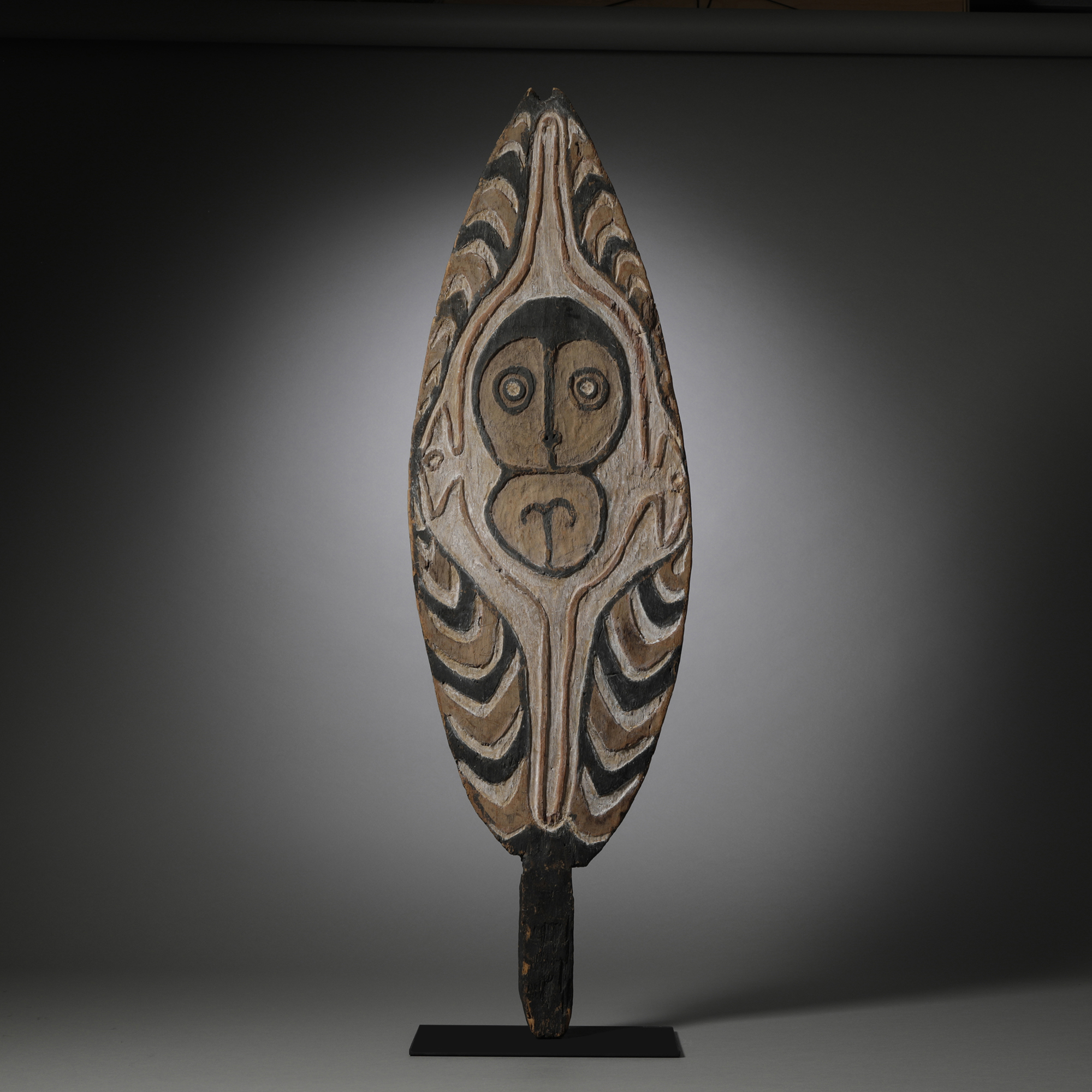
This example from Urama Island presents the form at its most commanding. The board is large — a full leaf- or canoe-shaped oval, pointed at crown and base — and its painted surface has retained exceptional color and compositional integrity across what is clearly a considerable span of years. The palette is the classic Gulf triad: white from burned lime, reddish-brown from iron ochre, and black from charcoal, applied in flat fields and fine outlines that together achieve a visual complexity far beyond their material simplicity.
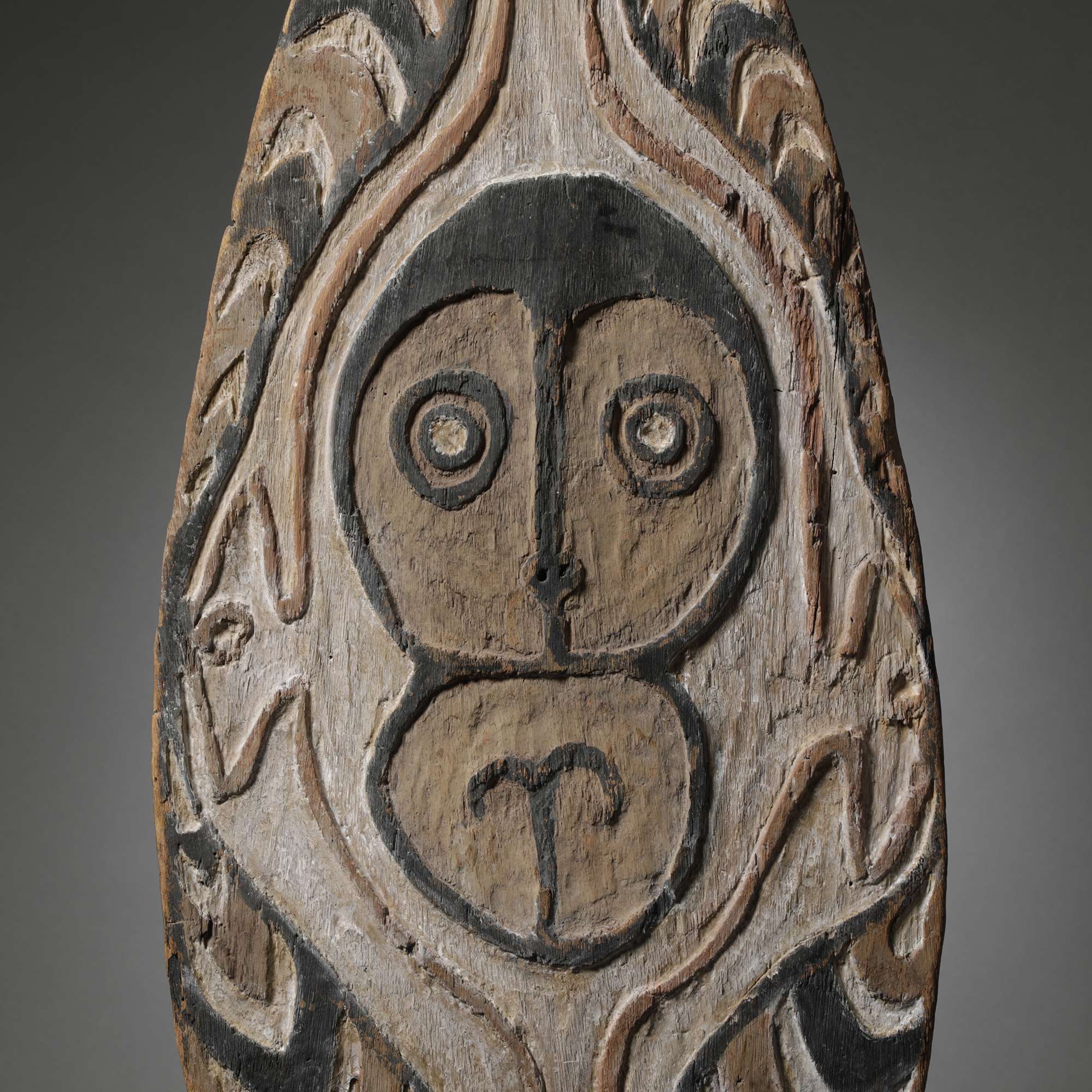
At the center of the composition, framed within a luminous white oval field, the spirit face looks outward. It is rendered as two lobed forms stacked vertically — the larger upper circle the head, the smaller lower lobe the chest or body — in warm reddish-brown, with two round eyes whose white pupils catch and hold the viewer across the decades. The nose is lightly indicated; below it, the chest lobe carries a small curved projection suggesting a mouth or chin. The face is simple and absolute. It does not invite interpretation so much as acknowledgment: something looks back.
From this central face, white curvilinear lines extend upward and downward along the board's vertical axis, tracing the organic logic of leaf veins or river channels toward the pointed terminations of the form. Flanking the central panel on both sides, the field is filled with tightly nested arc bands in reddish-brown outlined in black — a pattern that reads as ribs, as water, as the scaling of a crocodile, as the layered energies of a contained force pressing outward against the board's edge. The technical execution is confident and assured, the bands laid with a control that speaks to a painter working within a long-practiced tradition.
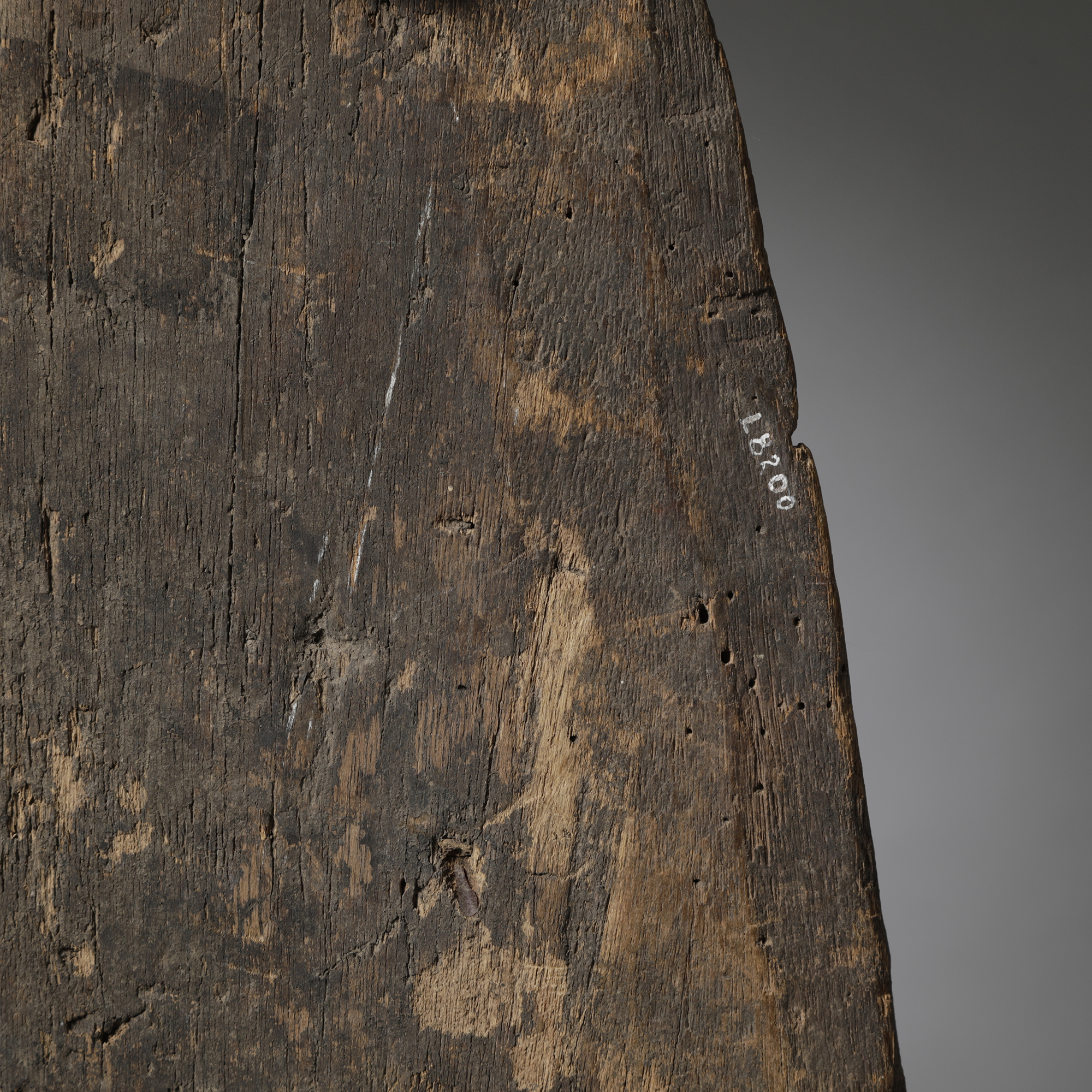
The reverse is unpainted and deeply patinated — dark, dry, and pitted throughout with the channels of wood-boring insects, a testament to the board's age and to the humid environment of the Gulf in which it spent its active life. An old iron wire repair at the upper back binds a longitudinal crack, and a painted collection number — consistent with early Australian or European institutional numbering — confirms a collecting history that predates the modern market. The handle, through which the board was thrust into the ground or held upright in ceremony, survives intact. When purchased, a later coat of paint was professionally removed to reveal the original surface.
Old collection number L8200 on reverse.
Karl Stirner (1923 - 2016), Pennsylvania, USA