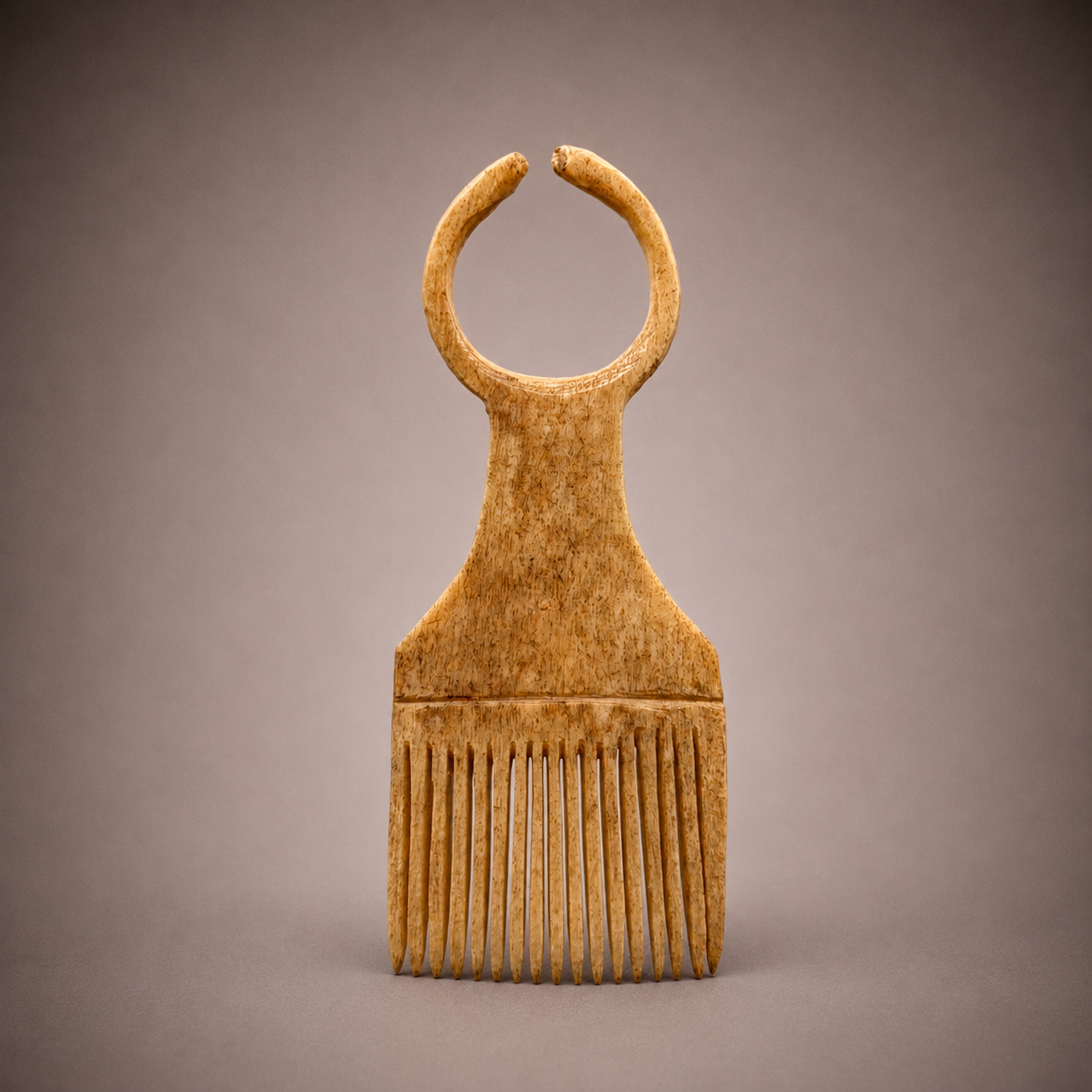
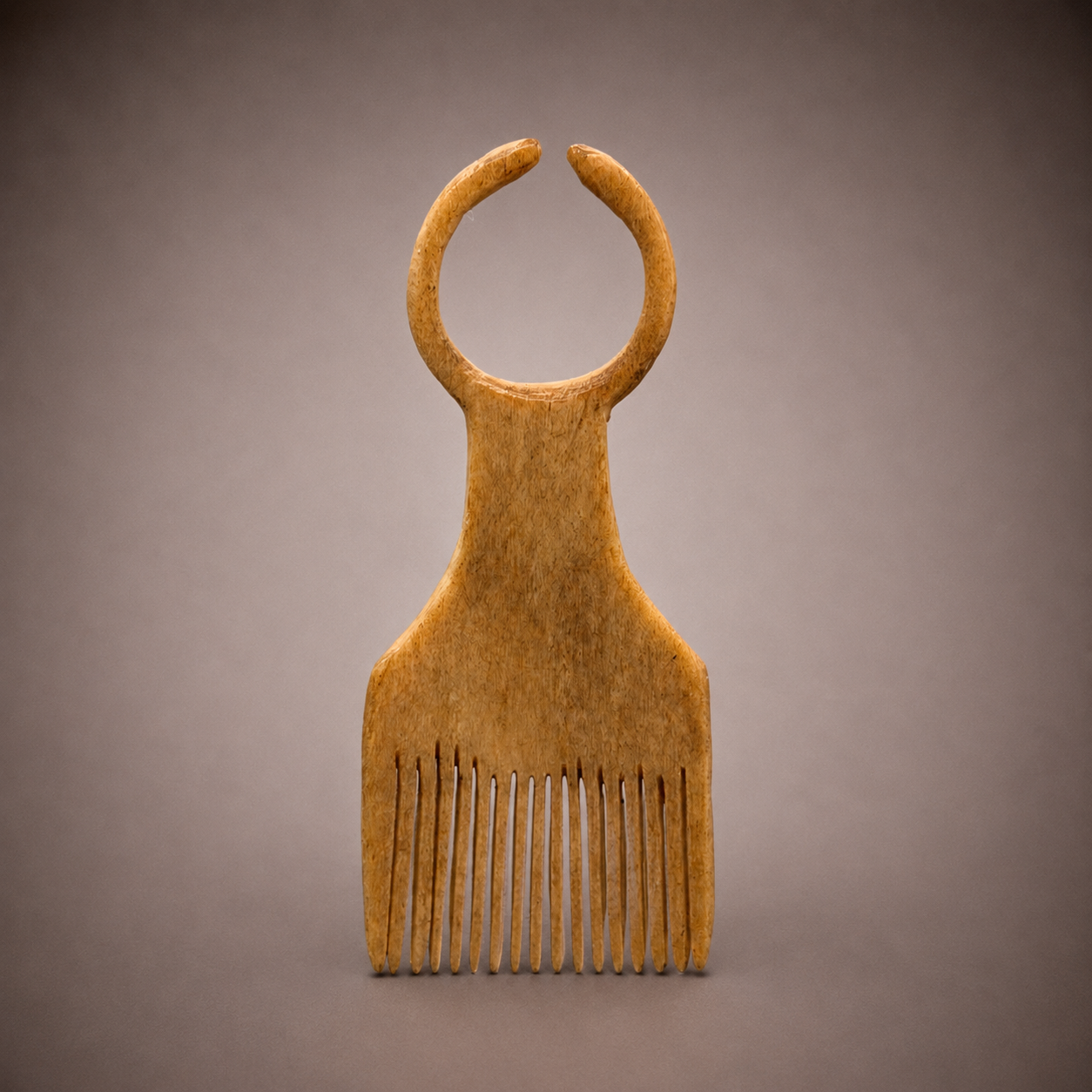
Personal grooming in the Arctic world was not vanity but social practice — the careful arrangement of hair, the maintenance of clothing, the attention to one's own appearance within the community were expressions of self-respect and of respect for those around you, values as central to Inuit and Yup'ik social life as any other. The objects made for this purpose were accordingly made with care, and this small ivory comb is no exception.
Carved from a single piece of walrus ivory or caribou antler — the material warm cream-yellow, its internal structure visible as a beautiful mottled pattern of amber-brown flecks that give the surface a vitality no manufactured object could replicate — the comb is resolved in three zones that together constitute a complete and elegant object. At the base, approximately 20 evenly cut teeth of consistent width and graduated length perform the object's practical function with the precision that daily use demanded: the gaps between them clean, the tips rounded, every tooth intact after what may be well over a century of existence. A fine incised horizontal line marks the boundary between tooth zone and body, a structural articulation that also reads as a quiet decorative statement — the maker's acknowledgment that even a comb deserves a moment of formal attention.
The body above is a plain trapezoidal panel, its surfaces undecorated, allowing the natural beauty of the material to carry the visual weight. And it does: the speckled, mottled pattern of the ivory or antler reads across the surface like a map of the material's own interior life — the record of growth and time encoded in the structure of the animal's tooth or horn, now made visible by the carver's thinning of the piece to its working dimensions.
At the crown, a fully three-dimensional circular loop rises from the body — the ivory worked in the round to create an open ring through which a sinew cord could pass, keeping the comb suspended from the owner's clothing or belt pouch, accessible at any moment. The loop's two terminal tips rest against the body with a slight organic irregularity that is the mark of a hand-carved object rather than a manufactured one. This small detail — the imperfect perfection of the loop — is what finally confirms the object's humanity: it was made by someone, for someone, with the particular attention that small personal objects attract when they are meant to last.
Seward Kennedy, London and New York