Among the Shona of Zimbabwe, the headrest (mutsago) was one of the most intimate objects a person could own. Used nightly to support the head during sleep, it was also the instrument through which the sleeper maintained contact with the ancestral world: Shona belief holds that the most significant communications from the vadzimu — the ancestral spirits — arrive through dreams, and the headrest was the physical threshold across which those dreams were received. A man's headrest was buried with him at death, or passed to a favored heir as an object charged with accumulated personal and ancestral power. It was never simply furniture.
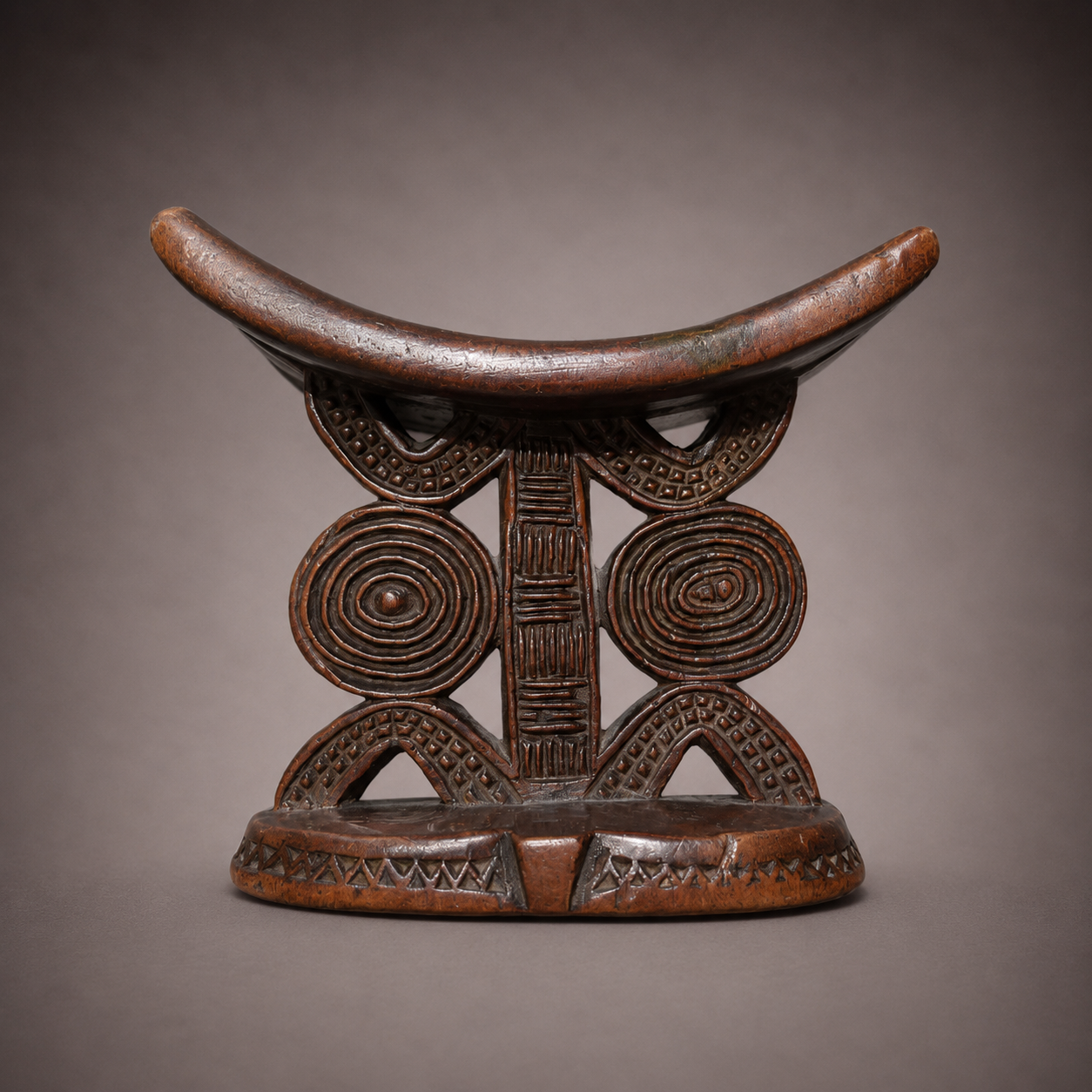
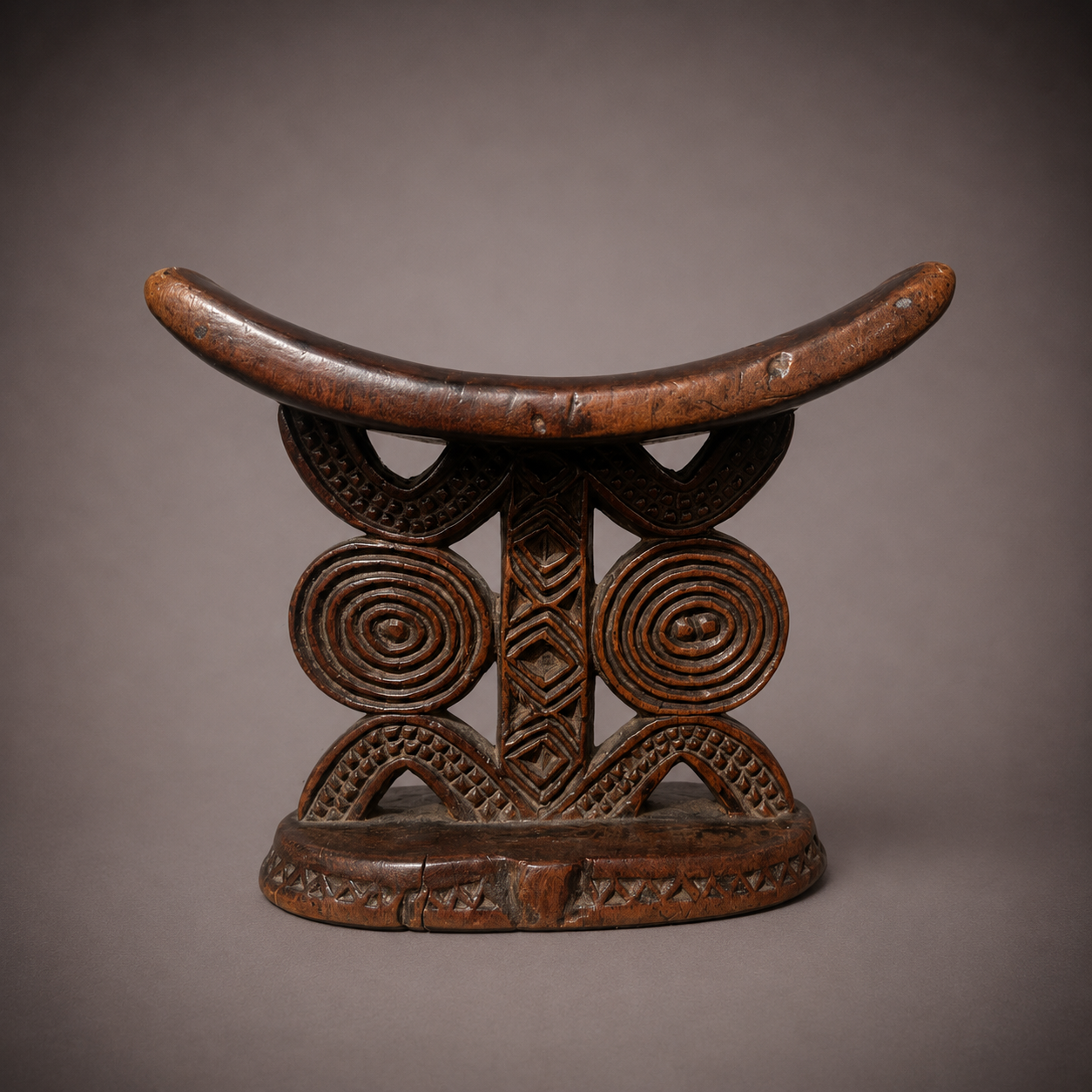
This example achieves the full formal ambition of the Shona headrest tradition. The crescent platform is generous and precisely curved — a smooth, rounded D-section arc that would have cradled the neck with exact comfort, its surface worn to a deep, even patina by long nocturnal use. No carver decorated the crescent itself; its eloquence is entirely in its form, in the confident sweep of the curve and the quality of the wood beneath the hand.
Below the crescent, the central support column rises from a broad oval base through three distinct decorative registers of exceptional refinement. The uppermost zone flanks the column with paired crescent-shaped lobes densely covered in fine stippled dotwork — a texture that catches raking light and creates a field of quiet visual vibration against the smoother surfaces on either side. The central and dominant zone is commanded by two large concentric circle motifs projecting laterally from the column, each spiraling inward through five or six tightly incised rings to a small raised boss at the center — the chirango or coil motif that is the most characteristic element of the finest Shona carving, evoking simultaneously the coiled snake, the unfolding of time, and the spiral logic of ancestral connection. The column itself, between and behind the circles, carries registers of parallel horizontal lines, diamond chain patterns, and lozenge forms — each face slightly varied, the mark of a carver at ease within a tradition he has thoroughly internalized.
The lower register bridges column and base through paired arched forms filled with further dotwork and chevron incision, and the oval base itself is edged with a continuous running border of small opposing triangles — the njuzu teeth pattern that appears on the finest Shona objects as a marker of completeness and protective intent. The base surface shows the smooth, dark compaction of long contact with sleeping mats and earth floors.
The patina throughout is the object's most eloquent testimony: warm reddish-brown deepening to near-black in the incised channels, the high surfaces polished by decades of handling to a silky, living sheen. This is a headrest that was used, and used well, across a long life.
Ben Hunter, London
Private Collection, USA