ZULU PEOPLES, KWAZULU-NATAL, SOUTH AFRICA
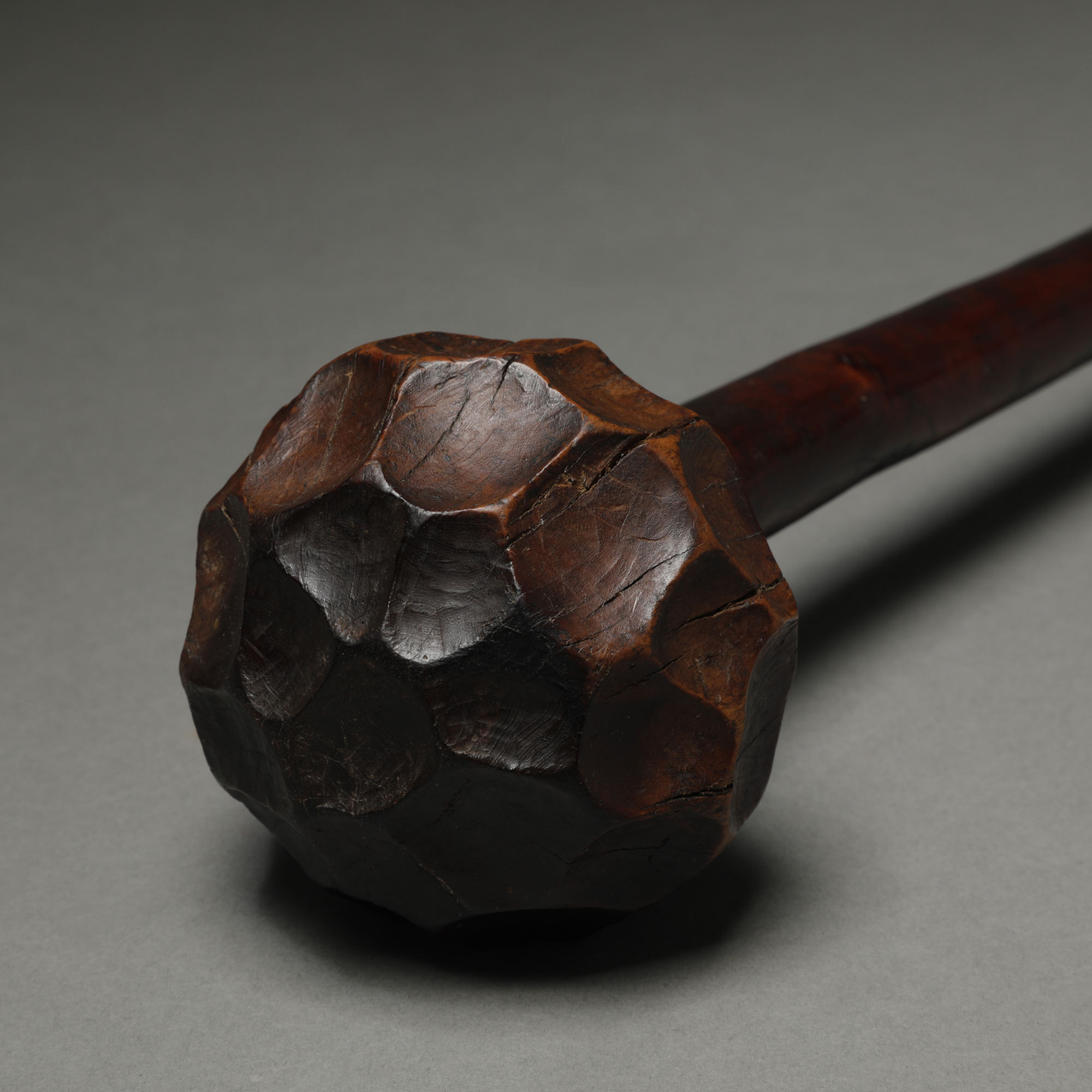
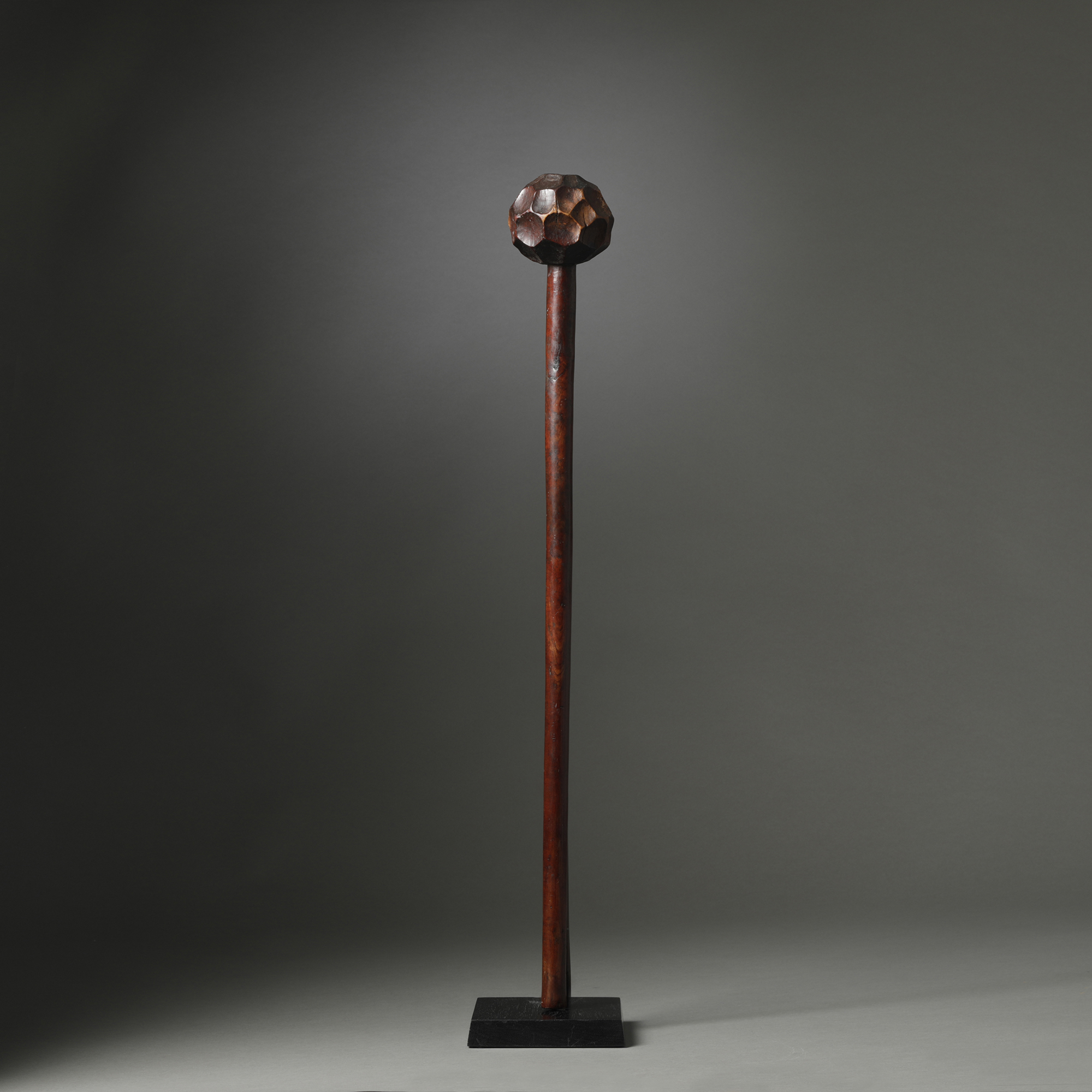
An exceptionally elegant North Nguni knobkerrie, distinguished by its boldly sculpted head, refined proportions, and remarkable economy of form. Rather than the more familiar spherical or bulbous terminal, the head has been carved into an elongated, fruit-like form, its two broad, convex surfaces meeting along a sharply defined central ridge. Rising to a gently pointed apex, the head recalls the fruits and seedpods of the southern African landscape, its swelling, organic volumes articulated with an almost architectural precision.
The sculptural sophistication of the piece is particularly evident in the transition from the slender cylindrical shaft to the broad, flattened head. The pronounced longitudinal ridge, extending toward the pointed extremity, imparts a sense of tension and movement, while the smooth, subtly swelling surfaces soften the otherwise rigorous geometry. Viewed from different angles, the head alternates between a broad, almost leaf-like silhouette and a narrow, blade-like profile, creating a striking interplay of light and shadow. This transformation of an organic, seemingly natural form into a carefully balanced geometric composition reveals the carver's exceptional sensitivity to volume, symmetry, and proportion.
Knobkerries were traditionally carried by men among the Nguni-speaking peoples of southern Africa, serving as weapons, emblems of personal identity, and expressions of status. Although fundamentally utilitarian, certain examples were conceived with a degree of refinement that elevated them well beyond their practical function. The distinctive flattened and ridged head of the present example suggests an intimate observation of natural forms, its possible botanical inspiration expressed through an unusually restrained and abstract sculptural vocabulary.
The surface displays a particularly attractive patina, its warm reddish-brown tones deepening to near black along the ridges and recessed areas. Subtle variations in color, together with fine traces of handling and wear, accentuate the underlying grain and contribute to the object's quiet sense of age and intimacy.
With its commanding silhouette, extraordinary restraint, and harmonious balance between organic inspiration and geometric precision, this knobkerrie exemplifies the sculptural ingenuity of North Nguni woodcarving. Devoid of applied decoration, it achieves a remarkable expressive power through proportion and the subtle articulation of its surfaces alone. Its distinctive head, at once suggesting a ripened fruit, a pointed seedpod, and a carefully faceted abstract volume, transforms a traditional implement into an object of exceptional sculptural elegance.
Private New England collection