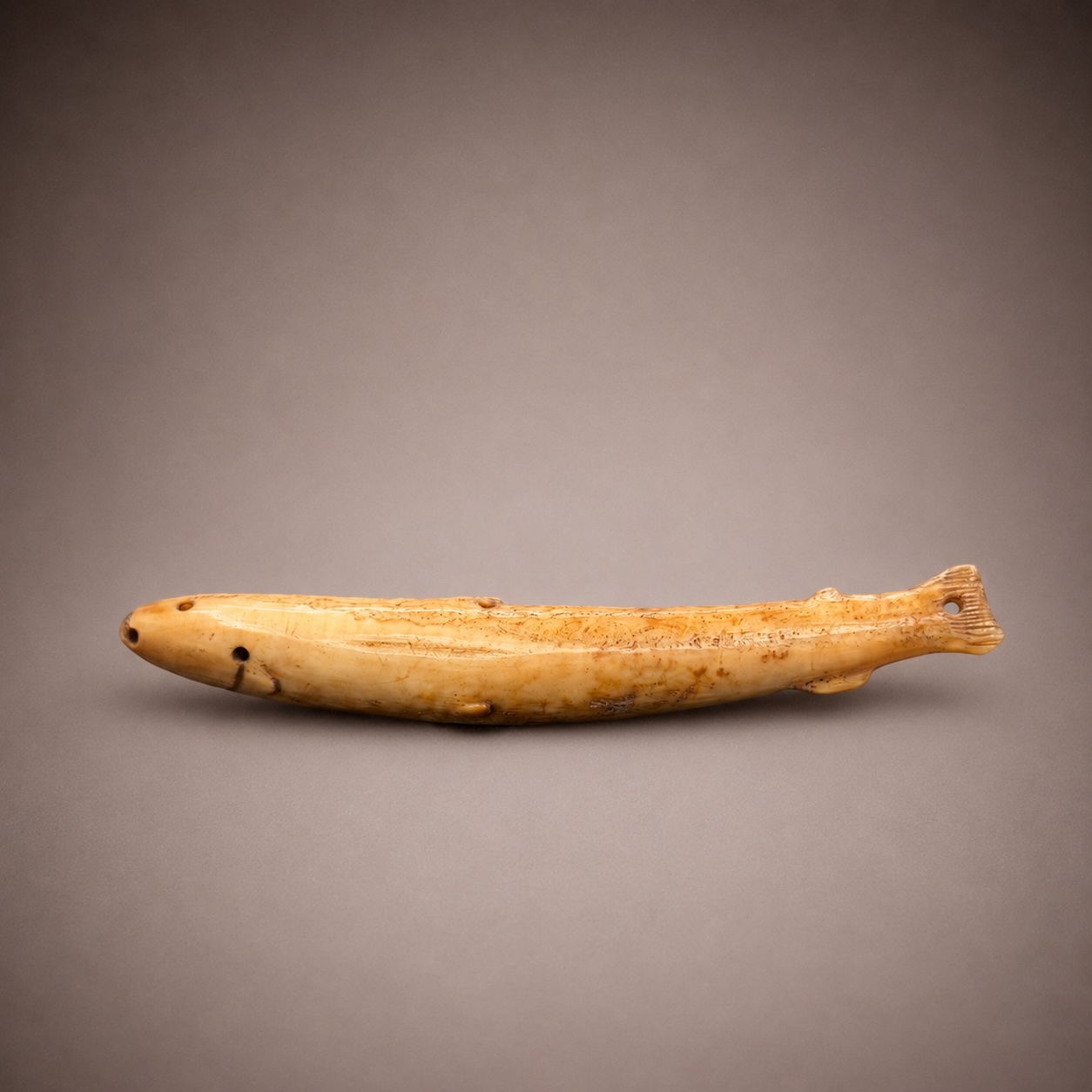
Ice fishing on the rivers and coastal waters of the Arctic was not a passive activity. The fisher sat over a hole chopped through ice that could be several feet thick, lowering a lure into the dark water below and working it with a practiced wrist motion — jigging it up and down, varying the rhythm, reading the resistance of the line for the moment when a fish struck. The lure's effectiveness depended on how convincingly it moved through the water, and that depended on its form, its weight, its balance, and the precise placement of the attachment holes that determined its angle and action. A good lure was a precision instrument, and the best were made with the full attention of a skilled carver.
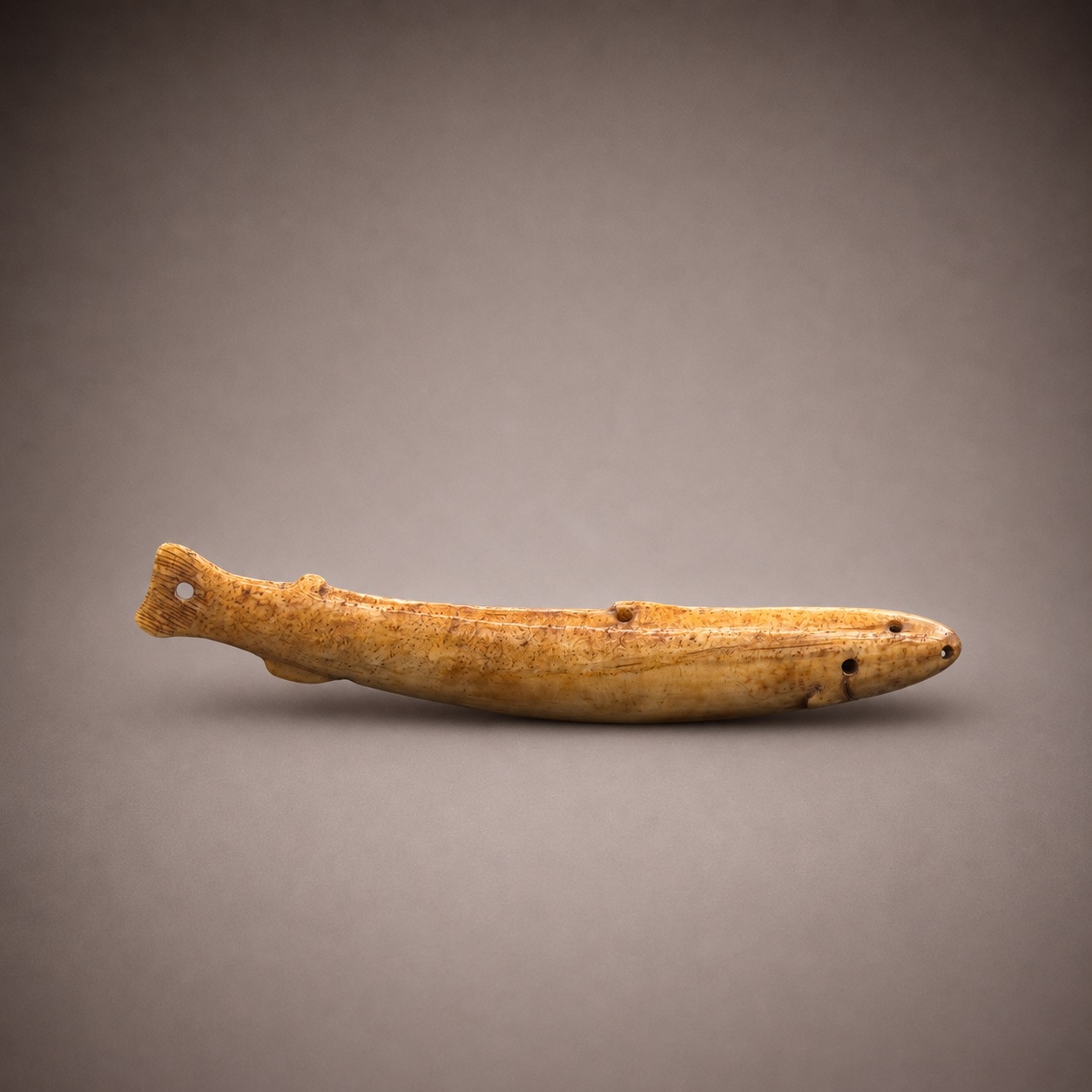
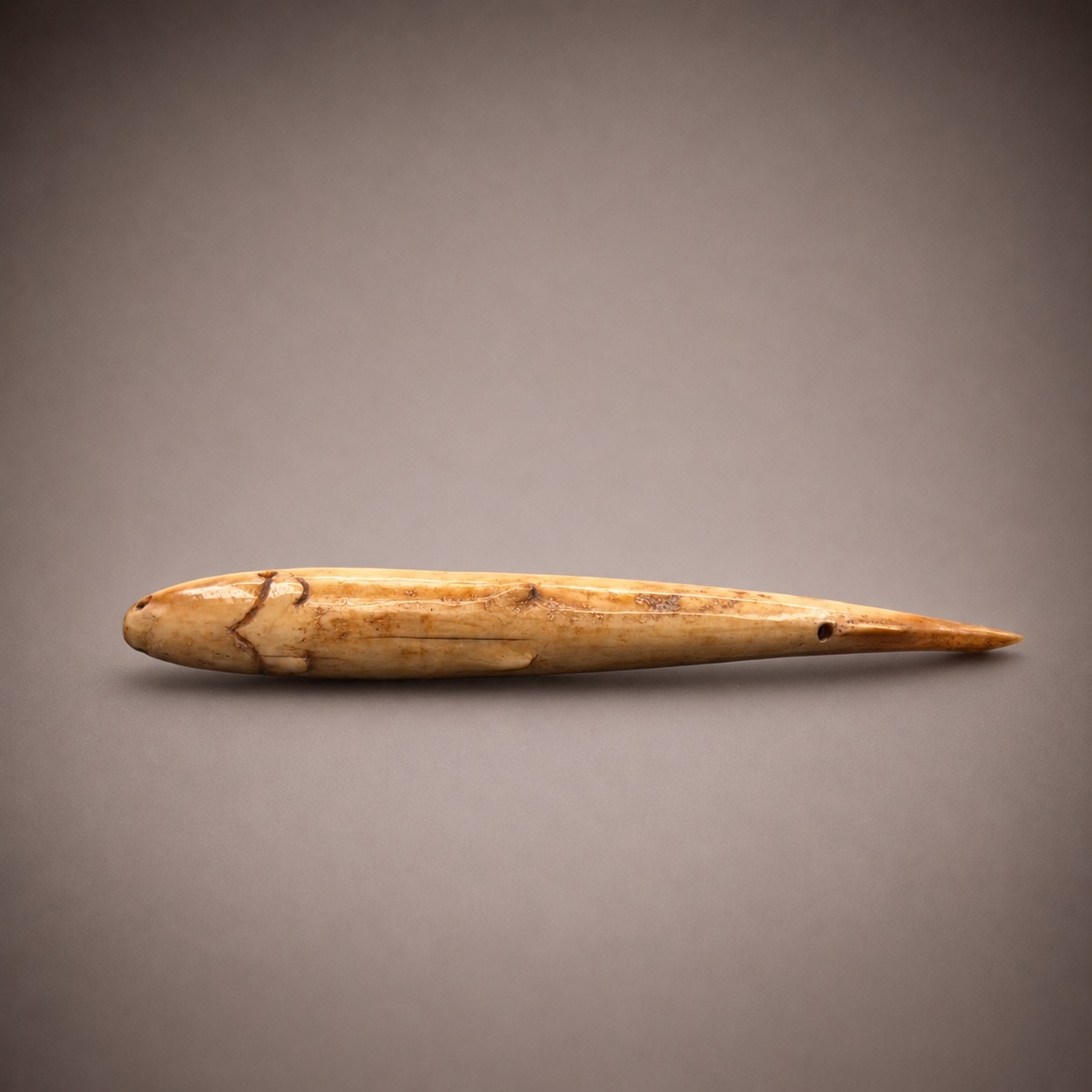
This fish lure is among the finest examples of the type. Carved from a single piece of walrus ivory that has aged to a warm amber-cream stained with the reddish-brown of long water immersion and sediment contact, the body describes a perfect fish silhouette — widest at the middle, tapering evenly to a pointed head and a forked tail — with a weight and density that would have given it exactly the right sink rate and the convincing, slightly nose-down swimming angle that fish respond to. The carver understood hydrodynamics from long practical experience, and translated that understanding directly into form.
At the head, two drilled holes accepted the fishing line — their precise placement determining the lure's tilt in the water, angling the head slightly down so that when jigged, the body rose and fell with the nodding motion of a small fish feeding near the bottom. At the tail, a second drilled hole provided the attachment point for the hook — a bone or later metal point that would have hung below the tail, concealed by the lure's realistic profile and ready for the strike. This dual-attachment system, with line at head and hook at tail, is the canonical Inuit lure configuration, refined over generations of practical testing in the rivers and coastal waters of the Bering Sea region.
The tail is carved with particular care: a fully realized forked caudal fin, each lobe rendered with fine parallel incised lines describing the fin rays with anatomical accuracy — the observation of someone who had cleaned and eaten thousands of fish, who knew exactly how the tail was structured and translated that knowledge into ivory with the confidence of total familiarity. Along the dorsal surface, a shallow longitudinal groove traces the fish's spine, giving the body its three-dimensional realism; fine incised lines along the mid-body suggest the lateral line that real fish use to sense pressure changes in the water — the organ of the fish that detects the approach of predators and prey alike, rendered here in miniature on a lure designed to attract the very creature it depicts.
The patina is the lure's most eloquent testimony to its active life. The ivory is stained unevenly — darker along the belly and in the carved recesses, lighter on the upper surfaces — the precise differential that results from repeated immersion in water carrying silt and organic material, the underside in greatest contact with the bottom. This is not the patina of a kept object but of a used one, worked season after season through ice holes in rivers and coastal waters until it passed out of use and into the long sleep of the collection.
Arthur Gross Collection