In the Arctic world, needles were not simple tools. The ability to sew — to construct the layered, perfectly fitted skin garments that stood between a person and death by exposure — was among the most essential skills a woman could possess, and the needles that made this possible were objects of genuine consequence. To lose a needle on the tundra or the sea ice was a serious matter. The needle case that protected them was accordingly an object of care and pride, made with the same precision and investment of meaning that went into the garments themselves.
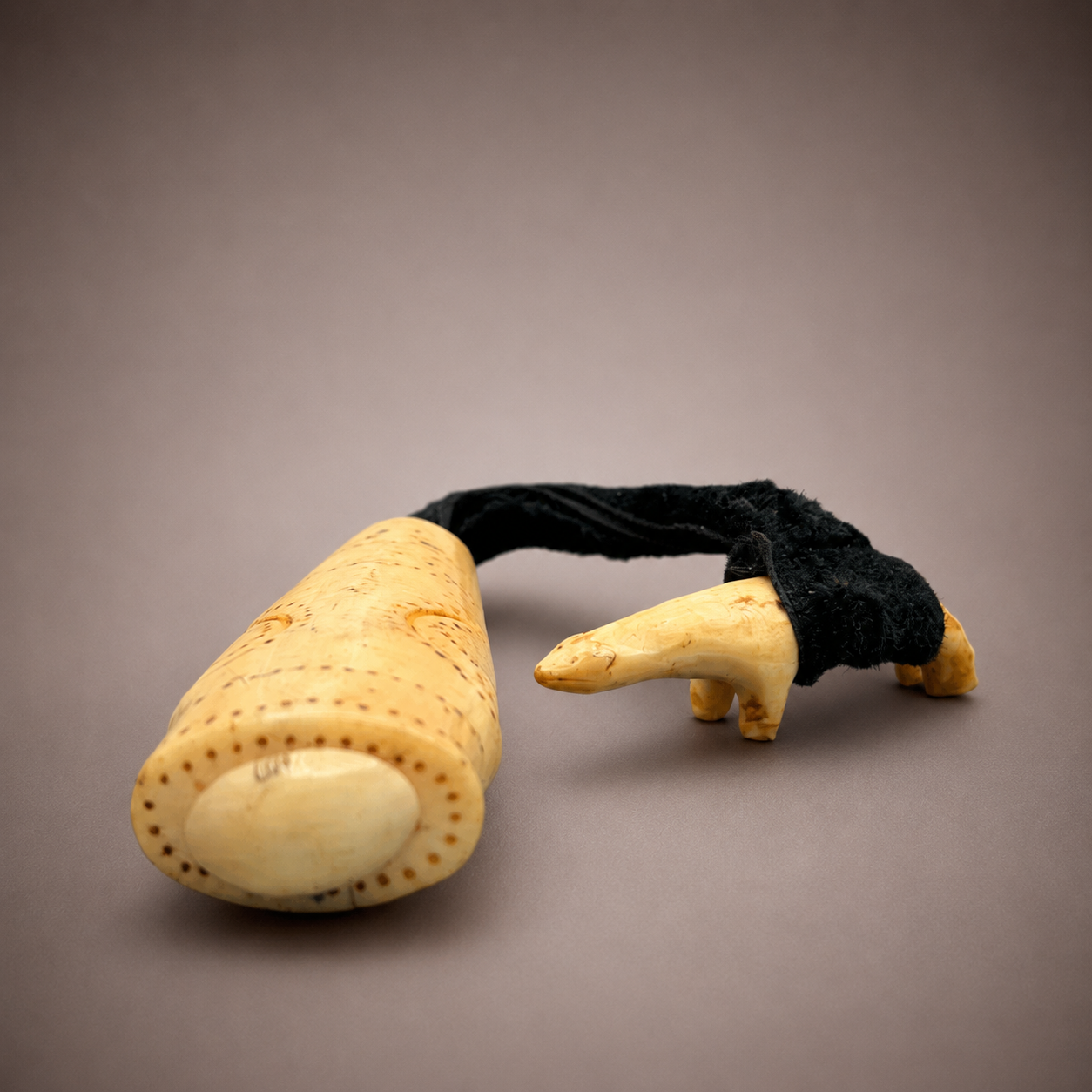
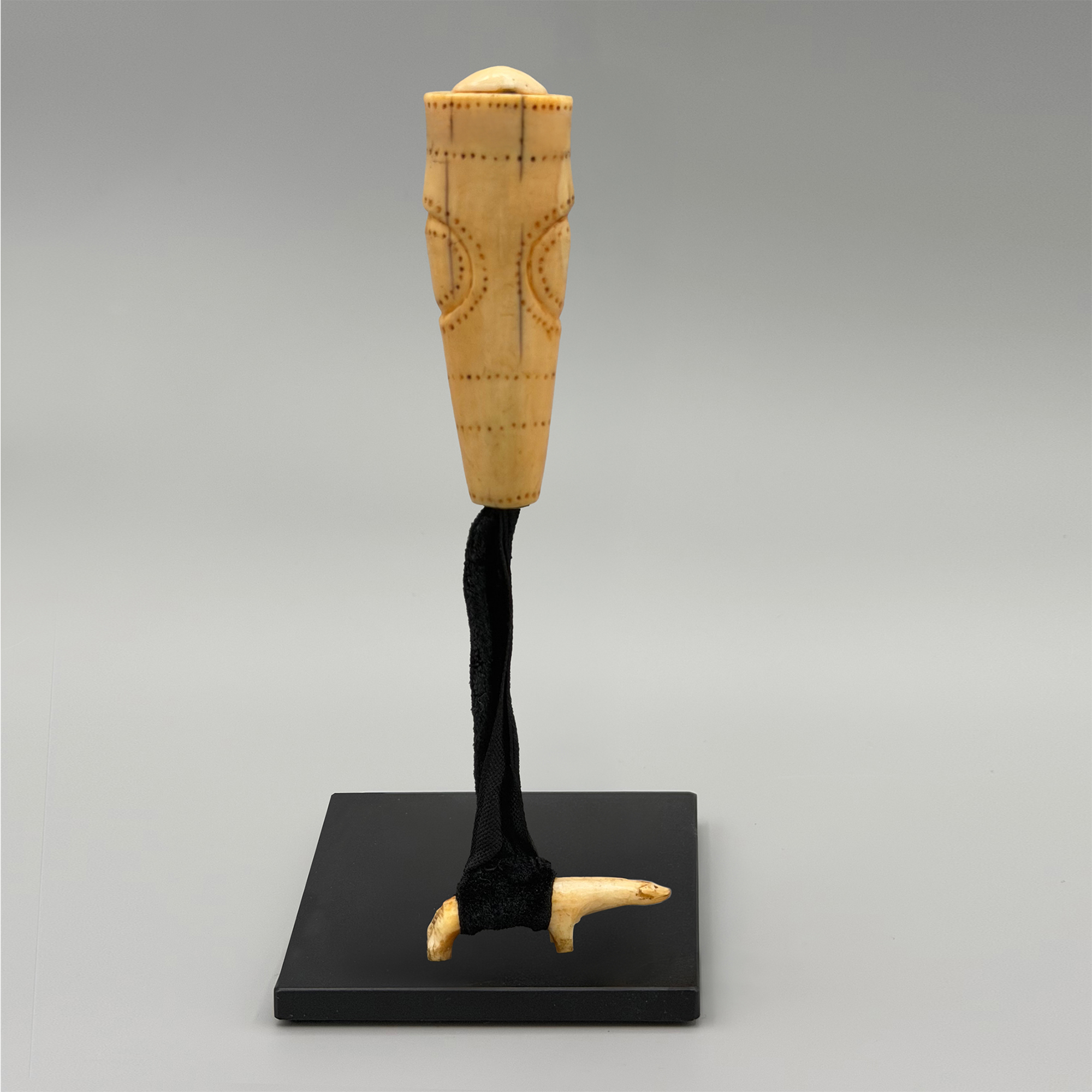
This miniature needle case is carved from a single piece of walrus ivory — tapering from a flat-crowned cylinder at the top to a rounded base — its entire surface covered in finely engraved decoration executed in the classic dot-and-line vocabulary of Arctic ornamental art. Horizontal registers of precisely drilled dot-punches divide the surface into bands, within which paired crescent or arc motifs bilaterally face each other on opposing sides of the cylinder — forms that may reference eyes, the ulu knife, or the structural visual grammar of yua, the inner person present in all living things. The dots retain their original dark infill — graphite or soot worked into the incisions to make the pattern legible — and the engraving shows the practiced hand of a carver working within a tradition of miniature precision that Arctic craftspeople brought to its highest expression.
The case is suspended from a loop of black European velvet ribbon — a trade material that entered the Arctic through the fur trade networks of the 18th and 19th centuries, and whose presence here anchors the object within the period of early contact without diminishing its essential indigenous character. The velvet was chosen for its softness and its ability to pass cleanly through the drilled suspension hole without abrading the ivory.
From the same velvet cord, at the base, hangs a second object of equal significance: a tiny carved ivory bear, complete in all its essential anatomy — four legs, a body, a head — rendered with the economy and authority that miniature Inuit carving demands. The polar bear (nanuq) was the most powerful animal in the Inuit and Yup'ik spiritual world: the being most nearly equivalent to a human in intelligence and presence, the animal most closely associated with shamanic transformation, and the most sought-after protector for personal amulets. To carry a miniature bear was to carry the bear's power — its strength, its hunting acuity, its capacity to move between worlds — compressed into an object small enough to hold in a closed fist.
Together — needle case and bear, utility and protection, the domestic and the shamanic bound on the same cord — this pair represents the kind of object that was made for a specific person, carried close to the body across years of use, and charged with accumulated personal meaning that no catalog description can fully recover.
Private Northeast collection