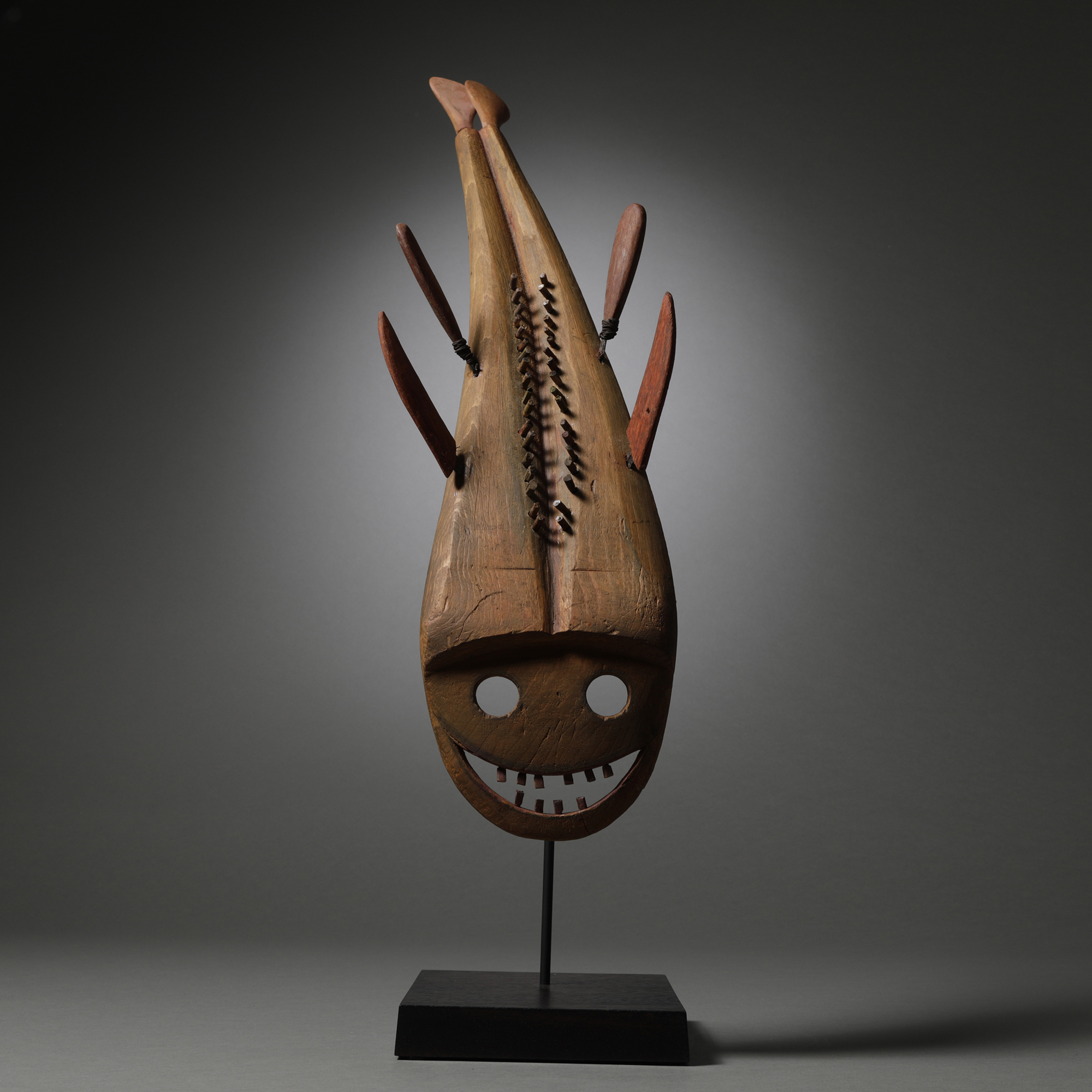
Sculpin (Cottus or Myoxocephalus species) were important spirit beings in the Yup'ik cosmological system, and fish masks of this type were made for the Agayuyaraq (asking/inviting ceremony) or other winter ceremonials in which the yuat (persons/spirits) of sea creatures were invited, honored, and asked to return.
The sculpin — ungainly, armored, broad-mouthed, and bottom-dwelling — was not a fish that invited easy sentiment. But in the Yup'ik world of coastal Alaska, every creature possessed a yua, an inner person or spirit, and it was precisely the most formidable and unexpected beings that demanded the most careful ceremonial attention. The sculpin's spiny body, gaping jaw, and fierce territorial nature made it a figure of power in the spiritual landscape of the Bering Sea coast, and the shaman who could speak to its yua — who could invite it, honor it, and persuade it to cooperate with human hunters — wielded knowledge of real consequence.
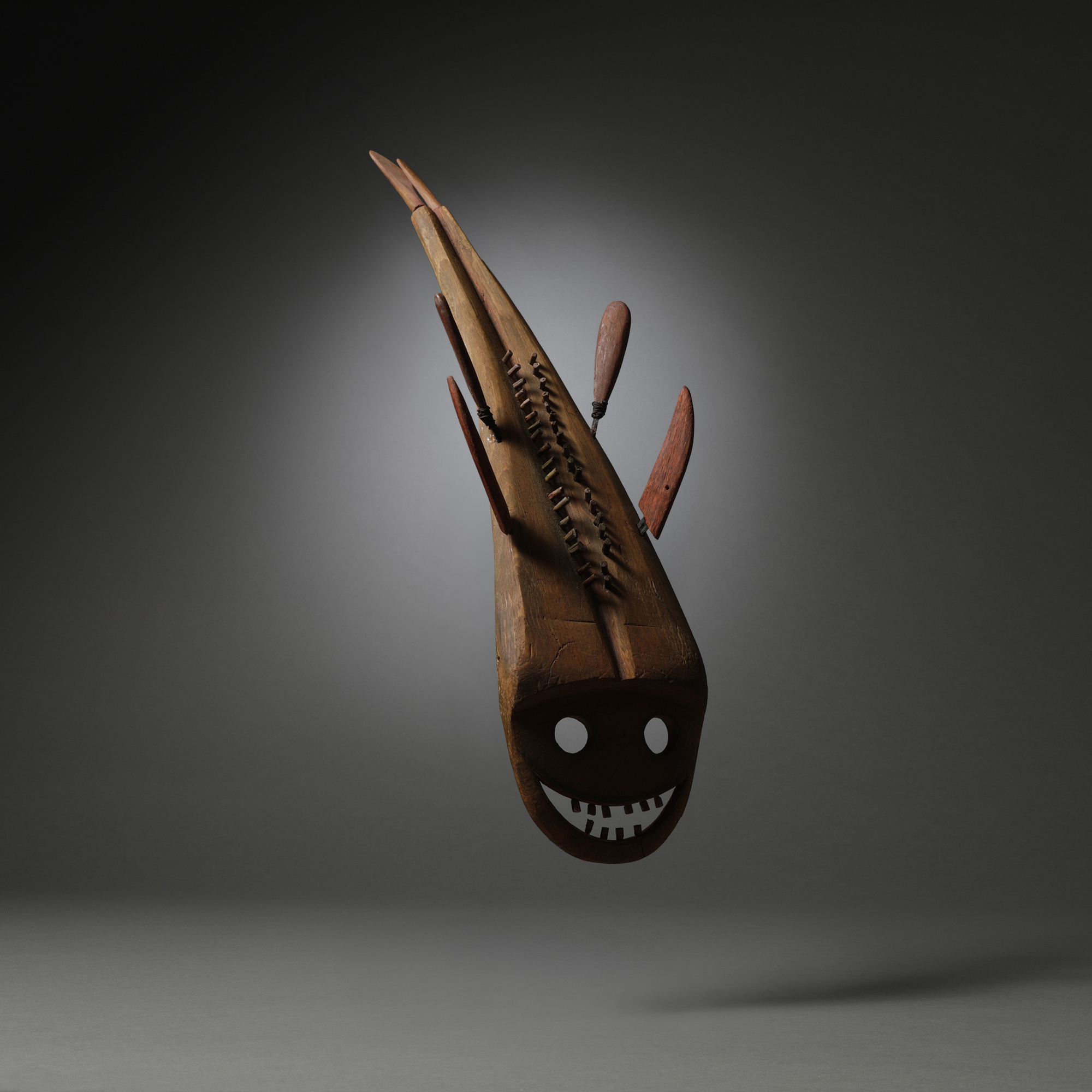
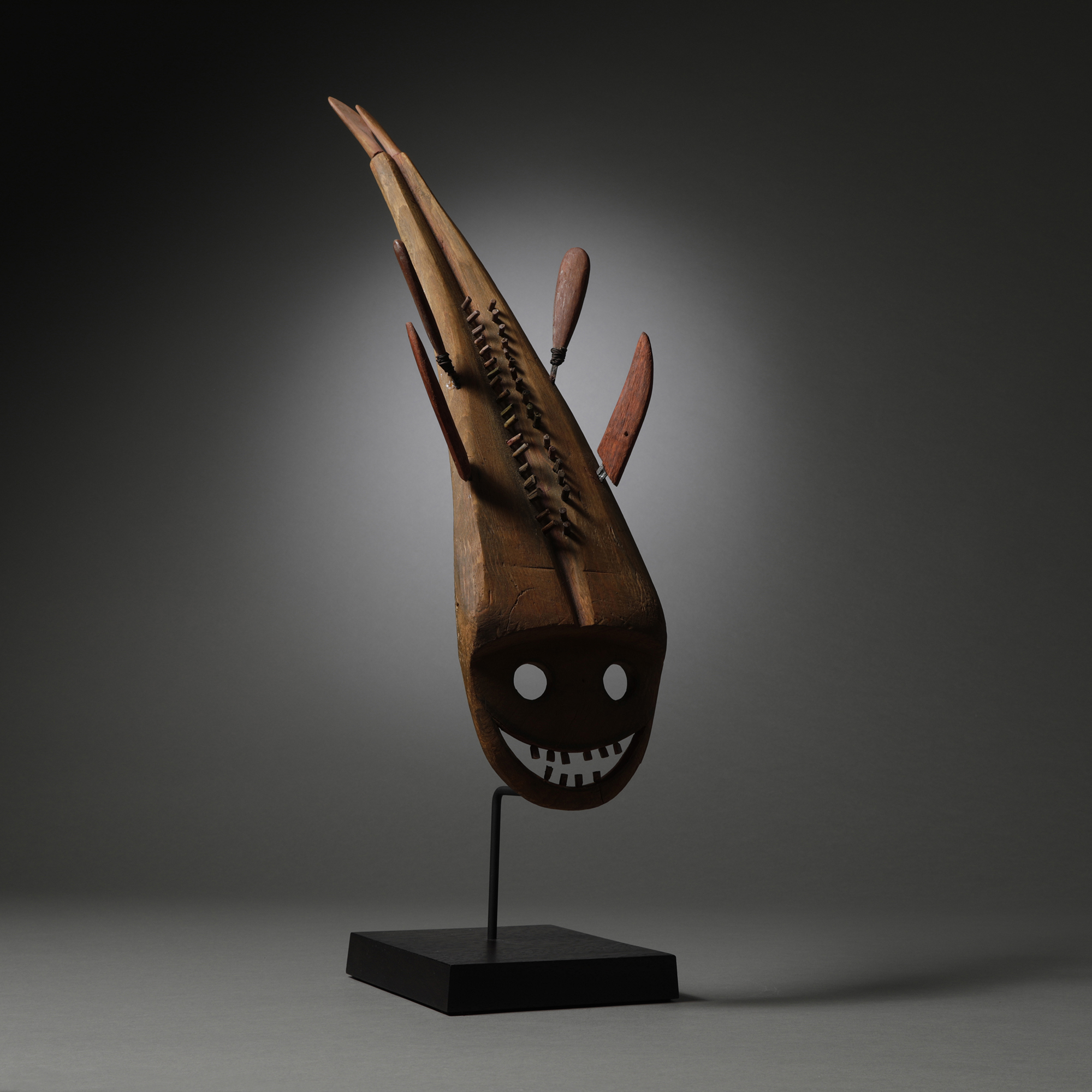
This mask renders the sculpin with the naturalistic precision and formal inventiveness that characterize the finest Yup'ik zoomorphic work. The body is an elongated, tapering form — broadening at the head and narrowing to the tail — carved from a single substantial plank of driftwood with the confident economy of a carver who understood the animal from long observation. The head is the commanding element: a broad, blunt snout with two large round eye apertures — the dancer's windows to the world, painted white to suggest the sculpin's prominent eyes — above a wide, lipless mouth from which a row of individually carved teeth emerges, the inner lip painted the vivid reddish-orange of the fish's actual coloration and of the yua's vital energy.
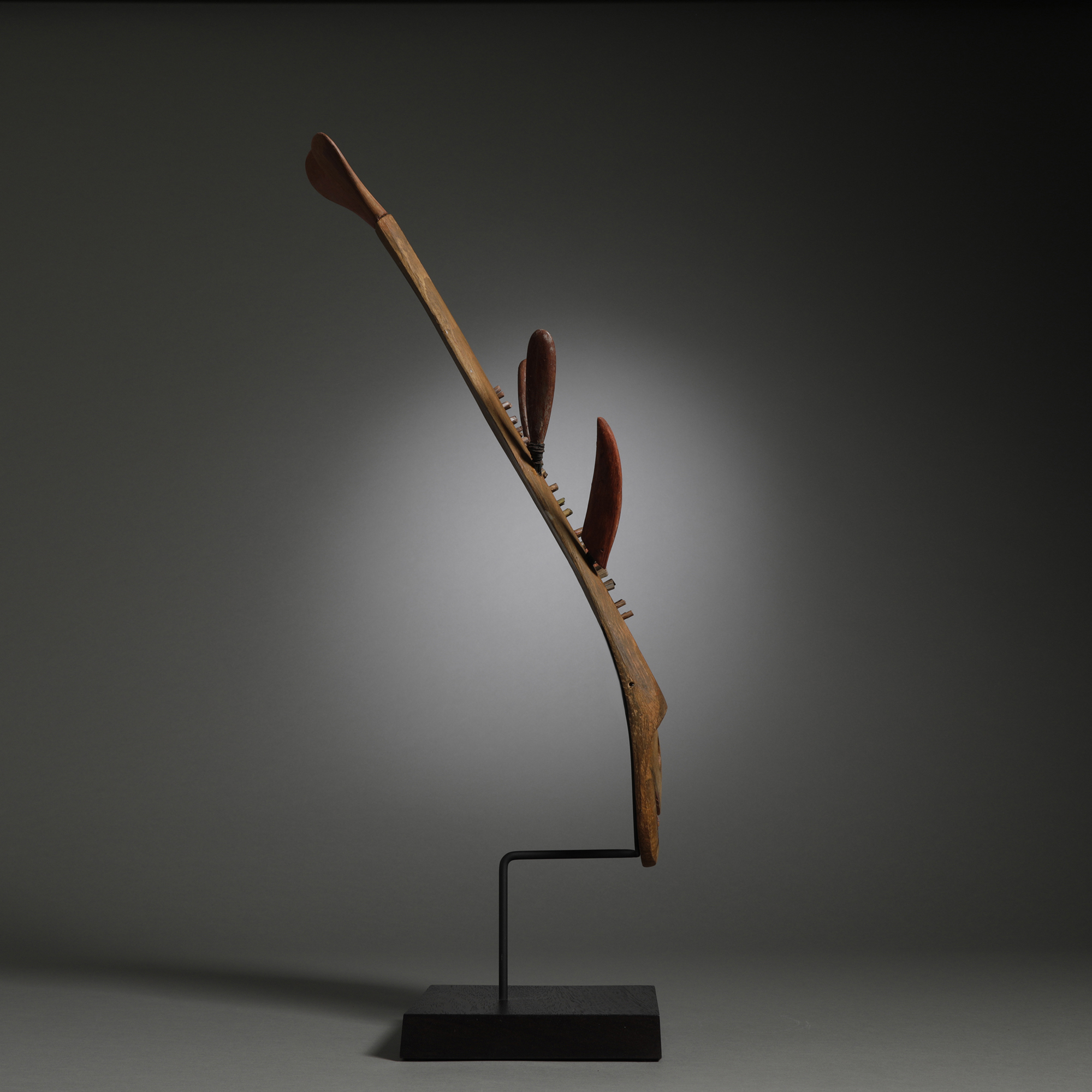
The dorsal surface carries the mask's most extraordinary technical achievement: a full ridge of individually inserted wooden spines running the length of the body's centerline, each pin driven through a drilled hole and secured from within, replicating with meticulous fidelity the sculpin's characteristic dorsal armature. The carver did not simplify or suggest the spines — he counted them, placed them, made them real. This is the kind of specificity that Yup'ik mask-making demanded: the spirit of the sculpin would recognize itself, or it would not come.
Four lateral fins — each a flat, paddle-shaped piece of wood painted reddish-orange and lashed through drilled holes with sinew or twisted fiber — project from the body's sides, their attachment knots still intact. One fin has separated from its lashing over the years, its loss the inevitable consequence of the organic materials that bound it; the attachment point and sinew remain, preserving the complete record of the original configuration. A carved caudal element at the upper terminus completes the fish form.
The surface throughout retains the warmth of aged, handled wood — the grain open and expressive, the paint worn and honest, the scratches and abrasions of ceremony and time fully integrated into the object's presence.
Sculpin masks are exceptionally rare. For a similar example, see Upside Down: Arctic Realities by Carpenter, E., Mooney, S. et al p. 222 fig. 17
Collected by Barton R. Lowder (1915 - 1991) from an Eskimo family. Lowder was on the crew of the steamer boat Nenana. The SS Nenana was a historic 237-foot river sternwheeler that operated on the Tanana and Yukon rivers in Alaska from 1933 to 1954.
Private Collection, New York