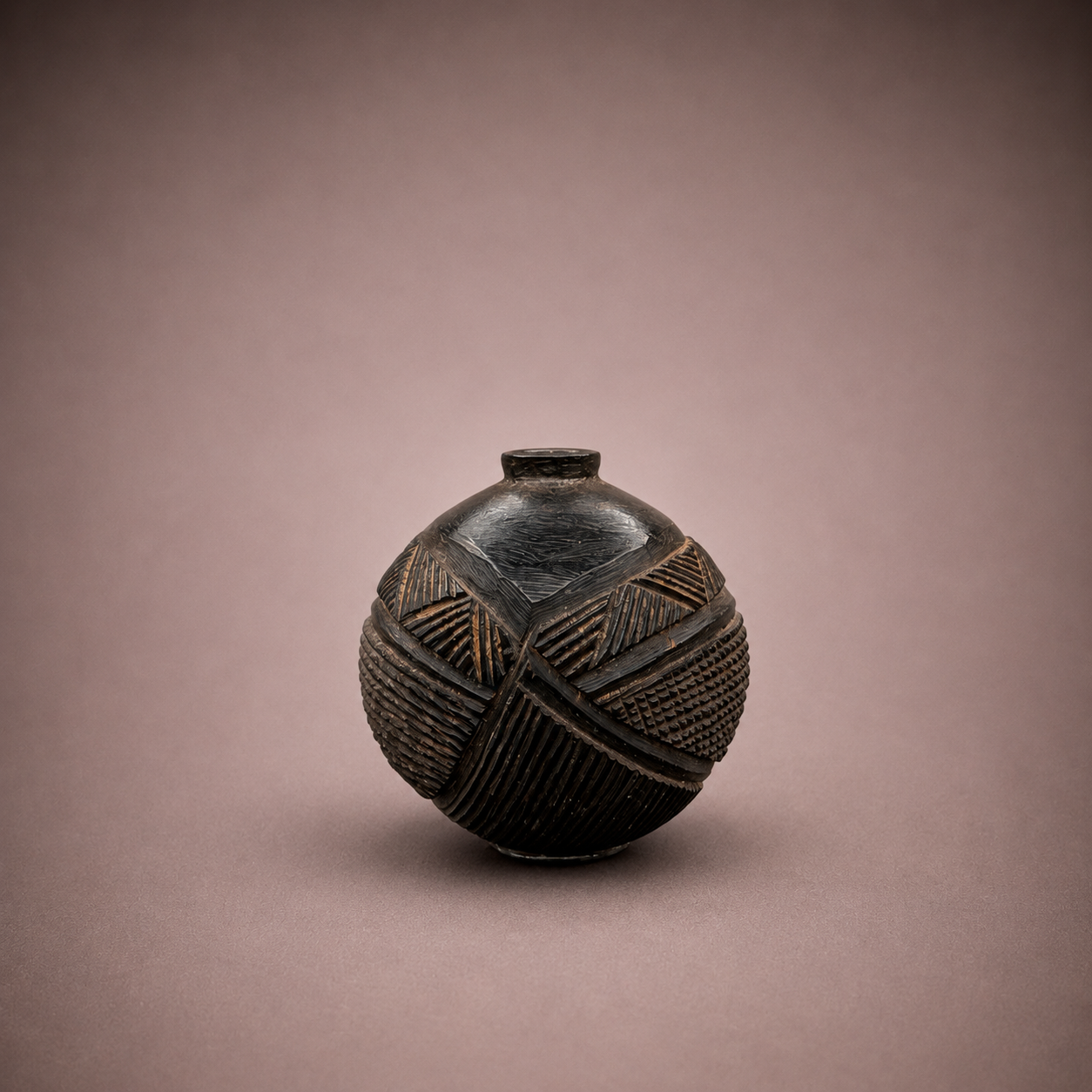
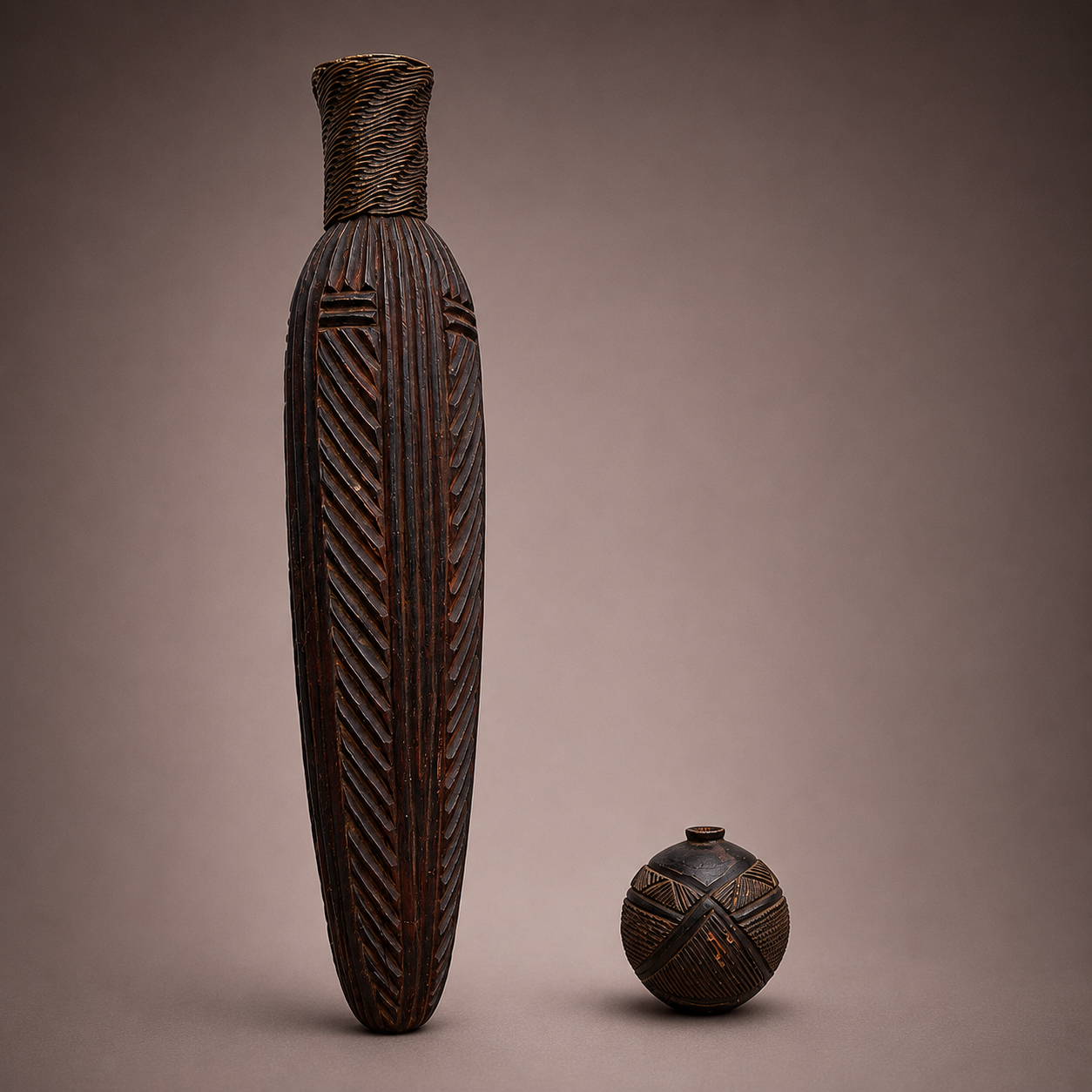
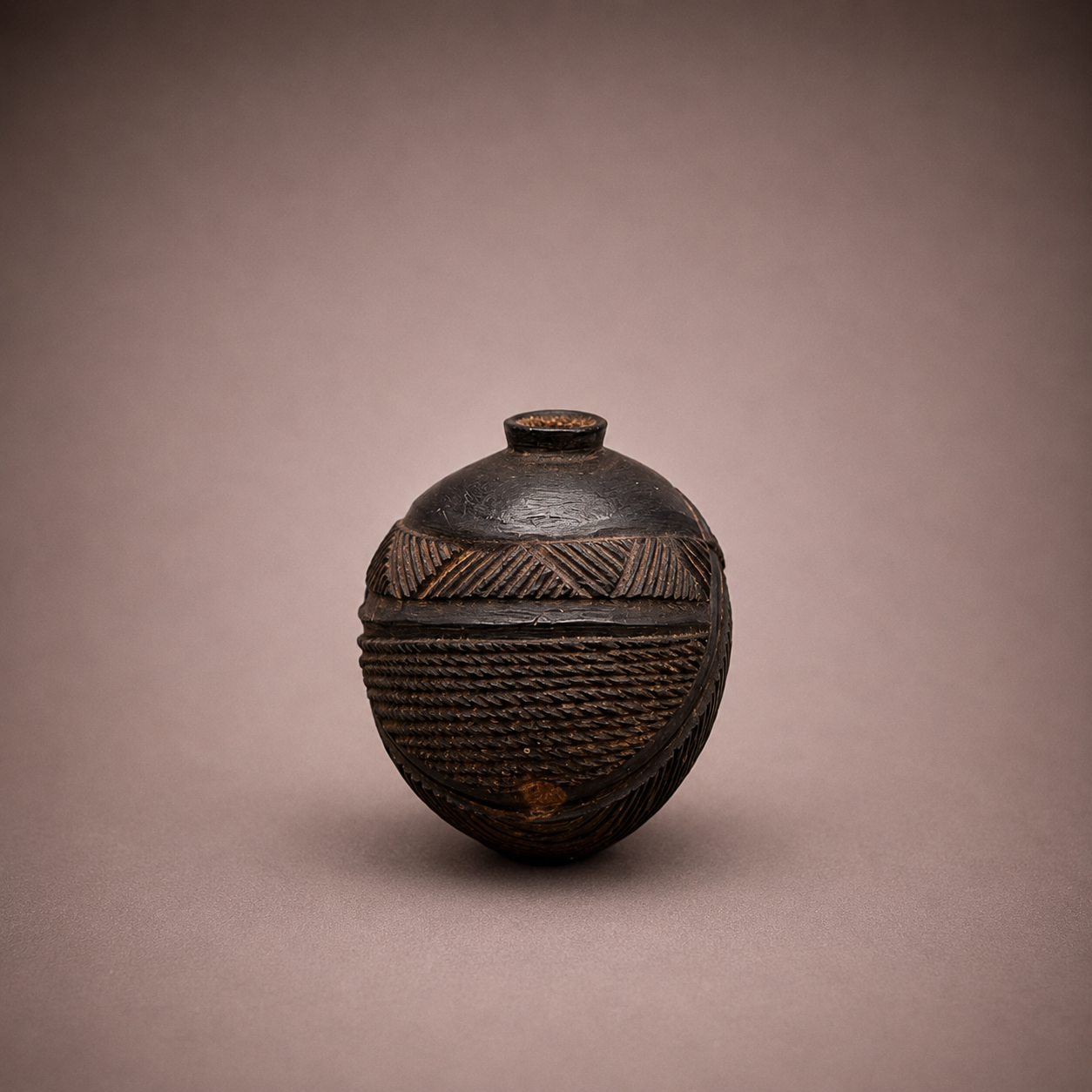
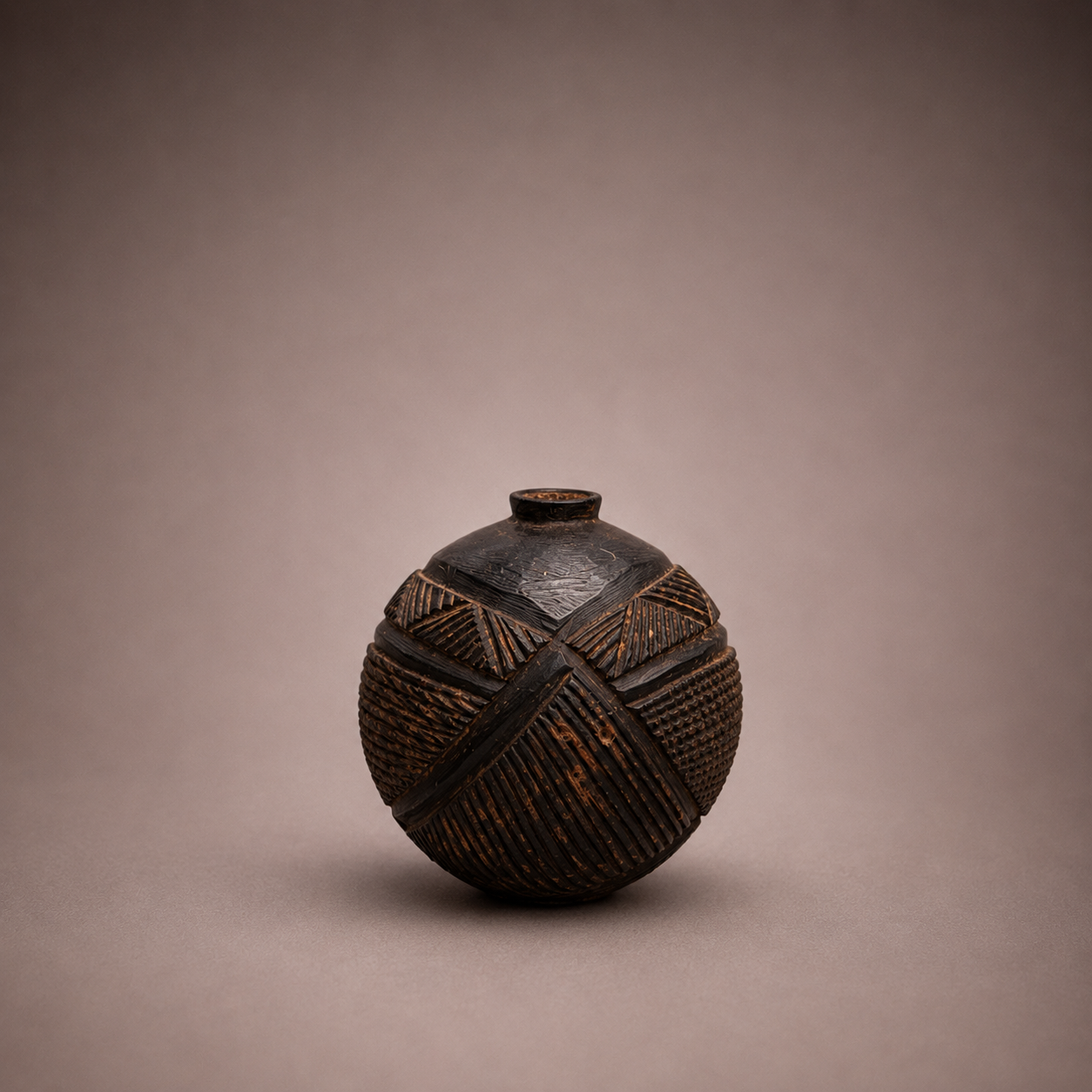
To hold this vessel is to hold a complete world in compressed form. The ishungu — the Zulu snuff container — is among the most formally resolved object types in the entire southern African decorative tradition: a sphere so nearly perfect that it reads as a geometric absolute, its surface so densely and precisely worked that every square centimeter is a considered decision, its function so intimate that it was carried on or near the body for years, decades, a lifetime.
Snuff (ugwayi) was central to Zulu social and spiritual life — offered to ancestors at the beginning of ritual, exchanged as a gesture of respect between individuals, carried always by those of status and years. The container that held it was accordingly an object of prestige, and the finest examples — like this one — were made with the full technical ambition of the Zulu carving tradition applied to the smallest possible scale.
The form is the large ukhamba beer vessel translated into miniature with total fidelity: the same near-perfect spherical body, the same small cylindrical neck, the same commanding geometric surface program — all compressed to an object that fits in a closed fist. The parallel is not accidental. The ukhamba and the ishungu share a formal language because they share a social one: both are vessels of offering, of exchange, of the careful transfer of substance between people and between the living and the ancestral world. To make the snuff container in the image of the beer vessel was to carry the full weight of that tradition in something small enough to slip into a pocket.
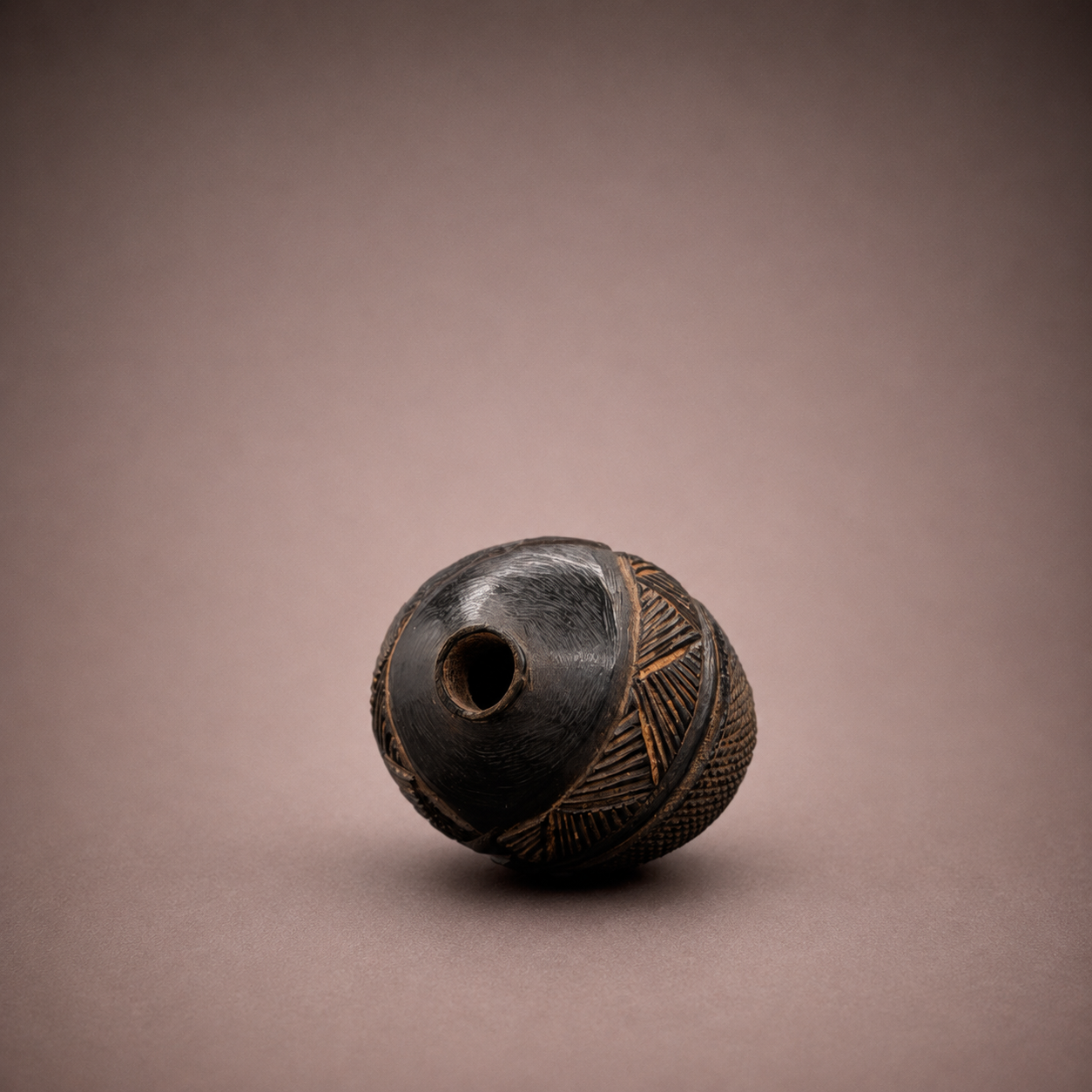
The surface is organized by bold raised dividing bands that cross the sphere in a structural X, partitioning the body into distinct decorative panels each filled with a different but related geometric vocabulary. Tightly packed diagonal parallel lines fill the large lower panels — the fundamental Zulu incised line register, executed here with a precision and consistency that speaks to a carver of considerable experience. The amasumpa nodule field — those small raised warts or bumps that appear across Zulu prestige objects from headrests to staffs to the finest ceremonial vessels — occupies its own panel to one side, each nodule placed with even spacing in a regular grid. In the upper zone flanking the neck, triangular panels carry radiating fan-line registers that echo the converging geometry of the dividing bands. The shoulder and neck darken to near-black — the accumulated evidence of handling at the object's most-touched point, where the stopper was removed and replaced, where fingers rested while the container was opened and offered.
The wood — dense, dark, carbonized — has aged to a surface of deep matte black that reveals its warm reddish-brown interior only in the incised channels and between the nodules, the two tones working together to describe form and decoration simultaneously. It is a surface that repays close attention: what reads from a distance as an almost uniformly dark sphere resolves at close range into a field of extraordinary textural richness.
Estate of Paul Walter. Walter was a New York-based collector and connoisseur who bought his first works — prints by the artist James McNeill Whistler — while attending Oberlin College in Ohio, and later obsessively collected all manner of objects, from Raj-era silver and Mughal miniatures to architectural drawings and art from many eras. Walter’s father had invented the electric igniter for gas cookers and, after becoming chief executive of his family’s electronics firm in 1968, he travelled frequently to European antiques markets and London's auction houses. His collection of African non-figurative objects was donated to the Yale University Art Gallery.