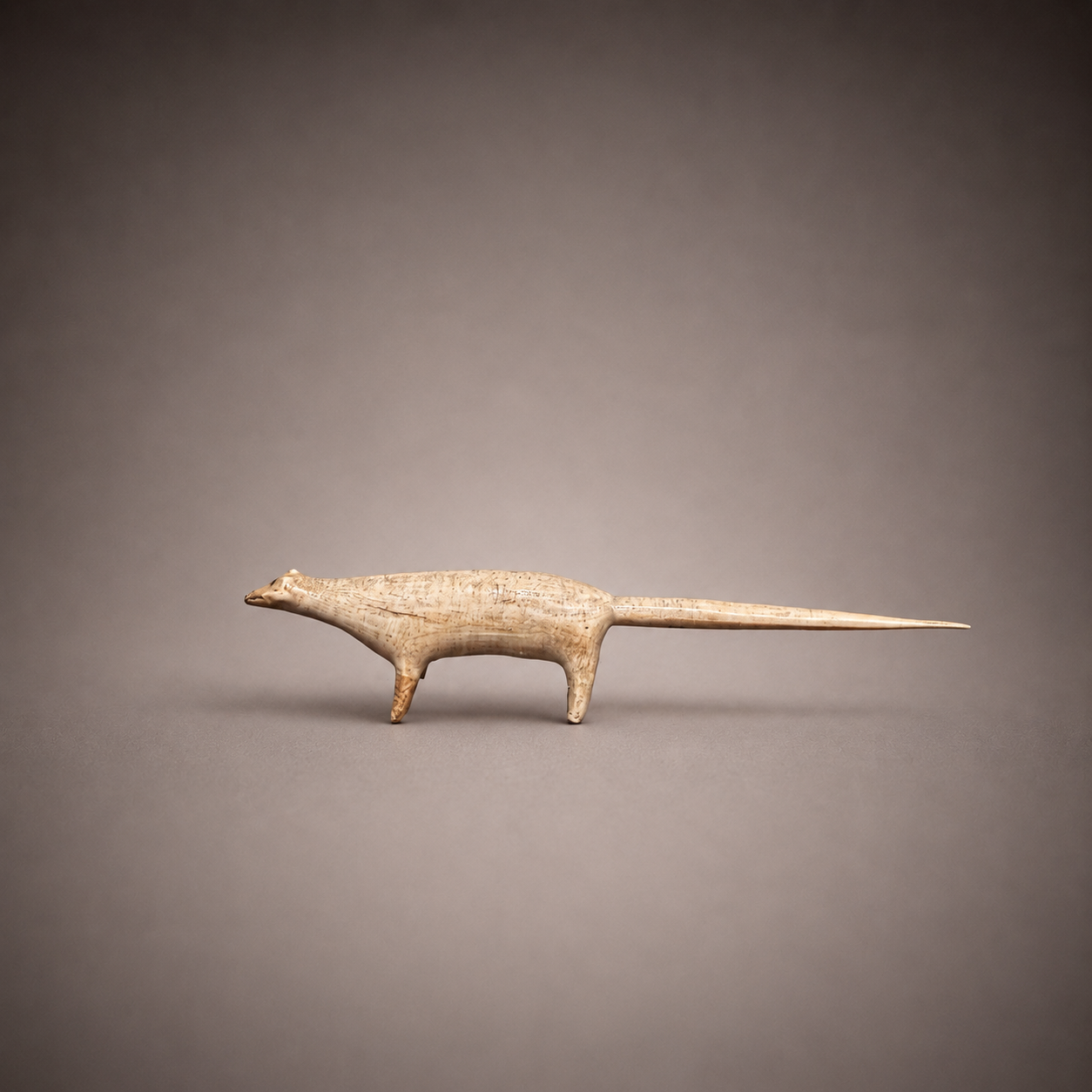
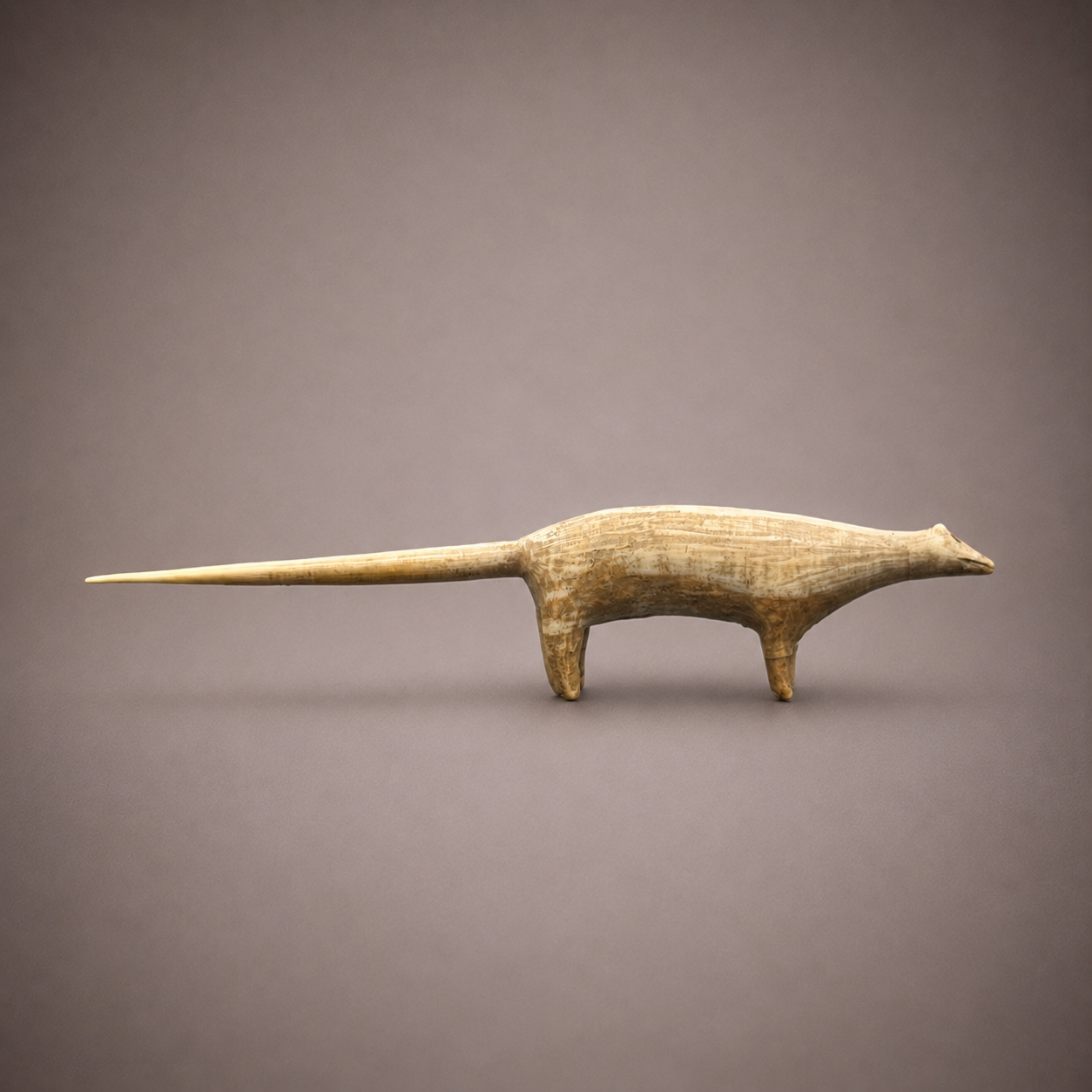
Among the Inuit and Yup'ik peoples, tattooing was a practice of profound social and spiritual significance — particularly for women, whose facial and body tattoos marked life transitions, signaled status and identity, and were understood to guide the spirit after death to the correct realm. The needles used to introduce pigment under the skin were accordingly objects of more than functional importance. A tattooing needle carried the marks it had made; it participated in the transformations it enabled; and when it was made in the form of a spirit animal, it brought that animal's power to the work.
The carver's insight was simple and exact: the fox's naturally long, tapering tail, held straight behind the body in motion, is already a needle — it needs only to be recognized and released from the ivory. The fox's body becomes the handle, the tail becomes the working point, and the whole object acquires a logic so complete that it seems inevitable rather than invented.
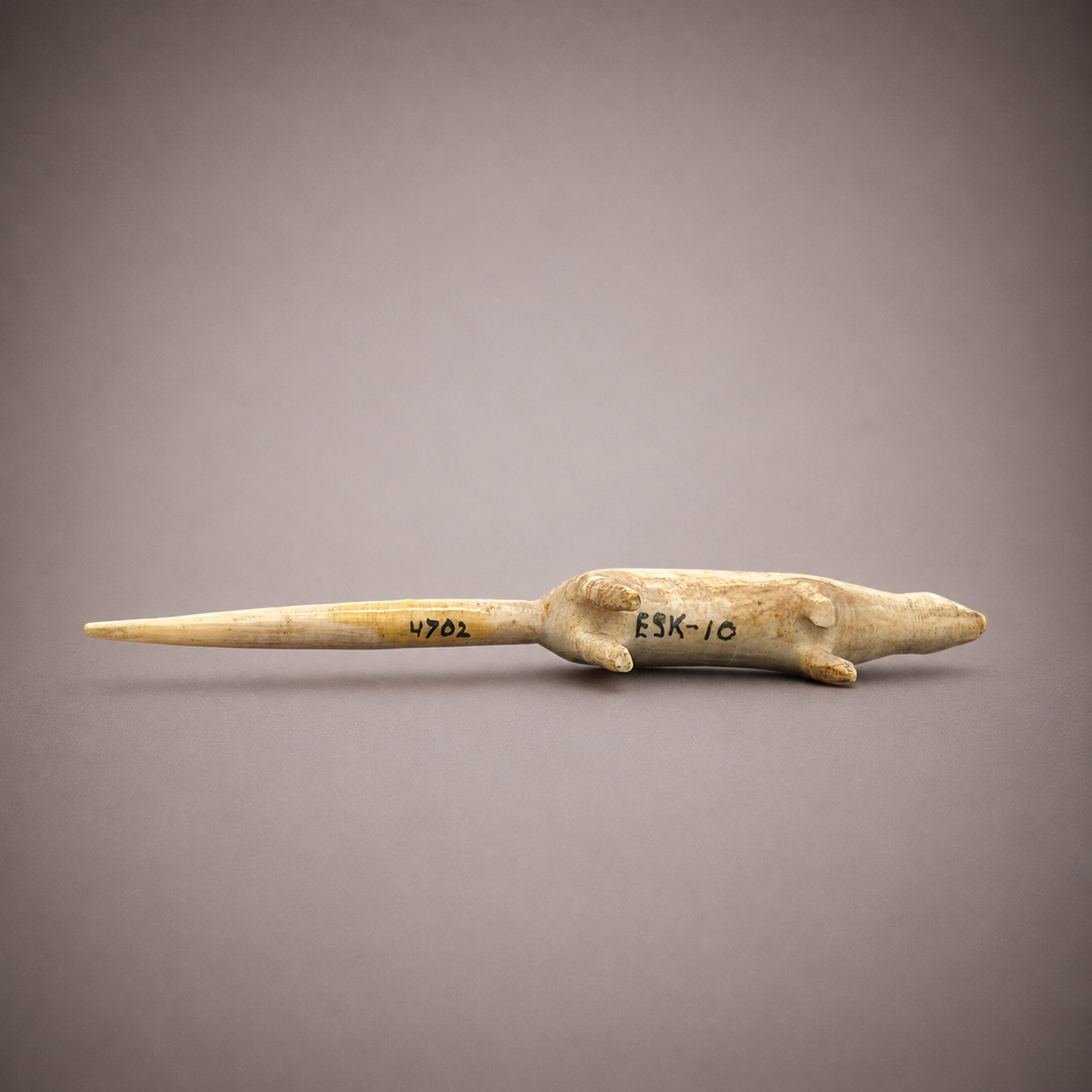
The fox itself is rendered with the observational precision that the finest Arctic animal carving always achieves through economy rather than elaboration. The long, low body is streamlined and forward-leaning — the fox in motion, nose down, following a scent with the focused, ground-reading attention that makes the arctic fox such a successful predator on the open tundra. The pointed snout is thrust forward, the tiny eye alert and bright, the ears just suggested at the crown. Four short legs with minimal toe separation give the piece stability when set down without interrupting the flowing horizontal silhouette. And then the tail: departing the haunches in a seamless transition, round in section, tapering evenly over its full length to a working tip that shows the slight wear of use — lighter in tone at the point, the ivory compressed and smoothed by repeated contact with skin.
The material throughout is walrus ivory or large marine mammal bone — light cream to warm ivory-white, the natural grain lines of the material running the full length of the piece like the suggestion of fur, the surface dry and silky with the particular quality of old ivory that has been handled regularly across many years. No decoration was applied. None was needed.
In Yup'ik tradition, the fox was associated with cleverness, with the ability to find what is hidden, with the capacity to move between states — between the visible world and the world beneath the snow, between the surface and what lies under it. A tattooing needle in fox form brought all of this to the act of marking: the fox's ability to find and penetrate, the fox's knowledge of hidden things, applied to the transformation of the human body into a surface that carried meaning. Note that right front leg is partially missing.
De-accessioned from the Cleveland Museum of Natural History