The shamans of the Yup'ik and Inupiaq peoples of coastal Alaska occupied a singular position at the membrane between the visible world and the world beneath appearances — the realm of yuat, the persons or spirits that animate every living thing, every animal, every force of weather and sea. It was the shaman (angalkuq) who could perceive and negotiate with these presences, and it was through the mask that this negotiation was made visible to the community. A mask worn in the qasgiq — the men's ceremonial house — or carried on the open water during the hunt did not merely represent a spirit; it materialized one, giving it a face through which it could look back at the living.
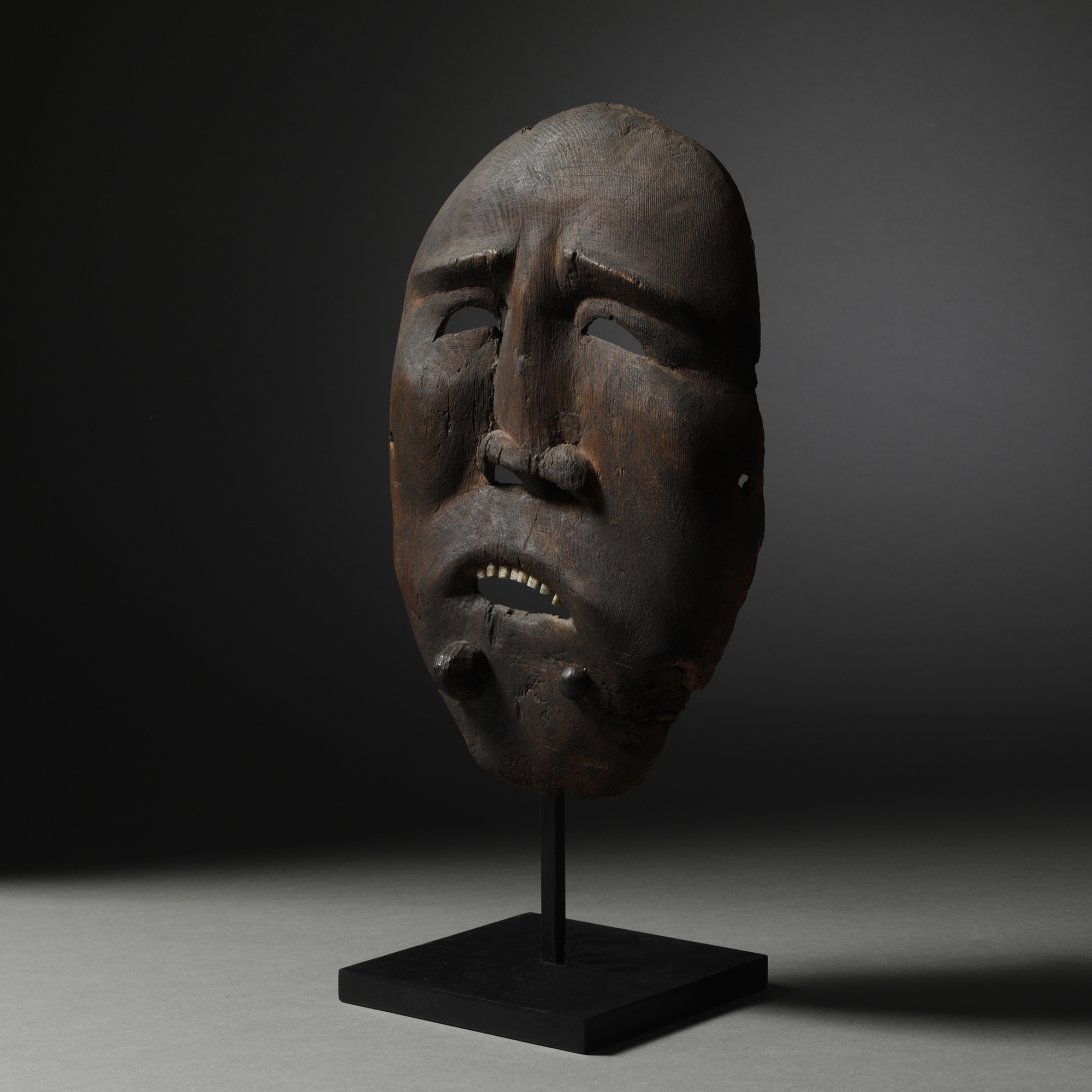
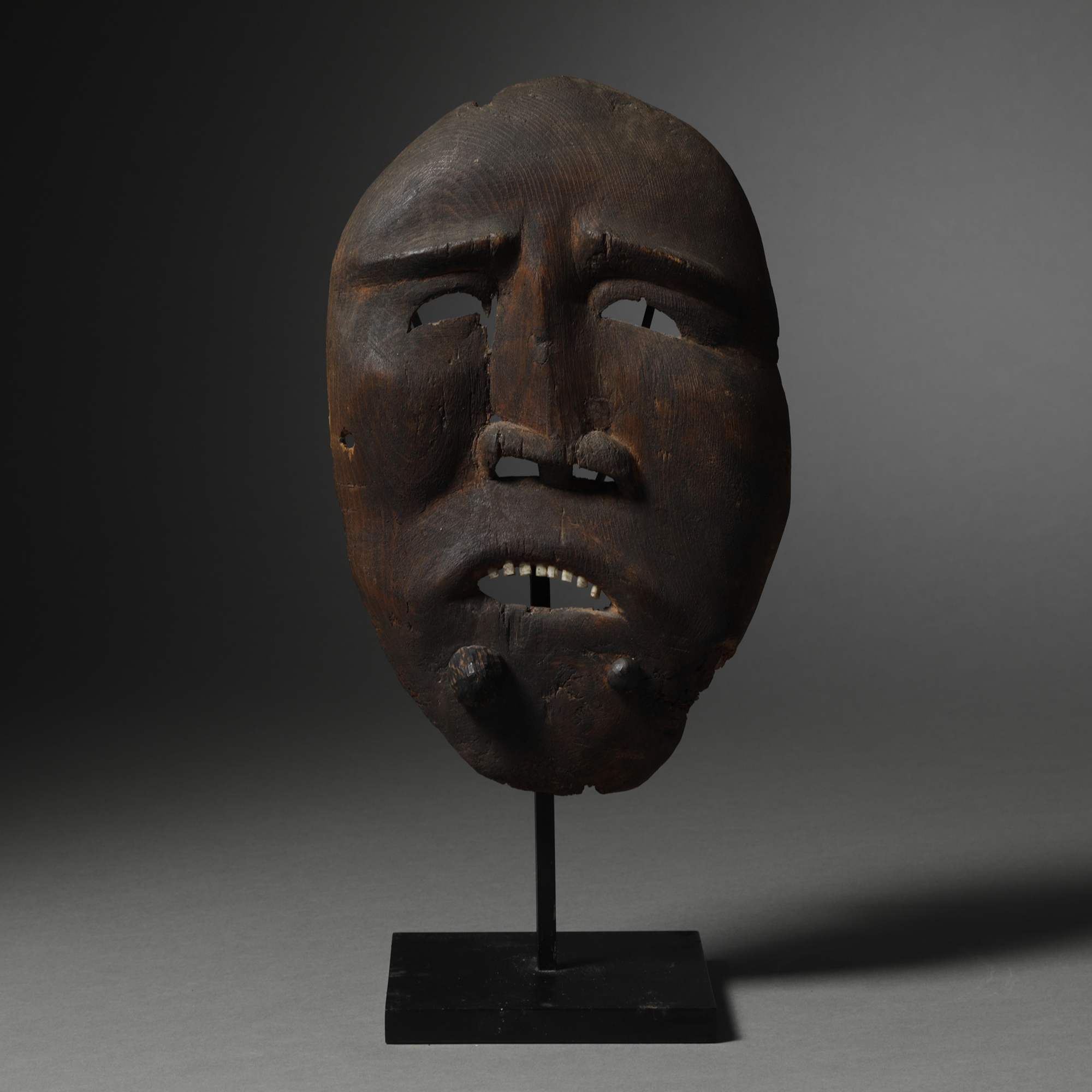
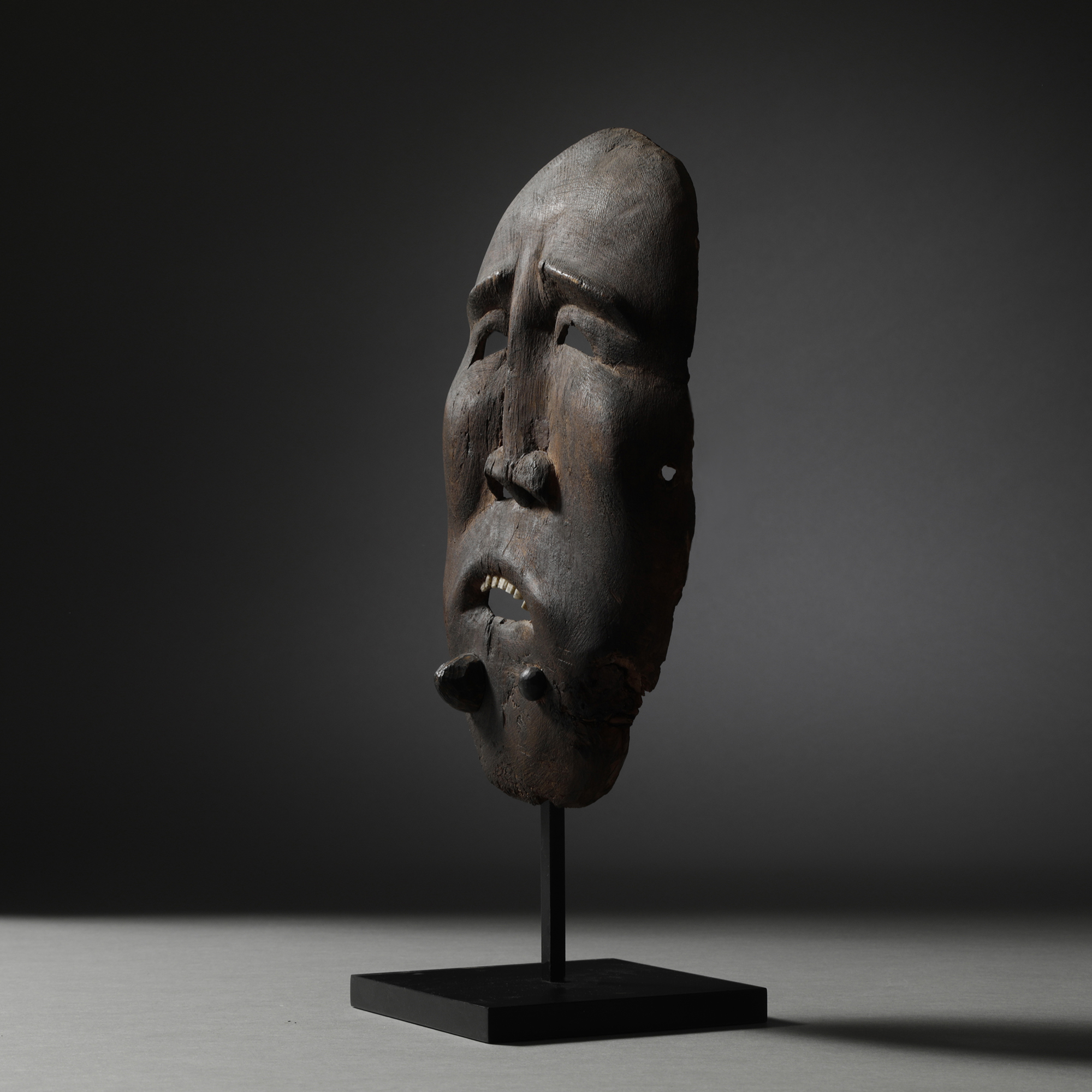
This mask presents a face of exceptional presence and authority. The forehead is broad and domed, the brow ridge a single heavy shelf from which deep-set eye apertures are cut — asymmetrically, deliberately so, the left aperture wider and more irregular than the right. In Yup'ik shamanic tradition, asymmetry was not error but grammar: the face that looks at once into the ordinary world and the spirit world cannot be perfectly balanced, for these are not equivalent realms. The nose is broad and projecting, carved with confident fidelity to human anatomy, its bridge rising unbroken from the brow in a single strong line.
The mouth is the mask's most technically demanding feature. It is held open — not in anguish but in speech, or song, or the controlled exhalation of shamanic power — and set into the upper jaw is a row of small, individually shaped teeth in bone or ivory, each one fitted with care into the carved wooden gum line. The effect, across the centuries since this mask was made and used, remains viscerally alive: the mask breathes, or is about to speak, or has just stopped singing.
Below the lower lip, flanking the chin, are two labret pegs — the ellanguaq of male adult identity among Yup'ik and Inupiaq men, worn through piercings made at adolescence and replaced with progressively larger plugs as a man aged and accumulated standing. Their presence here identifies the spirit or persona embodied in the mask as a man of status — a hunter, an elder, or a being of the spirit world rendered in recognizably human terms of prestige and maturity. One peg appears to be integral to the mask's wood; the other, darker and denser in tone, may be a separate material — bone or stone — inserted into a carved recess, a distinction in material that may itself carry meaning.
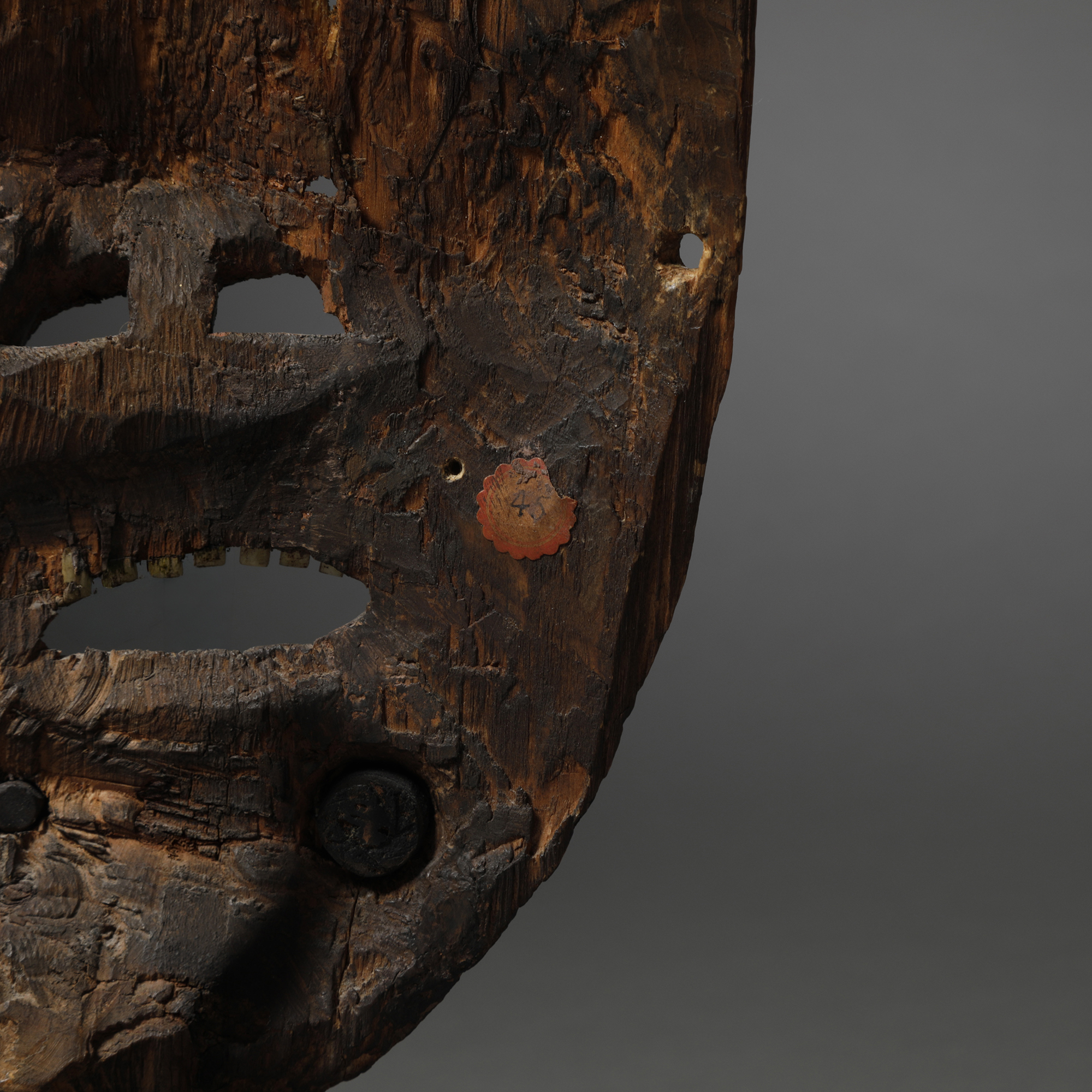
The patina speaks unambiguously of age and ground contact: a deep reddish-brown that has compacted to a near-silky surface over the high planes of the forehead, cheeks, and brow, darkening to near-black in the recessed eye sockets and nostrils. The reverse retains the rougher, lighter-toned surface of wood less exposed to the elements, and the slight warping and checked grain visible along the forehead are consistent with cyclical freezing and thawing over a long period in the ground. A single perforation at the left cheek provided an attachment or lashing point for the fiber or sinew that secured the mask to its wearer or to its ceremonial rigging.
Masks of this quality are rarely encountered outside major museum collections.
Christie’s, New York
Private Collection, New York