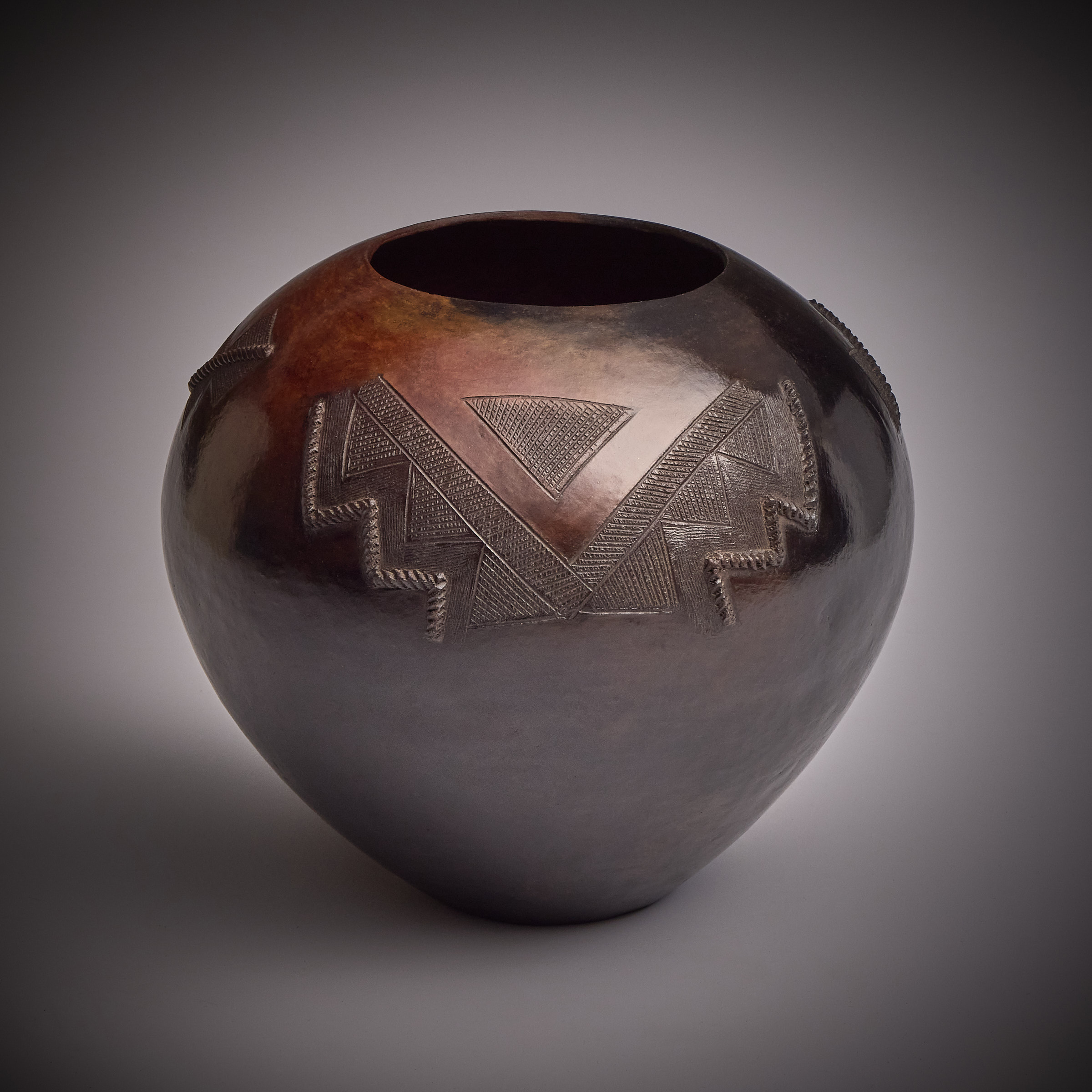
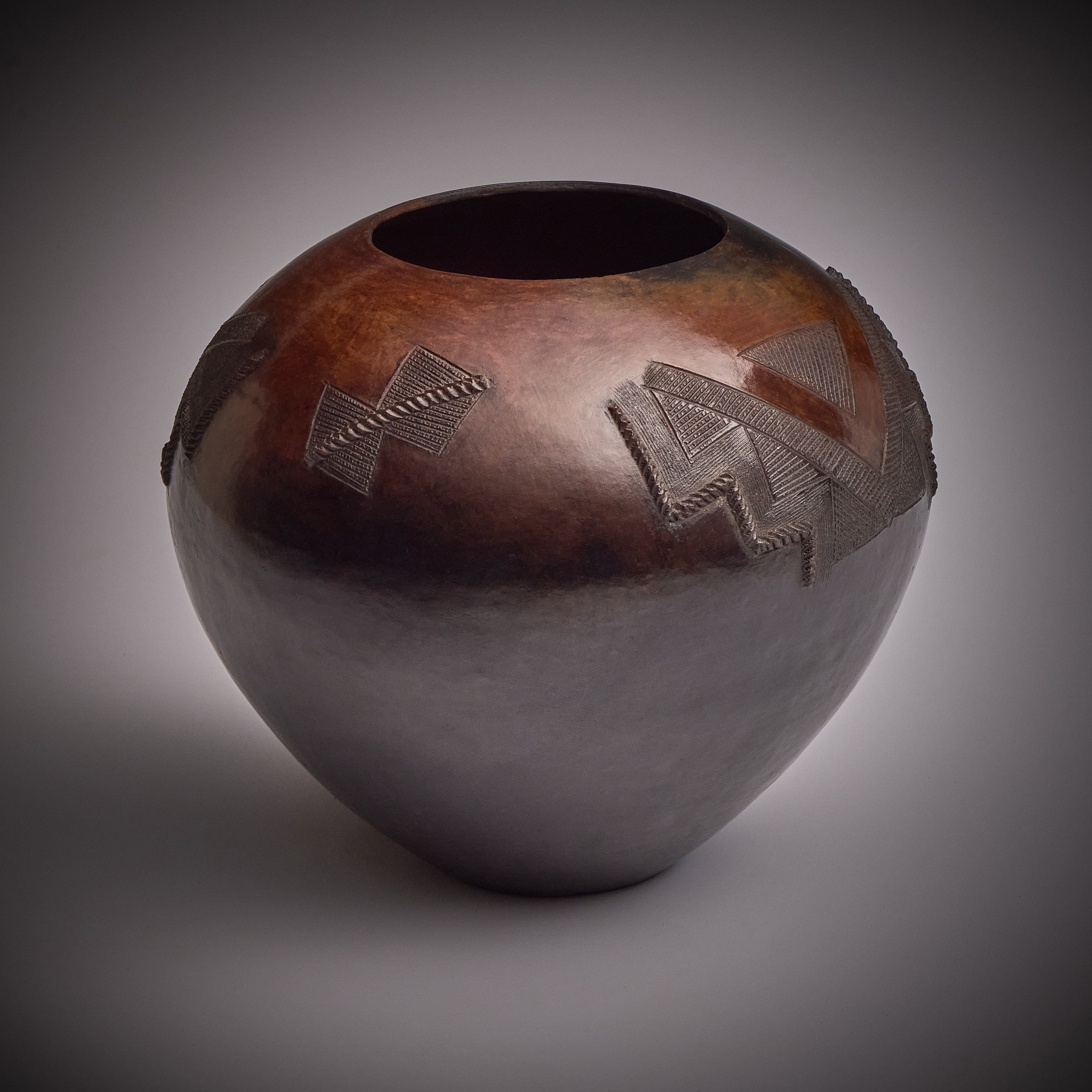
Artist: Nesta Nala
Oyaya, KwaZulu-Natal, South Africa
Nesta Nala (1940–2005) was a legendary South African ceramicist and a foundational matriarch of contemporary Zulu pottery. Born in Oyaya in the Thukela Valley of KwaZulu-Natal, she learned the multi-generational art form at age twelve from her mother, Siphiwe Nala, continuing an ancient maternal lineage that she later passed on to five of her daughters, including Jabulile and Thembi. While she initially produced utilitarian vessels for local sorghum beer ceremonies, Nala single-handedly shepherded the transition of Zulu ceramics from domestic wares into the global fine art market by the mid-1980s. Her hand-coiled, pit-fired earthenware - most notably the spherical ukhamba and the necked uphiso - is celebrated for its nearly flawless geometric symmetry, highly burnished, glossy jet-black surfaces meant to honor ancestral spirits and complex geometric relief patterns like the amasumpa (raised clay nodes).
Regarded as a pioneering South African art icon, Nala won the FNB Vita Craft Competition (1995), represented her country at the Cairo International Biennale (1994), and participated in the Smithsonian Folklife Project (1999). Today, her highly collectible masterworks reside in premier global institutions, including The Metropolitan Museum of Art, the Art Institute of Chicago, and the Harn Museum of Art.
Private Collection